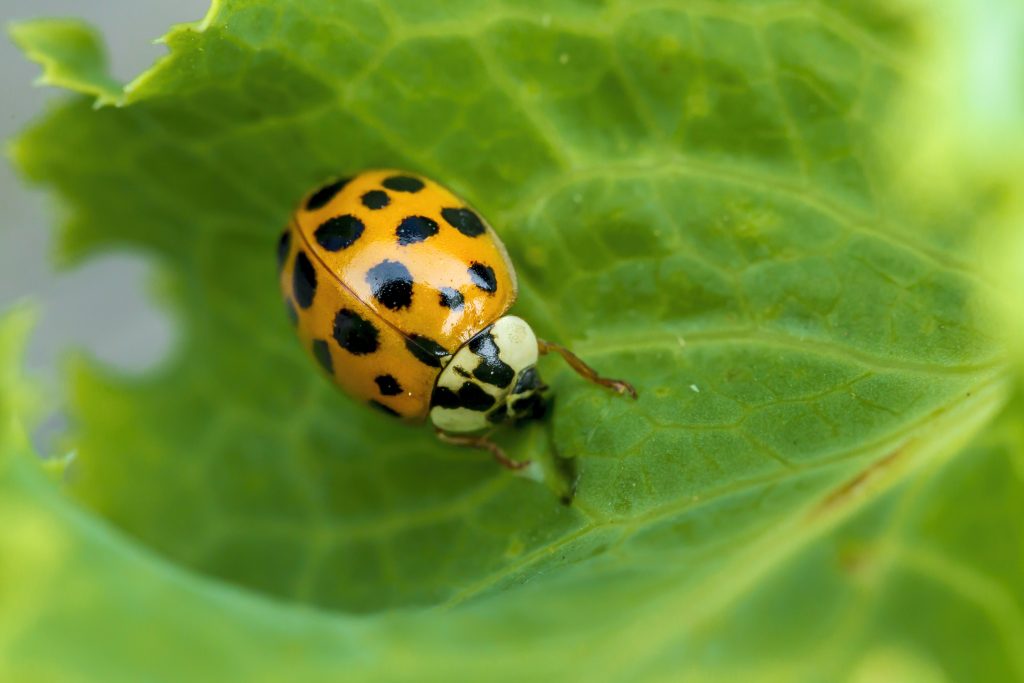
Asian Lady Beetles
Reviewed by TJ Jackson, Associate Certified Entomologist · Updated 2026-10-09
Harmonia axyridis | Category: Nuisance pests | The ladybug that moves in for the winter
If ladybugs are crowding your windows in October, they are almost certainly multicolored Asian lady beetles. Native lady beetles normally spend the winter outdoors. This imported species, brought to the U.S. to eat aphids, looks for a building instead, gathering on sunny walls in fall and coming back out in late winter and spring. It does not breed in your house, but it can pinch, stain and smell. Sealing gaps and an exterior treatment before October cut down how many get in.
Lady beetles every fall? Get ahead of October.
4.96 stars from 8,394 Google reviews · Family-owned since 1963
| Size | About 1/4 in, larger than most native lady beetles |
|---|---|
| Color | Yellow-orange to red, sometimes black; up to 19 spots or none |
| Top ID Marker | Black M or W mark on the white area behind the head |
| Habitat | Trees, shrubs and gardens in summer; sunny south and west walls, attics and wall voids in fall and winter |
| Activity | Moves onto homes on warm afternoons in fall; wanders indoors in late winter and spring |
| Bite Risk | Can pinch, not dangerous, yellow fluid stains and smells |
| Plan Coverage | Covered as a fall invader on the All Seasons Pest Plan |
Quick Answer: The “ladybugs” that gather on Oregon and Washington homes in fall are multicolored Asian lady beetles (Harmonia axyridis), an introduced species about 1/4 inch long, yellow-orange to red, with anywhere from no spots to 19 and a black M or W mark on the white area behind the head. Native lady beetles do not overwinter in homes. Asian lady beetles fly to sunny, south- and west-facing walls on warm fall afternoons, squeeze into wall voids and attics, and come back out on warm days in late winter and spring. They do not breed or feed indoors, but they can pinch, and a yellow fluid from their legs stains and smells. Sealing gaps before fall and vacuuming the ones inside work better than indoor sprays.
Key facts at a glance: About 1/4 inch · Orange to red, variable spots · M mark behind the head · Moves in on warm fall afternoons · Returns indoors in spring · No indoor breeding · Plan coverage: All Seasons Pest Plan.
Most ladybugs are welcome. Fewer than 1 in 3 lady beetle sightings in Oregon and Washington are the Asian species, and native lady beetles rarely become a problem in homes. If they are on a plant outside eating aphids, leave them be. The ones crowding a window in October are the ones to keep out.
Frequently Asked Questions
Are Asian lady beetles the same as ladybugs?
They are one kind of ladybug. Ladybug, or lady beetle, is the common name for a whole family of beetles, most of them native and welcome in gardens. The multicolored Asian lady beetle is an introduced species, and it is the one that moves into homes for the winter.
How can I tell an Asian lady beetle from a native ladybug?
Look behind the head. Asian lady beetles have a white area with a black M or W shape on it. They are also a bit larger, about 1/4 inch, and their color ranges from yellow-orange to red with many spots, few spots or none. Native convergent lady beetles have white lines that converge behind the head and do not invade homes.
Why are lady beetles swarming my house in the fall?
On sunny afternoons after a cold snap, Asian lady beetles fly to light-colored, south- and west-facing walls looking for a place to spend the winter, much like the cliffs they use in their native range in Asia. Gaps of about 1/8 inch are enough for them to get into wall voids and attics.
Do Asian lady beetles bite?
They can give a small pinch that feels like a pinprick, and it can occasionally break the skin. They do not sting or spread disease, though some people are allergic to them, with symptoms ranging from itchy eyes to asthma.
Will lady beetles breed or lay eggs in my house?
No. They do not feed or reproduce indoors. The beetles you see in March and April are the same ones that moved into the walls the fall before, waking up on warm days and looking for a way back outside.
Why do they leave yellow stains and smell?
When disturbed, Asian lady beetles release a yellowish fluid from their leg joints. It smells bad and can stain walls, curtains and fabric. Vacuum them instead of crushing or sweeping them, and keep pets from eating them.
Should I spray lady beetles indoors?
No. University extension services agree indoor sprays and foggers do not work well and can stain. Beetles that die in wall voids can also feed carpet beetles. Vacuum the ones inside and keep any treatment on the outside of the house.
Does the All Seasons Pest Plan cover Asian lady beetles?
Yes. We treat Asian lady beetles as one of the fall invaders on the All Seasons Pest Plan, along with stink bugs, boxelder bugs and cluster flies, with re-services included as needed between scheduled visits.
Signs You Have Asian Lady Beetles
1. Clusters on sunny walls in fall
Dozens to hundreds of orange to red beetles on south- and west-facing siding, window frames and trim on warm October afternoons.
2. Beetles at windows in winter and spring
Slow beetles on window sills, ceilings and light fixtures on warm days from late winter through April.
3. Yellow stains and a sour smell
Small yellow-orange spots on walls, curtains and window sills, and a musty odor where beetles have been disturbed or crushed.
4. Groups in the attic and corners
Clumps of beetles in upper corners, around attic vents, in window tracks and behind siding and trim.
5. Dead beetles in window tracks
Piles of dead beetles in window tracks, light fixtures and the attic in spring. Clean these up, since they can feed carpet beetles.
6. Boxelder bugs and stink bugs too
Asian lady beetles share the same fall habits as boxelder bugs and stink bugs, so homes that get one often get all three.
Behavior, Biology & Lifecycle
An imported aphid eater
The multicolored Asian lady beetle is native to eastern Asia. USDA released it in the U.S. for decades to control aphids, and the first established population was found in Louisiana in 1988. By the mid-1990s it had spread across much of the country, as far as Oregon, and is now found in large numbers in Washington.
How to know it is this one
Adults are oval, dome-shaped and about 1/4 inch long. Color ranges from yellow-orange to red, sometimes black, with 19 spots, fewer or none. The best mark is a black M or W on the white area behind the head.
Spiny larvae on your plants
The young look nothing like the adults: spiny, blue-black, alligator-shaped larvae with orange markings, usually found hunting aphids on trees and shrubs in summer.
A fall move to the walls
Flights start on sunny afternoons after cooler weather, once temperatures climb back into the mid-60s F. The beetles are drawn to light-colored, sunlit south and southwest walls and to contrast.
Dormant through the winter
Inside the walls and attic they rest through the winter without feeding or breeding. Warm days wake some of them, and they head toward light, which is why they turn up indoors in late winter and spring.
Native ladybugs winter outdoors
Native lady beetles like the convergent lady beetle spend the winter in large groups outdoors, often in mountain foothills on low plants, not in houses.
Local Context: Oregon and Washington
Asian lady beetles are outdoors all summer. They show up on our service tickets in October and March.
Public data puts lady beetle season in summer. Of the 7,081 verifiable multicolored Asian lady beetle sightings logged on iNaturalist in Oregon and Washington over the last five years, 71% fall between May and August, when the beetles are out on trees and gardens eating aphids. Google searches for ladybugs in the two states peak in June too.
Our records put them in fall and early spring. Across five years of service records in Portland, Vancouver, Salem, Olympia and Kelso, 52% of the visits where technicians recorded lady beetles came in October and November, and 39% came February through April. From May through August, when sightings peak, we recorded them on just 1% of those visits. Our records use one tag for all lady beetles, but the species that moves indoors is the Asian one.
USDA notes most of the beetles stay in wall spaces over winter, and on warm days in late winter and early spring some come into living areas looking for a way out. They also travel with other fall invaders: nearly 3 in 4 new lady beetle customers also had boxelder bugs recorded on the first visit.
Sightings peak in summer. Our visits come in two waves, fall and spring.
Each series is its share of the annual total, so the two are directly comparable. The orange line is service visits where our technicians recorded lady beetles.
Blue line: verifiable iNaturalist observations of Harmonia axyridis in Oregon and Washington, grouped by the month observed. See the records on iNaturalist.
Garden helper, house guest
In summer the blue line is a good thing: lady beetles eating aphids on your roses. The orange spikes are the same beetles moving into the walls in October and coming back out in March. Recorded sightings grew from 685 in 2021 to 2,292 in 2025, though some of that is more people using the app.
Worth knowing before you book
Lady beetles keep a calendar very close to boxelder bugs. Look at the chart: both spike in October and again in March. That is why we treat fall invaders as a group, and why a home that gets one usually gets the other.
Lady beetles are also a callback pest. More than half of the visits where we recorded them were re-service calls from plan customers, mostly when spring stragglers came out of the walls. Sealing and an exterior treatment before October cut down how many get in. Anything that gets past that shows up again in spring, and the plan covers the second wave.
Who sees lady beetles when
Each row is that source’s share of its own annual total, by month, over the last five years. Darker means a bigger share. Boxelder bugs are included for comparison.
Blue rows are public data (iNaturalist sightings, Google searches). Orange rows are our records: lady beetle service visits and new boxelder bug customers. Values are percent of the year.

“Nobody wants to vacuum ladybugs off the windows every week. If that is your fall, you are dealing with the Asian lady beetle, and it is predictable. More than half of our lady beetle visits come in October and November, and most new lady beetle customers have boxelder bugs too. So we get ahead of it: we treat the sunny sides of the house before they move in, you seal the gaps around windows and siding, and if some wake up in late winter, we come back. Vacuum them up. Squashing them leaves a stain and a smell.”TJ Jackson · ACE, Director of Operations, Interstate Pest Management
Asian lady beetles are covered as a fall invader on the All Seasons Pest Plan, with re-services included as needed between visits if they come back in spring. QualityPro certified.
Call your local office
- Portland503-782-1899
- Vancouver360-996-1442
- Salem503-461-0259
- Olympia360-526-8004
- Kelso / Longview360-515-3882
Sources: Interstate Pest Management service records, over the last five years, completed visits with lady beetles recorded and new boxelder bug customers. Sightings: public iNaturalist records of Harmonia axyridis and of all lady beetles (Coccinellidae) for Oregon and Washington, over the last five years. Search interest: Google Trends for ladybugs, Oregon and Washington, over the last five years, combined in proportion to population. Biology: WSU PestSense, Penn State Extension, University of Kentucky, University of Minnesota Extension, USDA ARS, Cornell University. Updated October 2026.
DIY Homeowner Steps
Seal before the end of September
Caulk gaps around windows, doors, siding seams, fascia and where pipes and wires enter. Gaps of about 1/8 inch are enough for them to get in.
Screen vents and fix screens
Cover attic, soffit and gable vents with fine screen (No. 20 mesh) and repair torn window screens. Add door sweeps where daylight shows.
Vacuum, don’t crush
Vacuum them up with a knee-high nylon stocking held inside the vacuum hose by a rubber band, then empty the stocking outdoors. Crushing or sweeping releases the staining fluid.
Clean up the dead ones
Vacuum dead beetles from window tracks, light fixtures and the attic in spring so they do not feed carpet beetles.
Skip indoor sprays and foggers
Indoor insecticides do not work well against lady beetles hidden in walls and can stain. Keep any treatment on the outside of the house, timed before they move in.
Asian Lady Beetles vs. Common Look-Alikes
| Feature | Asian Lady Beetle | Convergent Lady Beetle | Seven-Spotted Lady Beetle | Boxelder Bug | Spotted Cucumber Beetle |
|---|---|---|---|---|---|
| Size and shape | About 1/4 in, round dome | Slightly longer, oval | Round dome | About 1/2 in, flat and narrow | Oblong oval |
| Color and spots | Yellow-orange to red, 0 to 19 spots | Orange to red, usually spotted | Red with seven black spots | Black with red lines | Yellow-green with 12 black spots |
| Behind the head | White with black M or W | White lines that converge | White spot on each side of the head | Red lines | Black head |
| Winters in homes? | Yes, commonly | No, outdoors in mountain foothills | No | Yes, commonly | No |
| What it means | Seal, vacuum, exterior treatment | Garden helper, leave it | Garden helper, leave it | Seal, vacuum, exterior treatment | Garden pest, not a home invader |
Plans That Cover Asian Lady Beetles
All Seasons Pest Plan
$39/month
Setup fee $260 for initial treatment
Year-round coverage for the pests Northwest homes deal with most, including Asian lady beetles, stink bugs, boxelder bugs and cluster flies in the fall, and the spring stragglers that follow.
- Recurring exterior treatments
- Fall invader coverage
- Re-services included as needed between visits
Pest & Rodent Bundle
$47/month
Setup fee $280 for initial treatment
The same fall invader coverage plus rodent protection. The gaps lady beetles use in October are often the same ones mice use in November, so one round of sealing helps with both.
- Everything in the Pest Plan
- Rodent monitoring and control
- Re-services included as needed between visits
What Our Customers Are Saying
Real Results From Real Customers
Get help with Asian lady beetles in your area
Interstate Pest Management helps with Asian lady beetles across Oregon and Washington. Choose your area to see local plans, pricing and the number for your nearest team.