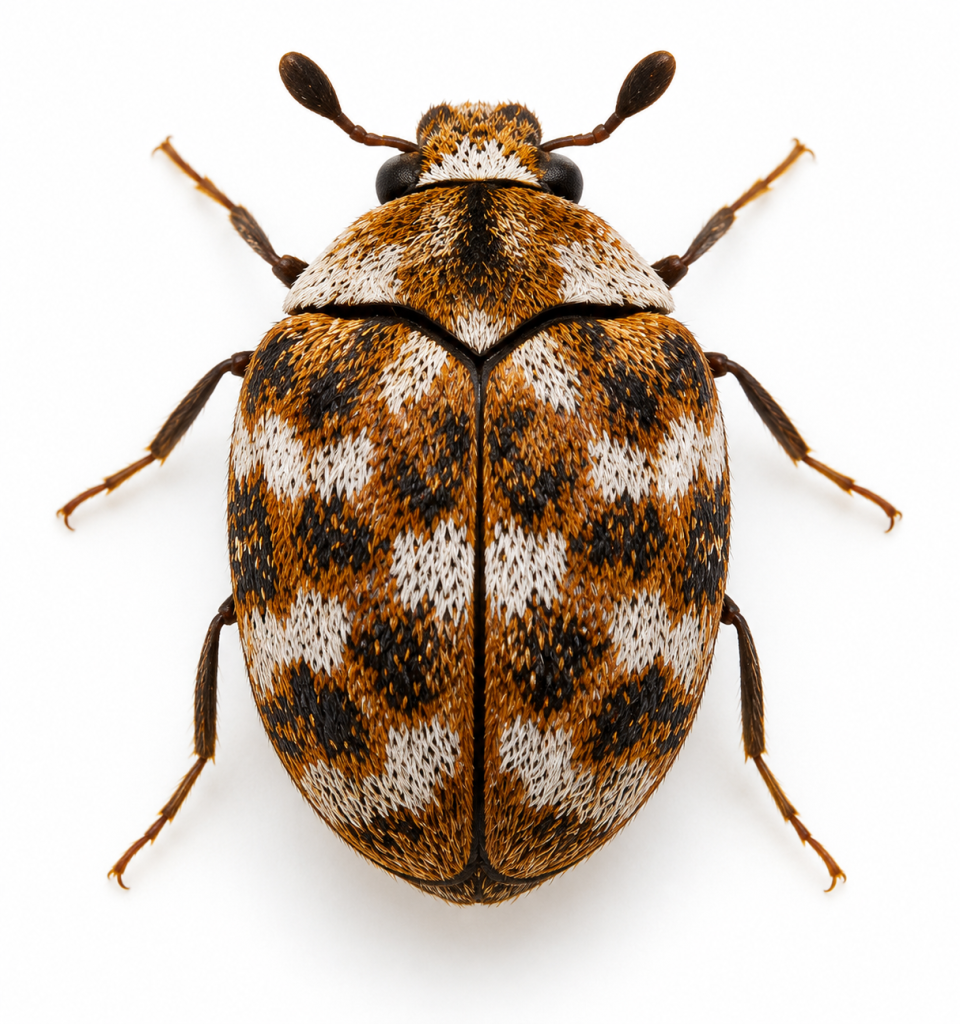
Carpet Beetles
Reviewed by TJ Jackson, Associate Certified Entomologist · Updated 2026-10-09
Anthrenus and Attagenus species | Category: Nuisance pests | Adults at the window, larvae in the wool
The tiny round, speckled beetles on a sunny windowsill in March are usually carpet beetles. The adults eat pollen and do no harm. Their fuzzy larvae feed on wool, silk, fur, feathers, pet hair and lint, and on the dead insects that pile up inside walls and attics. Larvae feed for months or longer, so the damage continues until the source is found and removed.
Little beetles at the window? Start with an inspection.
4.96 stars from 8,394 Google reviews · Family-owned since 1963
| Size | Adults 1/16 to 3/16 in; larvae 1/8 to 1/4 in, black carpet beetle larvae up to 1/2 in |
|---|---|
| Color | Adults mottled white, brown and yellow, or shiny black; larvae tan to brown and hairy |
| Top ID Marker | Round adult on a window in spring; bristly larva or shed skins near wool, lint or dead insects |
| Habitat | Carpet edges, under furniture, closets, vents, attics and wall voids with dead insects or old nests |
| Activity | Adults at windows March to June; larvae feed indoors year-round |
| Bite Risk | Does not bite, larval hairs can irritate skin |
| Plan Coverage | Inspection first, then treated on the All Seasons Pest Plan or a one-time visit |
Quick Answer: Carpet beetles are small, round beetles, 1/16 to 3/16 inch, either mottled white, brown and yellow (varied and furniture carpet beetles) or shiny black (black carpet beetle). The adults eat pollen and fly toward light, so they gather on windowsills in spring. Their hairy, tan to brown larvae do the damage, feeding on wool, silk, fur, feathers, leather, pet hair, lint and dead insects for months or longer. They do not eat synthetic fabrics and they do not bite, though larval hairs can irritate skin. Control means finding and removing the food source, such as a forgotten wool item, lint under furniture or dead insects in a wall or attic, then cleaning and vacuuming thoroughly. Sprays alone do not solve it.
Key facts at a glance: 1/16 to 3/16 inch adults · Mottled or black · Adults at windows in spring · Hairy larvae do the damage · Eat wool, fur, feathers, lint and dead insects · No bites · Plan coverage: inspection first.
Had stink bugs, lady beetles or cluster flies last fall? Penn State Extension notes carpet beetle larvae feed on the insects that die inside walls, ceilings and attics over the winter. That is a common source we find in spring.
Frequently Asked Questions
Are carpet beetles harmful to people?
They do not bite or sting. Some people who are exposed to larvae for a long time react to the larval hairs with an itchy, bumpy rash that feels like bites. Welts alone are never proof of a pest, so the source has to be confirmed.
Why do I see carpet beetles on my windowsills in spring?
Adult carpet beetles are drawn to sunlight and fly toward windows trying to get outside to feed on pollen. Adults at the windows in spring can mean larvae developed somewhere inside the house over the winter, though some fly in from outdoors.
What do carpet beetles eat?
The larvae eat animal-based materials: wool, silk, leather, fur, feathers, natural-bristle brushes, pet hair, lint and dead insects, and sometimes spices or dry pet food. They rarely damage cotton or synthetic fabrics unless those are blended with wool or heavily soiled. The adults eat pollen and nectar outdoors.
How do I tell carpet beetle damage from clothes moth damage?
Carpet beetle larvae tend to chew one larger area on a garment or rug and leave behind bristly, shell-like shed skins. Clothes moths leave scattered holes and silk webbing or cases. No webbing plus shed skins points to carpet beetles.
Where do carpet beetles come from?
Adults fly in from outdoors in spring and summer, and some ride in on cut flowers. Indoors they lay eggs near food: under furniture, along carpet edges, in closets, in vents and ducts, and in attics or wall voids with dead insects, bird nests or wasp nests.
How long do carpet beetle larvae live?
A long time. UC IPM lists the varied carpet beetle larval stage at roughly 220 to 630 days, and in poor conditions some larvae can last for years. That is why a small source can keep a problem going.
Will spraying get rid of carpet beetles?
Not by itself. WSU notes cleaning and removing the source are the only long-term controls, and UC IPM says insecticides are not needed when sanitation and exclusion work. Never spray clothing or bedding.
Is carpet beetle treatment part of the All Seasons Pest Plan?
We start with an inspection to find the source, because that decides the treatment. Most of our carpet beetle customers continue on the All Seasons Pest Plan, and some need only a one-time visit.
Signs You Have Carpet Beetles
1. Small round beetles at the windows
Speckled or black beetles about the size of a pinhead on sunny windowsills, drapes and light fixtures, mostly from March into June.
2. Fuzzy larvae and shed skins
Slow-moving, bristly tan to brown larvae, and brown, shell-like cast skins along baseboards, in closets, under furniture or in drawers.
3. Damage along carpet edges
Thin or bare patches along the edges of rugs and carpet and under furniture, where the vacuum does not reach.
4. Holes in wool and other natural fibers
Damage to wool sweaters, blankets, felt, fur trim and feather pillows, especially in hems, collars and cuffs of items in storage.
5. Dead insects in attics or wall voids
Piles of dead stink bugs, lady beetles or cluster flies from last fall, or an old bird or wasp nest, can feed carpet beetle larvae for months.
6. An itchy rash with no other explanation
Some people react to larval hairs with itchy bumps that feel like bites. Before blaming bed bugs or fleas, check for larvae and shed skins.
Behavior, Biology & Lifecycle
Three common species
The varied carpet beetle is about 1/10 inch and mottled white, brown and yellow. The furniture carpet beetle is a bit larger and rounder. The black carpet beetle is 1/8 to 3/16 inch and shiny black to dark brown.
Adults eat pollen
Adult carpet beetles feed on pollen and nectar outdoors and are drawn to sunlight. They do not eat fabric. Indoors, they head for windows trying to get back outside.
Larvae do the eating
Larvae are 1/8 to 1/4 inch, tan to brown and covered in bristles. Black carpet beetle larvae are carrot-shaped and up to 1/2 inch, with a long tuft of hair at the tail.
A slow, long larval stage
Females lay roughly 40 to 100 eggs on or near food, depending on the species. Larvae feed for months: roughly 220 to 630 days for the varied carpet beetle, and longer in poor conditions.
Fed by dead insects and nests
Larvae build up on overwintering lady beetles, stink bugs and cluster flies that die in walls and attics, and on old bird, bee and wasp nests.
Natural fibers only
Larvae feed on wool, silk, leather, fur, feathers and pet hair, and sometimes on spices, grains and dry pet food. They rarely eat synthetic fibers unless soiled or blended with wool.
Local Context: Oregon and Washington
Carpet beetles are outside on the flowers in June. The calls and the searches come in March and April.
Outdoors, carpet beetle season runs through late spring. Of the 1,453 verifiable carpet beetle sightings logged on iNaturalist in Oregon and Washington over the last five years, June is the single busiest month, when adults feed on pollen in gardens. But Google searches for carpet beetle in the two states peak earlier: 55% fall in March and April.
Our records line up with the searches. Across five years of service records in Portland, Vancouver, Salem, Olympia and Kelso, 55% of the visits where technicians recorded carpet beetles came March through May. June, the peak outdoors, brought us just 6%.
Many of the adults people find on windowsills in March grew up indoors over the winter, feeding on lint, wool, pet hair and dead insects. Penn State Extension notes larvae feed on lady beetles, stink bugs and cluster flies that die inside walls and attics, and our spring stink bug calls rise on the same schedule. Most of these calls are about carpet beetles alone: 58% of new carpet beetle customers had no other pest recorded on the first visit.
Our carpet beetle visits peak in spring, before the beetles peak outdoors.
Each series is its share of the annual total, so the two are directly comparable. The orange line is service visits where our technicians recorded carpet beetles.
Blue line: verifiable iNaturalist observations of the genus Anthrenus in Oregon and Washington, grouped by the month observed. See the records on iNaturalist.
Inside first, outside later
The orange line climbs in March because the beetles hatched inside. The blue line peaks in June because that is when beetles are out on flowers. Recorded sightings grew from 171 in 2021 to 422 in 2025, though some of that is more people using the app.
Worth knowing before you book
A carpet beetle problem is a source problem. When we find them in spring, the source is usually lint and pet hair along carpet edges, a wool item in storage, or a layer of dead fall invaders in a wall or attic. Spraying the beetles at the window does nothing about the larvae feeding somewhere else.
That makes the fix two-part: find and remove what the larvae are eating, then treat where they hide. Look at the chart. Carpet beetle visits and our spring stink bug calls rise together, so if stink bugs, lady beetles or cluster flies got into your walls last fall, keeping them out next fall helps with both.
Who sees carpet beetles when
Each row is that source’s share of its own annual total, by month, over the last five years. Darker means a bigger share. Our stink bug calls are included for comparison.
Blue rows are public data (iNaturalist sightings, Google searches). Orange rows are our records: carpet beetle service visits and new stink bug customers. Values are percent of the year.

“Holes in a wool sweater or a favorite rug feel personal, and the beetles on the windowsill make it worse. What I want to find is what the larvae have been eating. Most of our carpet beetle visits come in March, April and May, and the source is often a layer of dead stink bugs or lady beetles in a wall or attic from last fall, or wool, feathers or pet food stored somewhere quiet. We track down the source, you clear it out, and we treat what is left. Find the food and the damage stops.”TJ Jackson · ACE, Director of Operations, Interstate Pest Management
Carpet beetle work starts with an inspection. Most customers continue on the All Seasons Pest Plan, with re-services included as needed between visits. QualityPro certified.
Call your local office
- Portland503-782-1899
- Vancouver360-996-1442
- Salem503-461-0259
- Olympia360-526-8004
- Kelso / Longview360-515-3882
Sources: Interstate Pest Management service records, over the last five years, completed visits with carpet beetles recorded and new carpet beetle and stink bug customers. Sightings: public iNaturalist records of the genus Anthrenus for Oregon and Washington, over the last five years. Search interest: Google Trends for carpet beetle, Oregon and Washington, over the last five years, combined in proportion to population; weekly volume in each state is low, so single weeks are noisy. Biology: UC Statewide IPM Program, University of Kentucky, WSU PestSense, Penn State Extension. Updated October 2026.
DIY Homeowner Steps
Find the source first
Check wool clothing and blankets in storage, rugs under furniture, closets, heat vents and the attic. Look for larvae, shed skins and dead insects. Removing the source is the fix.
Vacuum the edges
Vacuum carpet edges, baseboards, under furniture, inside vents and closet floors. Lift rug edges to check underneath. Empty the vacuum outside afterward.
Clean, then freeze or heat infested items
Hot-wash, dry-clean or run items through a hot dryer. For things you cannot wash, bag them and freeze at 0°F for at least a week, or heat to 120°F or more for at least 30 minutes.
Store natural fibers sealed
Store clean woolens, furs and feathers in sealed plastic bins or bags. Cedar alone seldom stops them.
Clear out dead insects and old nests
Vacuum dead stink bugs, lady beetles and flies from window tracks and the attic, and remove old bird or wasp nests. Keep screens, doors and vents tight to keep adults out.
Carpet Beetles vs. Common Look-Alikes
| Feature | Carpet Beetle | Clothes Moth | Bed Bug | Cigarette Beetle | Asian Lady Beetle |
|---|---|---|---|---|---|
| Adult | Round, 1/16 to 3/16 in, mottled or black | Small golden moth, not drawn to light | About 1/5 in, flat, rusty red, no wings | About 1/8 in, light brown, humped | About 1/4 in, orange to red, M mark behind head |
| Larva | Hairy, bristly, slow | Shiny white with dark head, spins silk | Looks like a small adult | Small white grub in stored food | Spiny, alligator-like, outdoors |
| Damage | One larger area, shed skins, no webbing | Scattered holes, silk webbing | Bites, blood spots on sheets | Holes in spices, flour, pet food | Stains when disturbed |
| Where you find it | Windows, carpet edges, closets, voids | Dark closets, stored woolens | Mattress seams, couches | Pantry | Sunny walls and windows in fall |
| What it means | Find and remove the source | Clean and seal woolens | Book an inspection | Toss infested food | Seal and vacuum |
How Carpet Beetle Treatment Works
Step 1
Inspection
We confirm it is carpet beetles and find what the larvae are feeding on: lint and pet hair along edges, stored natural fibers, dead insects in a wall or attic, or an old nest.
Book an InspectionStep 2
Treatment and prevention
We treat the edges, cracks and voids where larvae hide and tell you what to clean, freeze or toss. Most customers continue on the All Seasons Pest Plan ($39/month), which also keeps stink bugs and lady beetles out of the walls next fall.
See the All Seasons PlanWhat Our Customers Are Saying
Real Results From Real Customers
Get help with carpet beetles in your area
Interstate Pest Management helps with carpet beetles across Oregon and Washington. Choose your area to see local plans, pricing and the number for your nearest team.