Stink Bugs
Reviewed by TJ Jackson, Associate Certified Entomologist · Updated 2026-10-08
Halyomorpha halys | Category: Nuisance pests | The fall invader that shows up twice a year
The stink bug Northwest homeowners find on the siding and the curtains is almost always the brown marmorated stink bug, an import from Asia that reached Portland in 2004 and Washington by 2010. Every September the adults leave gardens and fruit trees and look for a warm, dry place to spend the winter, and a house wall works well. They do not bite, breed indoors or damage the house. They smell when you bother them, and they have a habit of coming back out in spring, long after you thought they were gone. This page covers how to identify them, why spring catches people off guard, and what keeps them out.
| Size | 1/2 to 5/8 in, about the size of a thumbnail |
|---|---|
| Color | Marbled brown-gray, shield-shaped |
| Top ID Marker | Two white bands on each antenna, smooth shoulder edge |
| Habitat | Fruit trees, gardens and shrubs in summer; sunny walls, attics and wall voids in fall and winter |
| Activity | Moves onto homes from September, wanders indoors on warm days in late winter and spring |
| Bite Risk | Does not bite or sting, smells when disturbed |
| Plan Coverage | Covered by the All Seasons Pest Plan |
Stink bugs on the siding or back inside?
Book ServiceQuick Answer: The stink bugs that get into Oregon and Washington homes are brown marmorated stink bugs (Halyomorpha halys), a shield-shaped, marbled brown-gray insect about 1/2 to 5/8 inch long with two white bands on each antenna. They spend summer feeding on fruit, vegetables and ornamental plants, then gather on sunny house walls from September and squeeze into wall voids and attics for the winter. They do not bite, sting, breed indoors or damage the structure. Many come back out on warm days in late winter and spring, which is why indoor sightings often peak in March and April. Sealing gaps before September and vacuuming the ones that get in work better than indoor sprays.
Key facts at a glance: 1/2 to 5/8 inch · Marbled brown shield · White-banded antennae · Moves in from September · Returns indoors in spring · No bites, no indoor breeding · Plan coverage: All Seasons Pest Plan.
Seeing them in March? They did not just arrive. Stink bugs indoors in spring are the ones that moved into the walls last fall and are waking up on warm days. In our records, about 4 in 10 new stink bug customers call between March and May.
Frequently Asked Questions
Do stink bugs bite or hurt people?
No. Brown marmorated stink bugs do not bite, sting or suck blood, and they do not spread disease to people or pets. They do not chew wood, wiring or insulation either. The worst they do indoors is smell bad when they are disturbed or crushed.
Will stink bugs lay eggs or breed inside my house?
No. The stink bugs that get inside in the fall spend the winter resting in walls, attics and window frames. They do not feed or reproduce indoors. In spring they head back outside to mate and lay eggs on plants, so the bugs you see on a warm March afternoon are the same ones that moved in last fall.
Why am I seeing stink bugs inside in March and April?
Those are bugs that got into the walls or attic last fall. Warm spells wake them up, and some wander into the living space instead of finding their way back out. In our records, about 4 in 10 new stink bug customers call between March and May, about as many as call in the fall.
Where did brown marmorated stink bugs come from?
They are native to eastern Asia. In Oregon, the first one was caught in a trap in southeast Portland’s Ladd’s Addition in 2004. Washington’s first documented sightings came in the fall of 2010 in Clark and Skamania Counties. They are now established across the Portland and Vancouver area and well beyond.
Should I squash stink bugs or spray them indoors?
Neither. Squashing releases the smell. Indoor sprays and bug bombs are not recommended by WSU Extension, and bugs that die inside wall voids can draw carpet beetles. Vacuum them up instead, seal the bag and put it in the outdoor trash.
Do stink bugs hurt gardens and fruit trees?
Yes, that is where they do their real damage. Adults and nymphs feed on tree fruit, berries, vegetables and ornamental plants, leaving pockmarks and distorted spots on fruit. Tomatoes, peppers, apples and pears are common targets in Northwest yards.
Are all the stink bugs on my house brown marmorated stink bugs?
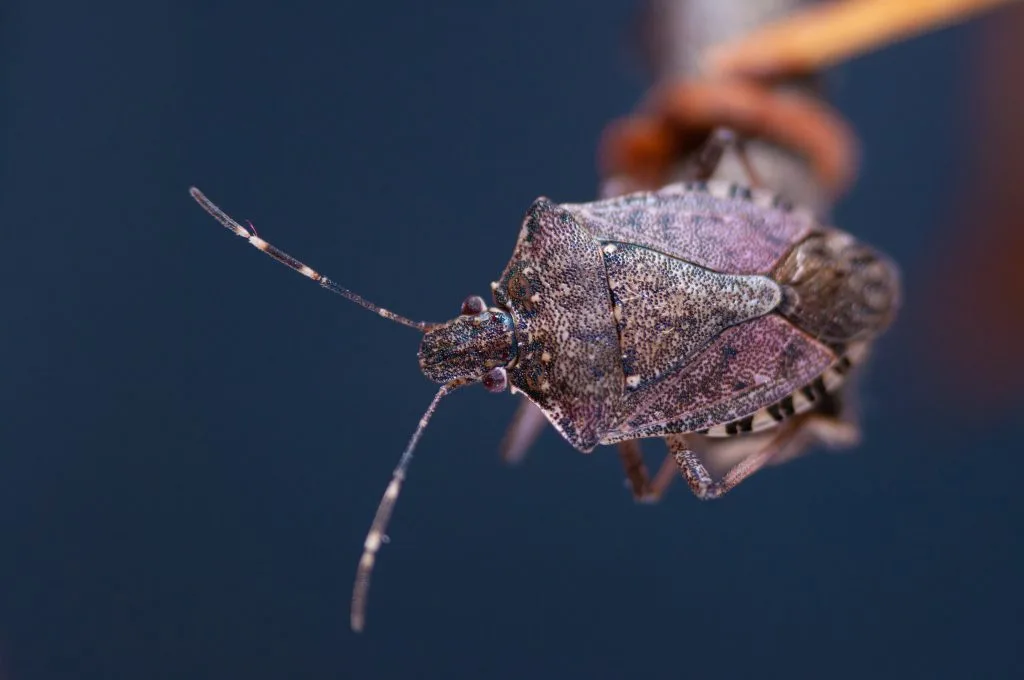
Usually, if they are coming indoors. The Northwest has several native stink bugs, but the brown marmorated stink bug is the one that moves into homes for the winter. Look for two white bands on each antenna and a smooth edge on the shoulders. Native look-alikes like the rough stink bug have a jagged shoulder edge and no white antenna bands.
Does the All Seasons Pest Plan cover stink bugs?
Yes. Stink bugs are covered under the All Seasons Pest Plan along with boxelder bugs, cluster flies and Asian lady beetles. That includes exterior treatment around the home and as-needed re-services between scheduled visits if they come back.
Signs You Have Stink Bugs
1. Brown shields on the sunny siding
From September on, stink bugs gather on warm, sun-facing walls, window frames and door trim while they look for a way in. A few dozen on one wall in October is typical.
2. Slow bugs near lights and windows
Indoors they turn up on window sills, ceilings and lamp shades, moving slowly. Warm days in late winter and spring bring the most indoor sightings.
3. A sharp smell when one is disturbed
Pick one up, vacuum it or brush it off a curtain and you will know. The odor is a defense, and it is the fastest way to tell a stink bug from a boxelder bug.
4. Bugs around trim, fans and fixtures
They squeeze in behind baseboards, around window and door trim, and through gaps by exhaust fans and ceiling lights. They prefer high, cool spots.
5. Dead bugs in the attic or window tracks
Bugs that never make it back out die in attics, window tracks and light fixtures. A pile of them in spring means they have been spending the winter in the house.
6. Pockmarked fruit in the garden
Outdoors, look for small sunken spots and corky, distorted patches on tomatoes, peppers, apples and pears. That feeding damage often shows up the same season the bugs start turning up on the house.
Behavior, Biology & Lifecycle
A newcomer to the Northwest
The brown marmorated stink bug is native to eastern Asia. Oregon’s first one was trapped in southeast Portland in 2004, and Washington’s first documented sightings came in Clark and Skamania Counties in the fall of 2010.
How to know it is this one
Adults are about 1/2 to 5/8 inch long, shield-shaped and marbled brown-gray. The giveaways are two white bands on each antenna, a smooth shoulder edge, and light and dark bands along the edge of the abdomen.
Spring eggs, summer growth
Females lay clusters of 20 to 30 pale eggs on the undersides of leaves in spring. The young go through five stages and the next round of adults shows up by August, just ahead of the fall move.
September is moving month
Beginning in September, adults gather in large numbers on the outside of homes looking for shelter. They work into wall voids and attics and favor high, cool spots.
Dormant, not gone
Inside, they spend the winter resting, without feeding or breeding. Warm spells wake some of them up, which is why they wander out in midwinter and again in March and April.
A tiny wasp on our side
The samurai wasp, a natural enemy from the stink bug’s home range, lays its eggs inside stink bug eggs. It was first recorded in Vancouver, Washington in 2015 and Portland in 2016, and researchers are studying it as a long-term check on the population.
Local context: Oregon and Washington
Everyone sees stink bugs in October. Four in ten of our stink bug calls come in spring.
Public data puts the stink bug year in late summer and fall. Of the 4,219 verifiable brown marmorated stink bug sightings logged on iNaturalist in Oregon and Washington over the last five years, 55% fall in August, September and October, and October alone carries 24%. Google searches for stink bug in the two states peak the same month. That is when the bugs pile onto sunny walls looking for a way in.
Our service records agree about October and disagree about spring. Across five years of stink bug service records in Portland, Vancouver, Salem, Olympia and Kelso, October brought in 27% of our new stink bug customers. But 41% called between March and May, a stretch that holds only 16% of public sightings and 24% of searches. Summer, when sightings are climbing, brought us just 8%.
The reason is the walls. Stink bugs that slipped in last fall rest in voids and attics all winter, and warm spells in March and April wake them up. WSU Extension notes they become active on warm days, and some find the living room instead of the way out. Nearly half of our new stink bug customers had boxelder bugs on the same first visit, which is why we treat for fall invaders as a group.
Sightings build through summer. Our calls come in two waves, fall and spring.
Each series is its share of the annual total, so the two are directly comparable. The orange line is new stink bug customers in our records.
Blue line: verifiable iNaturalist observations of Halyomorpha halys in Oregon and Washington, grouped by the month observed. See the records on iNaturalist.
Outdoors vs. indoors
Sightings track the bugs outdoors, where they feed and multiply all summer. Our calls track the bugs inside the house. The gap between the two lines in spring is the overwintering crowd coming back out. Recorded sightings also grew from 419 in 2021 to 984 in 2025, though some of that is more people using the app.
Worth knowing before you book
Stink bugs and boxelder bugs share a calendar, but not exactly. Look at March in the chart. Boxelder bug calls spike that month and drop off fast. Stink bug calls stay high from March into May, because stink bugs keep trickling out of the walls for weeks.
That makes timing the fix. Sealing and an exterior treatment in late summer cut down how many get in. Anything that gets past that will show up again in spring, so a plan with re-services included as needed covers the second wave without a second bill. If you are reading this in April, vacuum what you see and get the gaps sealed before September.
Who sees stink bugs when
Each row is that source’s share of its own annual total, by month, over the last five years. Darker means a bigger share. Boxelder bugs are included for comparison.
Blue rows are public data (iNaturalist sightings, Google searches). Orange rows are new customers in our records. Values are percent of the year.

“Stink bugs are one of the most annoying pests our customers deal with. Both in spring and fall, the exterior of homes can become inundated with adult stink bugs, and they can be a problem indoors too. These bugs are not hatching or reproducing on or in homes, but rather they are looking for a protected area to spend the winter. In spring and summer we see them entering or exiting that winter habitat. The key is treating early, in the fall, before they get into cracks and crevices. Once they get inside the best thing to do is vacuum them up.”TJ Jackson · ACE, Director of Operations, Interstate Pest Management
Stink bugs are covered on the All Seasons Pest Plan, with re-services included as needed between visits if they come back in spring. QualityPro certified.
Call your local office
- Portland503-782-1899
- Vancouver360-996-1442
- Salem503-461-0259
- Olympia360-526-8004
- Kelso / Longview360-515-3882
Sources: Interstate Pest Management service records, over the last five years, new stink bug and boxelder bug customers only. Sightings: public iNaturalist records of Halyomorpha halys for Oregon and Washington, over the last five years. Search interest: Google Trends for stink bug, Oregon and Washington, over the last five years, combined in proportion to population; weekly volume in each state is low, so single weeks are noisy. Biology: WSU Extension, WSU PestSense, Oregon State University, OSU Extension EM 9164, UC Statewide IPM Program. Updated October 2026.
DIY Homeowner Steps
Seal up before September
Caulk gaps around windows, doors, siding seams, fascia and the spots where pipes, wires and vents pass through the wall. Stink bugs start gathering on homes in September, so work done in August pays off most.
Fix screens and cover vents
Repair torn window screens, fit screens over attic, soffit and crawl space vents, and add door sweeps where you can see daylight. A stink bug is flat enough to use gaps that look too small.
Vacuum, don’t squash
Vacuum the ones that get in, then seal the bag and put it in the outdoor trash. A shop vacuum set aside for bugs keeps the smell out of your house vacuum.
Set a soapy water trap at night
Put a foil roasting pan with water and a few drops of dish soap under a lamp in a dark room. Stink bugs drawn to the light fall in and cannot climb out.
Skip indoor sprays and bug bombs
Indoor insecticides do little against stink bugs hidden in the walls, and bugs that die in wall voids can attract carpet beetles. Keep treatment on the outside of the house.
Stink Bugs vs. Common Look-Alikes
| Feature | Brown Marmorated Stink Bug | Rough Stink Bug | Consperse Stink Bug | Western Conifer Seed Bug | Boxelder Bug |
|---|---|---|---|---|---|
| Shape & color | Wide shield, marbled brown-gray | Shield, gray-brown, bark-like | Shield, tan to brown | Long and narrow, brown | Narrow and flat, black with red lines |
| Antennae | Two white bands | No white bands | No white bands | Long, plain | Black, plain |
| Shoulder edge | Smooth | Rough, toothed | Smooth | Not shield-shaped | Not shield-shaped |
| Other clue | Banded edge on the abdomen | Looks like tree bark | Dark spots on the legs | Flattened, leaf-like flare on the hind legs | Bright red body under the wings |
| Winters in homes? | Yes, commonly | Rarely | Rarely | Yes | Yes, commonly |
| Bites people? | No | No | No | No | No |
| What it means | Seal, vacuum, exterior treatment | Leave it outside | Leave it outside | Seal and vacuum | Seal, vacuum, exterior treatment |
Plans That Cover Stink Bugs
All Seasons Pest Plan
$39/month
Setup fee $260 for initial treatment
Year-round coverage for the pests Northwest homes deal with most, including stink bugs, boxelder bugs, cluster flies and lady beetles in the fall, and the spring stragglers that follow.
- Recurring exterior treatments
- Fall invader coverage
- Re-services included as needed between visits
Pest & Rodent Bundle
$47/month
Setup fee $280 for initial treatment
The same fall invader coverage plus rodent protection. The gaps stink bugs use in September are often the same ones mice use in October, so one round of sealing helps with both.
- Everything in the Pest Plan
- Rodent monitoring and control
- Re-services included as needed between visits
What Our Customers Are Saying
Real Results From Real Customers
Get help with stink bugs in your area
Interstate Pest Management helps with stink bugs across Oregon and Washington. Choose your area to see local plans, pricing and the number for your nearest team.