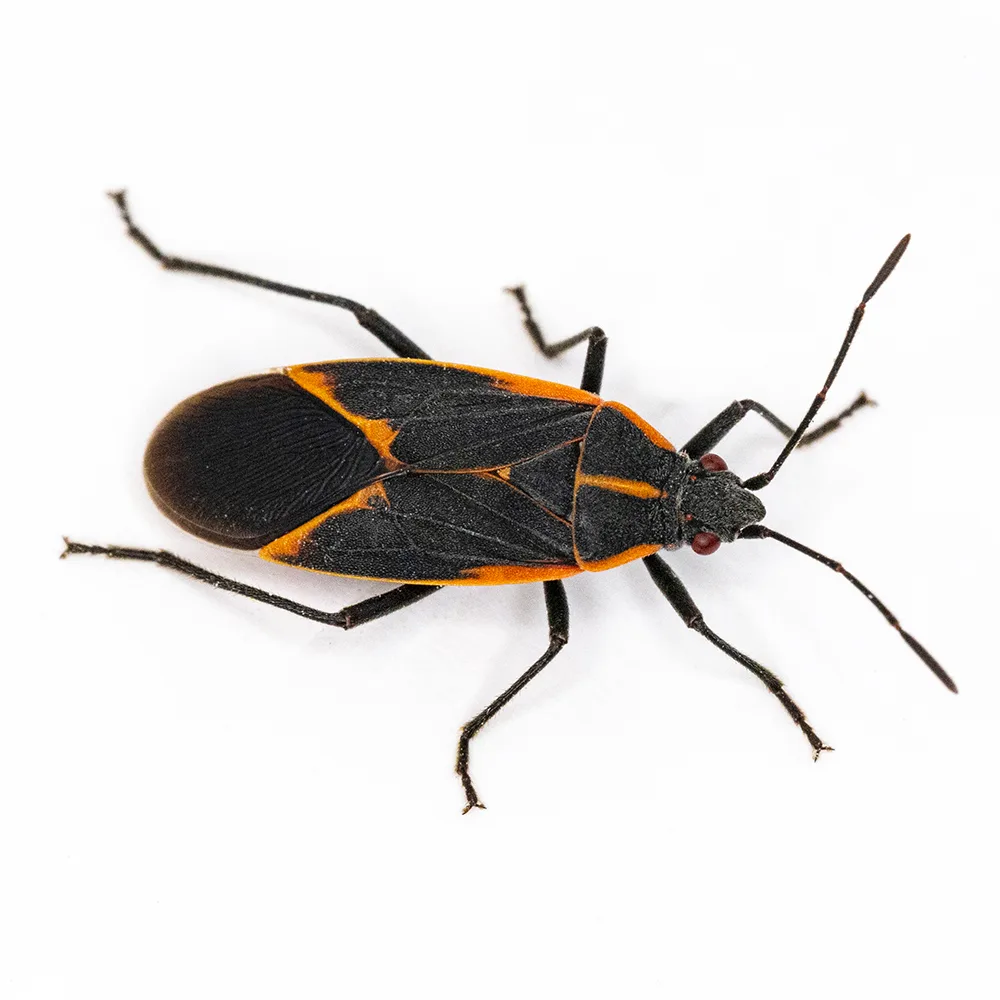
Boxelder Bugs
Reviewed by TJ, ACE Certified Technician · Updated 2026-07-27
Boisea rubrolineata | Category: Nuisance Pests | ✓ Covered: All Seasons Pest Plan
Some September afternoon you walk around the south side of the house and the siding is moving. Hundreds of flat black bugs with red pinstripes, packed onto the warm wall, doing nothing in particular. That’s the western boxelder bug, and here’s the part most websites bury: it can’t hurt you and it can’t hurt your house. It doesn’t bite, sting, chew wood, or carry disease. What it does is show up by the hundred and get into the window tracks. Below is how to identify it, why it picked your wall, and what actually keeps it out.
| Size | 11–14 mm long (about 1/2″), roughly 1/4″ wide |
|---|---|
| Color | Flat black with red outlines on the wings; red or orange body underneath |
| Top ID Marker | Three red stripes running lengthwise on the plate behind the head |
| Active Season | Spring through fall outdoors; indoors on warm winter days |
| Where You See Them | Sunny south and west walls, light siding, window frames, boxelder and maple trees |
| Harm To People Or Home | None. No bite, no sting, no disease, no structural damage |
| Plan Coverage | ✓ Covered under All Seasons Pest Plan |
Need help with this pest?
Get A QuoteQuick Answer: Boxelder bugs (Boisea rubrolineata, the western species found in Oregon and Washington) are flat black insects 11 to 14 mm long with red lines on the wings and three red stripes behind the head. They feed on the seeds of female boxelder and maple trees all summer, then move to buildings in late summer and fall looking for somewhere warm to overwinter. They gather on sunny south and west facing walls and light colored siding. They do not bite, sting, spread disease, or damage buildings. Sealing gaps around windows, doors, vents, and siding is the step that keeps them out; spraying alone does not.
Key facts at a glance: Size: 11–14 mm · Color: black with red lines · Family: Rhopalidae, the scentless plant bugs · Bites or stings: no · Damages structures: no · Breeds indoors: no · Generations per year in the PNW: one · Peak nuisance: late summer through fall, plus warm days in late winter · Plan coverage: Yes, All Seasons Pest Plan.
Good news first: boxelder bugs are harmless. We have been treating them across Oregon and Washington since 1963, and in all that time we have never seen one bite a person, damage a structure, or get into stored food. They pose no threat to you, your pets, or your house. If there are hundreds on the wall you have a nuisance and an eyesore, not an emergency, and you have time to handle it properly.
The stink bug mix-up: boxelder bugs are not stink bugs. They sit in the family Rhopalidae, which entomologists named the scentless plant bugs. Brown marmorated stink bugs are Pentatomidae. Both crowd onto PNW houses in the fall, which is why they get confused, but a stink bug is wide and shield-shaped and mottled brown while a boxelder bug is narrow, flat, and black with red pinstripes. We wrote a full side-by-side on this: boxelder bugs vs. stink bugs.
What You Need To Know About Boxelder Bugs
Our ACE Certified Technician TJ on boxelder bugs, why they aren’t stink bugs, and why they pick one wall of your house and ignore the rest.
Frequently Asked Questions
What do boxelder bugs look like?
Flat, narrow, about half an inch long. Black with red lines outlining the wings and three red stripes on the plate behind the head. The body under the wings is red to orange, which you notice when one flies. Young ones are bright red and wingless and pick up black as they grow.
Are they stink bugs?
No. Different family. Boxelder bugs are Rhopalidae, the scentless plant bugs; stink bugs are Pentatomidae. Shape is the fastest tell: stink bugs are wide brown shields, boxelder bugs are narrow black pinstripes. More on the difference here.
Do they bite or damage the house?
Neither. They pose no threat to people, pets, or the building itself, and they have no interest in wood, wiring, insulation, or your pantry. In 60-plus years of treating them we have never seen one do damage. The complaint is always volume, never harm.
Why is it only one side of my house?
Heat. They go for sunny walls, western and southern exposures worst, and light colored siding draws them harder than dark. The shaded north wall stays clean because there is nothing there for them. It is the stored warmth they are after, not the house.
Will they multiply inside over winter?
No. They go dormant in wall voids and attics and live off body fat. Egg laying happens outside in spring on host trees. The ones crawling across your ceiling in February are the same bugs that came in last September, not a new batch.
Does my All Seasons Plan cover them?
Yes, along with the other fall invaders that arrive at the same time: stink bugs, cluster flies, and lady beetles. Includes exterior service timed to the migration and free re-service between visits.
When are they most active?
One generation a year here. Adults come out of hiding in spring, nymphs grow over summer, and the new adults look for shelter in late summer and fall. That is the wall-covering phase and the bulk of our calls. Then a second round in late winter when the ones already inside wake up.
Should I cut down my boxelder tree?
Probably not, and it might not fix it anyway. They feed on the seeds of female boxelders, so a seedless male tree barely registers, and they fly in from neighboring yards regardless. Taking out a seed-bearing host helps if the problem repeats every year, but sealing the house is what actually works.
Signs You Have Boxelder Bugs
Nobody discovers boxelder bugs subtly. They announce themselves. Here’s what you’re looking at and what each sign tells you:
1. A wall that looks like it’s moving
Dozens to hundreds of bugs packed onto sunlit siding, usually the south or west face. This is the classic sighting and it happens fast, often over a single warm afternoon.
2. Red pinstripes at close range
Get within a few feet and the three red stripes behind the head plus the red wing outlines are unmistakable. Nothing else in the PNW that clusters on siding has that pattern.
3. Bright red bugs with no wings
Those are nymphs, and they mean a host tree is close. Adults can arrive from a few properties over, but nymphs don’t travel. Look for a boxelder or maple in the yard or next door.
4. Bugs in the window tracks
Window channels, weep holes, and the gap under the sash are the most common way in. If you’re finding them in the tracks, some already made it into the wall void behind.
5. Indoor sightings on warm winter days
A sunny 55° day in January warms the wall and wakes up whatever overwintered inside it. They wander toward windows and light. This is a fall problem that you’re discovering in winter.
6. Small dark spots on light surfaces
Their droppings can leave marks on siding, curtains, and light upholstery. Usually it wipes off. This is also why crushing them on a white wall is a bad idea.
Behavior, Biology & Lifecycle
Once you know the yearly cycle, the timing of everything else makes sense, including why September is the month that matters:
One generation per year here
There is a single generation annually in the Northwest, which is why the timing is so predictable year to year. Worth knowing if you go looking for advice online: California sources describe a second generation. That is a California pattern and it does not apply up here.
It’s the female trees they want
Boxelder (Acer negundo) is dioecious, meaning an individual tree is either male or female. Boxelder bugs feed almost entirely on the seeds of the female trees, so a seedless male cultivar barely registers with them. When we walk a property with a repeat problem, a seed-bearing boxelder or maple is usually standing right there.
Ours is the western species
Most boxelder bug articles online describe Boisea trivittata, the eastern species. Oregon and Washington have Boisea rubrolineata, the western boxelder bug, native to the western states. The behavior is similar, but if you are comparing photos to identify what is on your siding, use a western source.
Eggs, nymphs, and the summer build
Overwintered adults emerge in spring. Females lay small rusty-red eggs in bark crevices and on the leaves of host trees, in groups of two or three. They hatch in 10 to 14 days. Nymphs come out bright red and wingless, feed on flowers, seeds, and tender twigs, and darken as they mature over the summer.
Why they pick your wall
Come fall they gather on warm, sunny surfaces before settling in somewhere for the winter. Western and southern exposures get hit hardest, and light colored siding worse than dark. Stored heat is the whole attraction. That is why a shaded north wall on the same house gets ignored completely.
They barely hurt the trees either
Damage to ornamental and fruit trees is minimal. Commercial pear growers in the Hood River Valley do watch for them, because their feeding can scar fruit in a way that is easy to confuse with stink bug damage. For a residential yard, though, the tree is fine and treating it is not the answer.
What You Can Do Yourself
This is a pest a homeowner can largely handle. Here’s the order our techs would do it in.
Seal up before Labor Day
Caulk around windows and doors, seal where utility pipes come through the wall, and close siding seams and gaps under the fascia boards. Silicone or silicone-latex caulk holds up best out here; foam sealant handles the bigger voids. Doing this in September beats doing it in November by a mile.
Screens, vents, door sweeps
Patch torn window screens, mesh the attic gable and soffit vents, seal around window AC units, and add sweeps to any door you can see daylight under. These bugs are flat. The gap you would call too small to matter is usually not too small.
Hose the wall early in the morning
A jet of water knocks them off the siding and kills a good share of the younger ones. Do it while it is still cool out so they are too sluggish to just fly up and land again. It is temporary relief and it is free, which makes it worth doing while you work on the sealing.
Vacuum indoors, don’t squash
Squashing them on light paint or upholstery can leave a mark. Vacuum instead, then empty it outside. A trick worth knowing: drop a knee-high stocking into the vacuum tube and rubber-band it at the end, and the bugs collect in the stocking instead of your bag.
Skip the hardware store spray
We have watched homeowners empty a lot of cans at this bug over the years and it does not move the needle. A retail spray kills what it lands on and does nothing about the next wave that shows up an hour later. Sealing the house is the step that changes the outcome.
Boxelder Bugs vs. The Other Fall Invaders
Four different insects pile onto Pacific Northwest houses in the fall for exactly the same reason, and people mix them up constantly. Here’s how to tell which one you’ve got:
| Feature | Boxelder Bug | Brown Marmorated Stink Bug | Cluster Fly | Lady Beetle |
|---|---|---|---|---|
| Size | 11–14 mm | 12–17 mm | 8–10 mm | 5–8 mm |
| Shape & color | Narrow, flat, black with red pinstripes | Wide brown shield, mottled | Dull grey fly, golden hairs on thorax | Round dome, orange to red, often spotted |
| Family | Rhopalidae (scentless plant bugs) | Pentatomidae (stink bugs) | Calliphoridae | Coccinellidae |
| Odor | Slight | Strong, cilantro-like | Slight, sweetish | Noticeable, yellow staining fluid |
| Where they gather | Sunny S/W walls, light siding | Sunny walls, then attics | Attics and upper-floor windows | Sunny walls, attics, wall voids |
| Bites or stings? | No | No | No | Can nip, rarely |
| Damages the house? | No | No | No | No (may stain) |
| Breeds indoors? | No | No | No | No |
| Fix that works | Exclusion | Exclusion | Exclusion | Exclusion |
| Plan coverage | ✓ All Seasons | ✓ All Seasons | ✓ All Seasons | ✓ All Seasons |
Notice the bottom three rows are identical across all four. That’s the real lesson here: seal the house once and you deal with every fall invader at the same time. Read more on stink bugs, cluster flies, ladybugs, or how overwintering insects survive the winter.
Plans That Cover Boxelder Bugs
All Seasons Pest Plan
$39/month
Setup fee ~$260 for initial treatment
Year-round protection from the pests Pacific Northwest homeowners deal with most, with exterior service timed to the fall migration that brings boxelder bugs, stink bugs, and cluster flies to your siding.
- Recurring exterior treatments
- Fall invader coverage
- Free re-service between visits
Pest & Rodent Bundle
$47/month
Setup fee ~$280 for initial treatment
The same fall coverage plus rodent monitoring. Worth noting: the gaps that let boxelder bugs in are often the same ones mice use, so sealing season covers both problems.
- Everything in Pest & Rodent plans
- Best value for whole-home protection
- Free re-service guarantee
Where this information comes from
Interstate Pest Management has treated homes across Oregon and Washington since 1963. Boxelder bugs are one of the three or four calls that define our fall season, and in a heavy year our techs will treat them at hundreds of properties between August and the first hard frost. Everything on this page comes out of that work.
This page was written and reviewed by TJ, an Associate Certified Entomologist credentialed through the Entomological Society of America. Where we cite outside research, we cite Oregon State University, because the western boxelder bug is a western species and regional sourcing matters for this pest.
What Our Customers Are Saying