How to Get Rid of Boxelder Bugs: A Pacific Northwest Homeowner’s Guide
Written by Luke Knoll, Marketing Manager · Updated July 22, 2026
Serving Oregon & Washington since 1963 | ★ 4.9 average across 7,700+ reviews | ✓ Boxelder bugs covered under the All Seasons Pest Plan
Seeing clusters of black-and-red bugs on the sunny side of your house right now? Those are boxelder bugs, and I’ll give you the reassuring part first: they can’t hurt you, your kids, your pets, or your house. They’re one of the most common fall nuisance pests we get called about across Oregon and Washington. Here’s how to tell what you’re looking at, how to keep them out with a few things you can do yourself this summer, and when it’s worth having us come take a look.
Quick answer: To get rid of boxelder bugs, seal them out before fall. Caulk cracks around windows, doors, and utility lines, repair torn screens, and add door sweeps. Summer is the time to do it. For the ones already inside, vacuum them up instead of crushing them, and clear outdoor clusters with soapy water or a strong hose stream on a cool morning. Skip the indoor sprays and foggers. Boxelder bugs come in from outside and don’t breed indoors, so sealing the house is what pays off.
The main thing to know: Boxelder bugs are harmless. They don’t bite, sting, spread disease, or damage your home. They’re a nuisance and nothing worse.
How to identify a boxelder bug
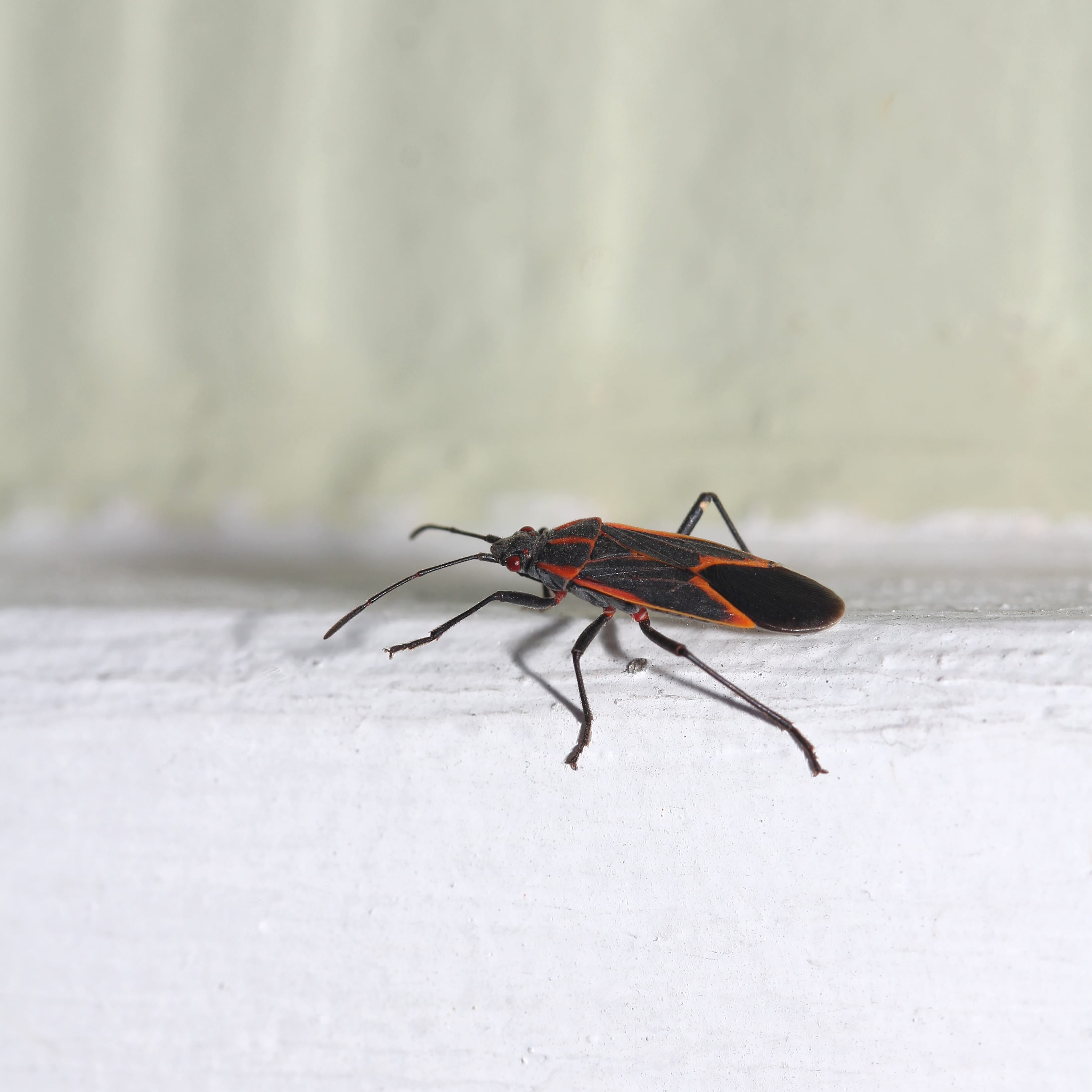
The one you’ll see in Oregon and Washington is the western boxelder bug (Boisea rubrolineata). Adults run about half an inch long, dark brownish-black, with three thin red-orange lines behind the head and bright red-orange edges on the wings. Flip one over and the abdomen is red. The young ones (nymphs) are smaller and almost entirely bright red, which is why you’ll usually spot a mix of red and black bugs moving together.
Quick ID checklist
✓ About ½ inch long, dark, with red-orange lines on the back
✓ Bright red nymphs mixed in with the darker adults
✓ Gathered in large clusters on warm, sunny walls, usually south- or west-facing
✓ Show up in force in late summer and fall
Boxelder bug or stink bug?
People mix these two up constantly, since both pile onto houses in fall. Quick tell: boxelder bugs are black with sharp red-orange lines. Brown marmorated stink bugs are a mottled, shield-shaped brown and give off a stronger smell when you disturb them. You don’t have to tell them apart to fix the problem, though. The steps below work for both. (Fighting ants this season too? Our guide to the ants of the Pacific Northwest covers the eight species we get called about most.)
Why boxelder bugs show up on your house in fall
Boxelder bugs spend spring and summer feeding on the seeds and leaves of female boxelder trees, along with some maples and ash. As the weather cools, that summer’s grown-up population goes looking for a warm, protected spot to spend the winter, and the sunny side of a heated house is exactly what they’re after.
Oregon State University Extension notes they’re drawn to warm walls with southern or western exposure and to light-colored surfaces. Once they’ve warmed up on the siding, they start hunting for cracks, gaps around windows and vents, and any other opening that leads inside. That’s the moment a wall full of harmless outdoor bugs turns into a living-room problem.
Are boxelder bugs dangerous?
Short answer: no. The Pacific Northwest Pest Management Handbooks confirm boxelder bugs cause no structural harm and no health threat to people or pets. They don’t bite, don’t sting, and don’t breed inside your home. The one real annoyance: crush one and its body fluids can leave a small stain on curtains, walls, or fabric. So indoors, the rule is simple. Vacuum them, don’t squash them.
How to get rid of boxelder bugs: DIY steps that work
The most effective boxelder control is also the cheapest: keep them out of the house in the first place. Here’s the order I’d work through.
Step 1 · Seal them out (do this in summer)
This is the single most effective thing you can do, and timing is everything. Do it now, June through August, before the fall rush. Caulk cracks around windows, doors, and where pipes or utility lines enter the house. Repair or replace torn screens. Screen attic vents and the gaps around AC units. Add or replace worn door sweeps and weatherstripping. The PNW Handbooks recommend finishing this kind of exclusion work over the summer, while the bugs are still out in the trees.
Step 2 · Vacuum the ones inside
For bugs that have already made it indoors, reach for the vacuum instead of a shoe or a tissue. Crushing them stains surfaces and can attract more. A useful trick from OSU Extension: slip a knee-high nylon stocking into the vacuum tube and hold it with a rubber band so the bugs collect in the sock, then empty it into soapy water so you’re not dealing with the smell.
Step 3 · Knock down outdoor clusters
When you see a mass of bugs on the siding, a spray bottle of water with a little dish soap knocks them down on contact. On cool mornings, when the bugs are too chilly to fly off, a strong stream from the garden hose clears them off walls and foundations fast. This won’t wipe out the population, but it buys you time while you finish sealing up.
Step 4 · Make your yard less inviting
Rake up leaf litter, boards, and debris piles near the foundation where bugs like to gather, and keep vegetation trimmed back from the walls. If you have a female (seed-bearing) boxelder tree that’s clearly the source of a heavy, repeat infestation, tree removal is an option, but treat it as a last resort. As UC Integrated Pest Management points out, adult bugs can fly a mile or more from where they fed, so pulling one tree is no guarantee, and it’s a call best made with an arborist.
Step 5 · Skip the indoor foggers
It’s tempting to grab a can of bug spray or a fogger, but indoor pesticides are the wrong tool for this. The bugs inside aren’t breeding. They wandered in from outdoors, so spraying inside does nothing about where they’re coming from, and it leaves residue you don’t need. Sealing the outside is what pays off.
When to call a pro for boxelder bugs
DIY exclusion works for light, manageable cases, and I’d rather you keep your money when you can handle it yourself. But boxelder bugs have one frustrating habit: they fly in from around the neighborhood, sometimes from trees a mile off. Once a few hundred of them decide your sunny south wall is the place to be, sealing alone often can’t keep up. And finding every last gap around a two-story house is hard to do from a ladder.
That’s where we come in. At Interstate Pest Management, we treat the exterior perimeter at the right time, late summer into early fall, so the bugs get stopped before they reach the wall, and we check for the entry points that are tough to spot from the ground. No indoor fogging needed. We’ve been doing this for Pacific Northwest homeowners since 1963, and boxelder bugs are covered under our All Seasons Pest Plan, right alongside ants, spiders, wasps, and the other seasonal pests you get living in Oregon and Washington. No contracts. If they come back between visits, so do we, and the visit is included in your plan.
Beat the Fall Rush
Get boxelder bugs handled before they get inside
Summer is the right time to boxelder-proof your house. We’ll inspect your entry points and set up a perimeter that keeps the fall cluster outside where it belongs.
Boxelder bugs: your questions answered
The questions PNW homeowners ask us most.
Frequently asked questions about boxelder bugs
Are boxelder bugs harmful or dangerous?
No. Boxelder bugs don’t bite people or pets, don’t sting, don’t spread disease, and cause no structural damage. The only downside indoors: crush one and it can leave a small stain on curtains, walls, or fabric. They’re a nuisance and nothing worse.
What’s the fastest way to get rid of boxelder bugs indoors?
Vacuum them up instead of squashing them, since crushing causes stains and odor. Empty the canister or bag into a bucket of soapy water right away. Skip the indoor foggers and aerosol sprays. They don’t fix anything, because boxelder bugs come in from outside and don’t breed indoors.
Why do boxelder bugs cluster on my house?
In late summer and fall, boxelder bugs look for a warm, sheltered place to spend the winter. They’re drawn to warm, sunny south- and west-facing walls, especially light-colored ones, then work their way into cracks, gaps, and vents to get inside.
When should I boxelder-proof my house?
Summer, before the fall rush. Sealing cracks, repairing screens, and adding door sweeps in June through August works far better than trying to stop them once they’re already clustering on the wall in September and October.
Should I cut down my boxelder tree?
Not necessarily. Boxelder bugs feed mainly on female (seed-bearing) boxelder trees, plus some maples and ash, but removing a tree is a big decision and not a guaranteed fix. Adult bugs can fly a mile or more from where they fed. Seal the house first, and only think about the tree for recurring, severe infestations, ideally with an arborist’s input.
Do I need a professional for boxelder bugs?
DIY exclusion handles light cases. But because boxelder bugs fly in from surrounding trees and gather in large numbers on warm walls, sealing alone often isn’t enough once a big cluster forms. A pro can apply a properly timed exterior perimeter treatment and find the entry gaps you can’t easily see. Interstate Pest Management covers boxelder bugs under the All Seasons Pest Plan.
Are boxelder bugs the same as stink bugs?
No, though people confuse them because both get into homes in fall. Boxelder bugs are black with distinct red-orange lines and a red abdomen. Brown marmorated stink bugs are mottled brown, shield-shaped, and smellier when disturbed. The prevention steps, sealing and exclusion, are the same for both.
Plans that keep boxelder bugs out, year round
Boxelder bugs, ants, spiders, wasps and more, covered under one simple plan.
All Seasons Pest Plan
$39/month
Setup fee ~$260 for initial treatment
Year-round protection from the pests Pacific Northwest homeowners deal with most: boxelder bugs, ants, spiders, wasps, and more.
- Recurring exterior treatments
- Seasonal pest coverage
- Re-services included as needed between visits
- No contracts
Pest & Rodent Bundle
$47/month
Setup fee ~$280 for initial treatment
The most complete protection for your home. Full pest coverage plus active rodent monitoring. One plan, one team, one less thing to worry about.
- Everything in the All Seasons plan
- Best value for whole-home protection
- Re-service guarantee
- No contracts
Sources & further reading
What our customers say
Real results from real customers
★★★★★ 4.9 average across 7,700+ reviews at our five Pacific Northwest locations: Portland, Kelso, Vancouver, Olympia, and Salem.