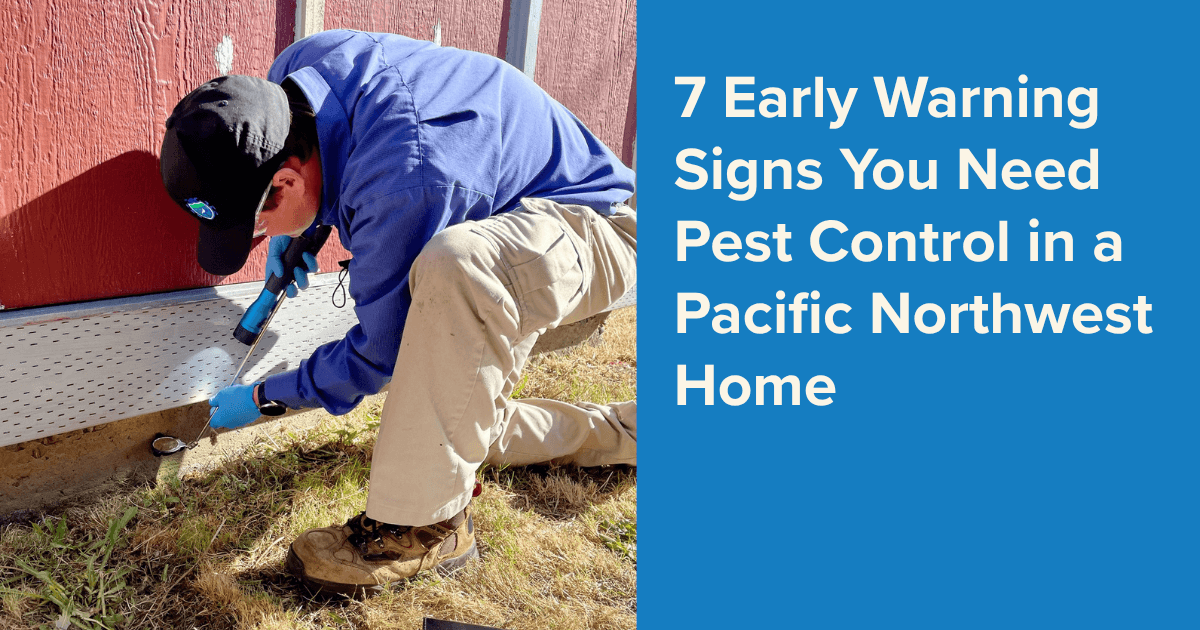
If you’ve spotted a trail of ants that keeps coming back, droppings in a kitchen drawer, or you’re hearing scratching in the wall at 2 a.m., you already have your answer: something moved in before you noticed. Most of the calls we take aren’t from people who saw one bug. They’re from people whose problem finally got too big to ignore, and by then it’s usually been building for weeks.
The Pacific Northwest does pests a lot of favors. Wet winters, mild summers, and dense vegetation give ants, rodents, spiders, and stinging insects everything they need to stay active year-round. Our technicians have been inspecting homes from Olympia to Salem since 1963, and the pattern holds: the signs show up long before the homeowner sees them.
Here are the 7 warning signs we look for, what each one means, and what to do about it before it gets expensive.
The usual suspects in PNW homes
Five groups account for most of the residential calls we run in Oregon and Washington: ants (especially carpenter ants and odorous house ants), rodents like the house mouse and Norway rat, spiders, stinging insects, and seasonal invaders like silverfish, earwigs, and stink bugs. Homes near wooded lots, creeks, and greenbelts face the heaviest pressure.
Carpenter ants are the most misunderstood of the group. Homeowners tend to treat them as a warm-weather problem, but a colony nesting inside a heated wall stays active through winter, quietly expanding its galleries while the house sits still. Oregon State University’s Solve Pest Problems guide is a good primer on how they work, and the short version matters for every sign below: carpenter ants don’t eat wood, they excavate it.
There’s also no off season here. Spring brings moisture-seeking ants and new stinging insect colonies. Summer pushes activity outdoors, which can hide what’s happening inside. Fall is the big invasion window, when rodents and insects move toward warmth. Winter is when everything that got inside settles in and breeds. The signs below can show up in any month.
The 7 early warning signs
1. Droppings
Dark, pellet-shaped droppings in kitchen drawers, along baseboards, behind appliances, or in the garage are the clearest indicator of rodent activity. Fresh droppings are soft and dark. Older ones turn gray and crumble. Finding them in more than one location usually means the population is established, and that’s a rodent control job, not a single trap.
One caution before you grab a broom: never dry-sweep or vacuum rodent droppings. Ventilate the area, wet everything down with a bleach solution, and wipe with paper towels while wearing gloves. Deer mice in our region can carry hantavirus, and stirring up dried droppings is exactly how people get exposed.
2. Gnaw marks
Mice and rats chew constantly to wear down their teeth. Look for gnaw marks on food packaging, wood trim, plastic pipes, and wiring insulation. Chewed wiring is also a fire hazard, which puts this sign in its own category of urgency.
3. Scratching sounds at night
Noise in walls, ceilings, or under floors between dusk and early morning usually means rodents moving through the structure. Rats sound heavier and more deliberate. Mice are faster and more erratic. In neighborhoods with mature tree canopy, noise overhead often points to the roof rat, which reaches the attic by branch and wire. If you’re hearing it consistently, it’s time for exclusion work, because the entry points are already in use.
4. Mud tubes along the foundation
Subterranean termites build pencil-width mud tubes along foundations, crawl space framing, and exterior walls so they can travel between soil and wood without drying out. These get missed in PNW homes because they usually appear in crawl spaces, where nobody looks. If you find one, book a termite and WDO inspection promptly. Treatment cost scales with how established the colony is, so the earlier it’s caught, the smaller the bill.
5. Frass or sawdust near wood
Small piles of coarse, sawdust-like material near baseboards, window frames, or beams mean carpenter ants are actively tunneling. Their galleries are smooth and clean inside, which is how a technician tells carpenter ant damage from termite damage: termite galleries are mud-lined. Carpenter ants prefer moisture-damaged wood, so frass often points to a water problem too.
6. Persistent indoor ant trails
A few ants after a rainy week is normal life in the Northwest. A trail that reappears in the same spot after you’ve cleaned means an established colony nearby with a foraging route into your home. Odorous house ants, the little ones that smell like rotten coconut or blue cheese when crushed, are among the most common indoor ants in Washington and Oregon. Carpenter ants showing up indoors at night, especially near damp wood, point to something more serious. Either way, spraying the trail yourself usually makes it worse by scattering the colony. Targeted treatment works on the nest, not the trail.
7. Nest or hive activity on the structure
Paper wasp nests under eaves, yellowjacket traffic in and out of a wall void or a hole in the ground near the foundation, or a sudden concentration of flying insects at one exterior spot all mean an active nest. Yellowjacket colonies grow all summer, so the small June nest is the August problem. A nest inside a wall void is a job for our stinging insect team, not a can of spray from the hardware store.
What you can do today
Three things, all free or close to it:
- Seal the gaps. A mouse can fit through a hole the width of a pencil, about a quarter inch, per the CDC. Walk your foundation and check where pipes and wires enter, under garage doors, and around crawl space vents. Steel wool packed into the gap and capped with caulk beats foam alone, because rodents chew through foam.
- Cut off food and water. Store pantry goods, pet food, and birdseed in sealed containers, fix drips under sinks and in the crawl space, and eliminate standing water around the foundation.
- Clear the perimeter. Move firewood off the ground and away from the siding, trim vegetation touching the house, and rake leaf litter away from the foundation. These are the runways and harborage pests use to reach your walls.
Traps and store-bought baits can handle a single mouse or an early trail, but only paired with sealing. Bait without exclusion is a revolving door.
When to call a professional
Call when the signs show up in multiple rooms, when you hear rodents but can’t find the entry points, when you find mud tubes or frass near structural wood, or when a nest is inside a wall void. Bed bugs, active termite colonies, and wildlife in the soffits are also beyond a weekend fix. An inspection finds the entry points and nest locations behind the sign you noticed, and that’s what actually ends the problem.
Not sure what you’re looking at? Browse our Pest Library to put a name on it first. Our office answers Monday through Friday, 8 a.m. to 5 p.m., and yes, a real person picks up.
How we treat, and what to ask any company
We practice integrated pest management, and it happens to share initials with our name. In practice it means our technicians identify the species first, find the entry points and harborage, and apply the lowest-impact treatment that solves the problem at its source instead of blanket-spraying the perimeter. If you have kids or pets, ask us (or anyone you hire) which products will be used, where they’ll be placed, and what the re-entry interval is. You should get straight answers and the product label on request.
Before hiring any pest control company, ours included, verify three things: a current state pesticide applicator license, proof of liability insurance, and the service guarantee in writing. A good company hands you all three without hesitation.
Why year-round beats a one-time visit
A one-time treatment fixes what’s visible. It doesn’t change the conditions that invited the problem, and in this climate those conditions come back every season. That’s why most homes here do better on a recurring plan: exclusion work before fall, ants before spring, wasps before August. If pests show up between visits, we come back and re-treat at no charge. You can see how that works on our Year-Round Prevention page.
That approach is why homeowners across Portland, Vancouver, Salem, Olympia, and Kelso/Longview have kept us around for four generations, and why our Google rating sits at 4.96 stars across more than 8,000 reviews.
Frequently asked questions about early pest warning signs
What are the most common early signs of a pest problem?
Droppings, gnaw marks, scratching sounds at night, mud tubes on the foundation, frass or sawdust near wood, ant trails that keep coming back, and nest activity on the outside of the house. Any one of them means something is already established, not just passing through.
How do I clean up rodent droppings safely?
Never sweep or vacuum them. Air the space out for 30 minutes, spray the droppings with a bleach solution (1½ cups of bleach per gallon of water) until soaked, let it sit 5 to 10 minutes, then wipe with paper towels while wearing rubber or nitrile gloves and double-bag everything. Deer mice in the Northwest can carry hantavirus, and dry sweeping is how the dust gets airborne.
How can I tell carpenter ant damage from termite damage?
Look at the galleries. Carpenter ants excavate wood and leave galleries that are smooth and clean, with piles of coarse frass pushed out nearby. Termite galleries are mud-lined, and subterranean termites announce themselves with pencil-width mud tubes on foundations and framing.
Will spraying an ant trail get rid of the ants?
Usually it makes things worse. Spray kills the foragers you can see and can scatter the colony into multiple satellite nests, which turns one trail into several. The trail is a symptom. Effective treatment targets the nest and the conditions feeding it.
I’m seeing carpenter ants inside in winter. Is that normal?
It’s a red flag. Ants foraging indoors during cold months usually means the colony is nesting inside the structure, often in moisture-damaged wood, because a colony outside would be dormant. That’s worth an inspection rather than a wait-and-see.
When is DIY enough, and when should I call?
DIY sealing, sanitation, and a couple of traps can handle a single mouse or an early ant trail. Call a professional when signs appear in multiple rooms, when you can’t find the entry points, when frass or mud tubes show up near structural wood, or when a stinging insect nest is inside a wall void.
Spotted one of these signs?
Don’t wait for the second one. Contact Interstate Pest Management, book online, or call (503) 782-1899. We’ve been solving Pacific Northwest pest problems since 1963, and the best solution is just down the road.