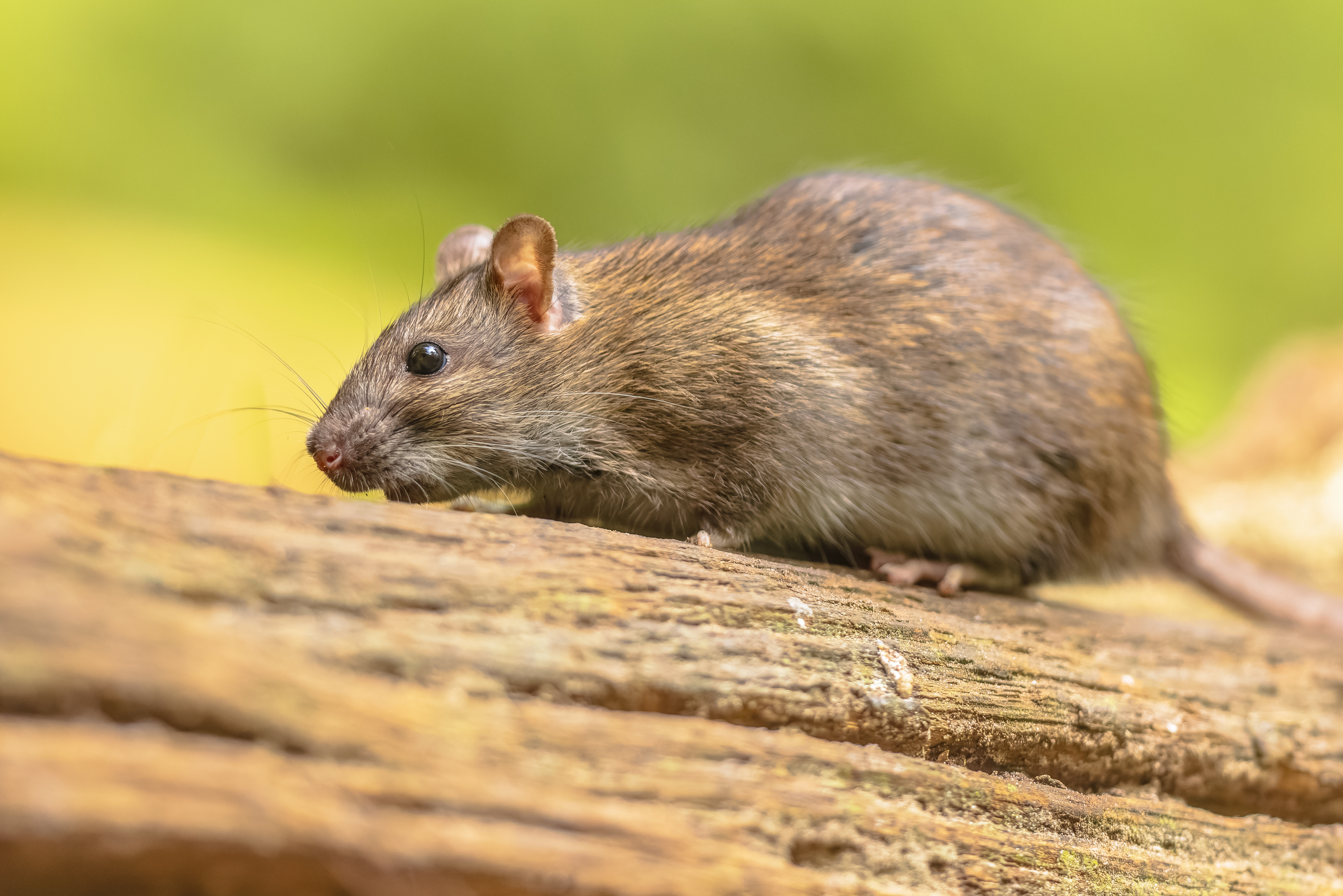

Scratching or scrambling in the walls at night, and droppings bigger than a mouse’s with pointed ends, are two of the first signs of rats in your house to check. Where you hear the noise is your best clue. Scrambling low in the crawl space points to a Norway rat; sounds up in the attic point to a roof rat. Either way, the fix starts with the same small gaps, and you can check for most of them tonight with a flashlight.
- Rat droppings are larger than mouse droppings and pointed at each end. Mouse droppings are only 1/8 to 1/4 inch.
- Noise low in the crawl space points to a Norway rat. Noise in the attic points to a roof rat.
- Seal gaps larger than 1/4 inch, put food away and set snap traps along walls. Call if fresh signs keep showing up.
Signs of rats in your house, in the order to check them
Norway rats are mostly active at night, and rats reuse the same paths along walls and fences. That habit is what gives them away. Grab a flashlight and work through these in order:
- Droppings. Rat droppings are larger than mouse droppings and pointed at each end. One rat leaves about 50 a day, so they add up quickly. Roof rat droppings often turn up near food.
- Gnawing. Look for fresh gnaw marks. Roof rats also leave gnawed fruit or nuts.
- Greasy rub marks. Dark, greasy smudges along the routes rats travel, usually tight against a wall.
- Burrows. Norway rats dig. Outside, look for holes 2 to 4 inches across with smooth, hard-packed soil.
- Nighttime sounds. Squeaking, scrambling or gnawing in the walls, under the floor or in the attic.
Rat or mouse?
House mouse droppings are only 1/8 to 1/4 inch long. If what you’re finding is clearly bigger, with pointed ends, you’re likely dealing with a rat. Body size tells you too: a house mouse weighs about half an ounce, while even the smaller roof rat weighs 5 to 10 ounces. If it turns out to be mice, our guide to keeping mice out of your house this fall walks through the next steps.
Norway rat or roof rat? Where you hear it matters
Here in the Pacific Northwest you’re almost always dealing with one of two rats. The Norway rat and the roof rat are the only rats officially living in Washington, and neither is native to the region. An Oregon State University Extension wildlife specialist has reported more rats in parts of Portland, and Salem appears to be seeing more too. The two species live in different parts of a house, which is why the sound matters.
Noise down low: Norway rat
The Norway rat is a burrowing rat that nests at or under ground level and in the lower floors of buildings. It’s the heavier of the two, 7 to 18 ounces, grayish-brown and about 16 inches long including its scaly tail. It has a blunt nose, and its ears don’t reach its eyes when folded forward. If the scrambling is in the crawl space, under the floor or low in the walls, think Norway rat. More in our Norway rat guide.
Noise up high: roof rat
The roof rat is slimmer and darker, 5 to 10 ounces, with a pointed nose, ears long enough to reach its eyes, and a tail longer than its head and body. It usually nests aboveground, in attics, trees and overgrown shrubs or vines, and it travels along utility lines and fence tops at dusk. Noise in the attic or upper walls at night points this way. More in our roof rat guide.
What we check on a rat call
- We start by asking what you’ve heard and seen, and where. Then we walk the outside of the house at ground level before we go in.
- Every door threshold, utility line, dryer vent and foundation vent gets checked for gaps 1/4 inch or larger. We press on foundation vent screens by hand to make sure the mesh holds.
- We check the soil within 2 feet of the foundation for burrows, then move up to the roofline: soffit vents, fascia, roof vents, and any branches or plants touching the house.
- Every entry point gets photographed and marked on a sketch of your home, so you can see exactly what we found.
- Rats don’t really have an off-season in our records. Over the last five years, about 38% of our new customers came to us about rodents, and in December rodents are more than 6 in 10 of new customer calls.
From Interstate’s Rodent Inspection protocol and five years of our rodent service records.
What you can do first
- Seal gaps larger than 1/4 inch. Cover openings with 1/4-inch hardware cloth or metal flashing. Work from the ground up: foundation vents and crawl space access first, then soffit vents, fascia and roof vents if you can reach them from a stable ladder.
- Put the food away. Store pet food and bird seed in sealed metal or thick plastic containers, and use trash cans with secure lids.
- Trim branches back. Keep tree branches at least 4 feet from utility lines, since roof rats use those lines to reach the house.
- Use snap traps, placed right. University of California IPM rates snap traps the most effective and most economical way to trap rats. Set them close to the wall, right on the routes where you see rub marks or droppings. Traps with a large plastic trigger work better than ones with a small metal trigger. For roof rats, set traps off the ground on ledges and shelves.
- Skip the glue boards. The Washington State Department of Health does not prefer glue or live traps over snap or electronic traps.
One note on poison bait: if you use it at all, it belongs in a tamper-resistant bait station, especially anywhere children, pets or other animals could reach it.
When to call a professional
If you’ve sealed what you can reach and set traps, and you’re still finding fresh droppings or gnaw marks, it’s time to have someone look. The same goes when the openings are up at the roofline or deep in the crawl space. Rats are persistent, and the gaps that matter most are often the hardest to get to.
Our one-time Rodent Service is $350 for the initial visit and $60 per follow-up, and exclusion work to seal entry points comes with a 1-year warranty on the materials used. To stay ahead of rodents all year, the All Seasons Rodent Plan is $39 a month with a $280 setup, and All Seasons Pest and Rodent is $47 a month with a $280 setup. Both include re-services as needed between scheduled visits if pests come back.
Not sure where they’re getting in? A technician will inspect, explain what’s going on, and recommend a plan for your home.
Schedule an InspectionFrequently Asked Questions
Are these rat droppings or mouse droppings?
Mouse droppings are small, about 1/8 to 1/4 inch long. Rat droppings are larger and pointed at each end. One rat can leave about 50 droppings a day, so a fresh pile in one spot usually means you’ve found a route it uses regularly.
What does it mean if I hear noises in the attic instead of the crawl space?
Location is your best early clue. Roof rats usually nest aboveground, including in attics, and travel along utility lines and fence tops. Norway rats nest at or under ground level and in lower floors, so scrambling in the crawl space or under the floor points to them. The first fix is the same for both: find and seal the gaps.
When should I call a professional about rats?
Call if you’ve sealed what you can reach and set traps but still find fresh droppings or gnaw marks, or if the openings are at the roofline or deep in the crawl space. A technician will check ground level, roof level and the crawl space for gaps 1/4 inch or larger and show you what they found.
Local rat help from a team that’s been here since 1963
Interstate is third-generation, family-owned since 1963, with a QualityPro-certified team and offices in Portland, Vancouver, Salem, Olympia and Kelso. We use Integrated Pest Management: we find out why pests are getting in, fix what we can, and treat only where it’s needed.
On a rat call, that means a top-to-bottom inspection, photos and a sketch of every entry point we find, a clear plan for sealing them, and scheduled follow-up visits to check traps and stations.

On a Norway rat call I walk the outside of the house before I go in. These are ground animals. They burrow against the foundation, under the shed, in the blackberries along the back fence, and they come in low. … Find the burrow, find the hole they are using, and the trapping part gets a lot shorter.TJ Jackson, Certified ACE and Director of Operations
“…He also found the place where the rats are getting into my garage. I totally missed it when I looked myself.…”Charmagne W. · Google Review · Portland
“We had been feeding the wild birds in our yard and noticed that rats were under the house. Interstate did a great job!”Cynthia R. · Google Review · Olympia
“They were great and crawled into places that I was terrified to go. Thank you for taking care of our rat problem!”Alicia D. · Google Review · Portland
- Olympia 360-526-8004
- Kelso / Longview 360-515-3882
- Vancouver 360-996-1442
- Portland 503-782-1899
- Salem 503-461-0259
Hearing something in the walls tonight? A local technician will check your home from the crawl space to the roofline for the gaps rats use to get in. Book your inspection online, call 360.382.2451, or contact your local office.