As the nights get colder this time of year, mice start looking for a warm way into homes around Portland, Vancouver, Salem, Olympia and Kelso. The gap they need is smaller than most people expect, about the width of a pencil. If you’re wondering how to keep mice out of your house, October is the month to do it. A little time spent sealing doors, vents and the line where your siding meets the foundation now can save you a winter of cleaning up droppings.
Why Mice Move Into Your House in Fall
Mice often move into homes in autumn, when nighttime temperatures drop. Once it gets cold outside, your house is an easy place to find shelter.
They also need very little room to get in. According to UC IPM, a mouse can squeeze under a gap just 1/4 inch tall and through an opening 3/8 inch wide. That is why a home can look tight from the outside and still let mice in. The usual spots are the places where something passes through or two materials meet:
- Door thresholds, especially where an older sweep has worn down
- Places where pipes, wires and other utilities enter the house
- Vents, including foundation vents
- The line where your siding meets the foundation
These are the same places our technicians check on every rodent inspection, looking for any gap 1/4 inch or larger.
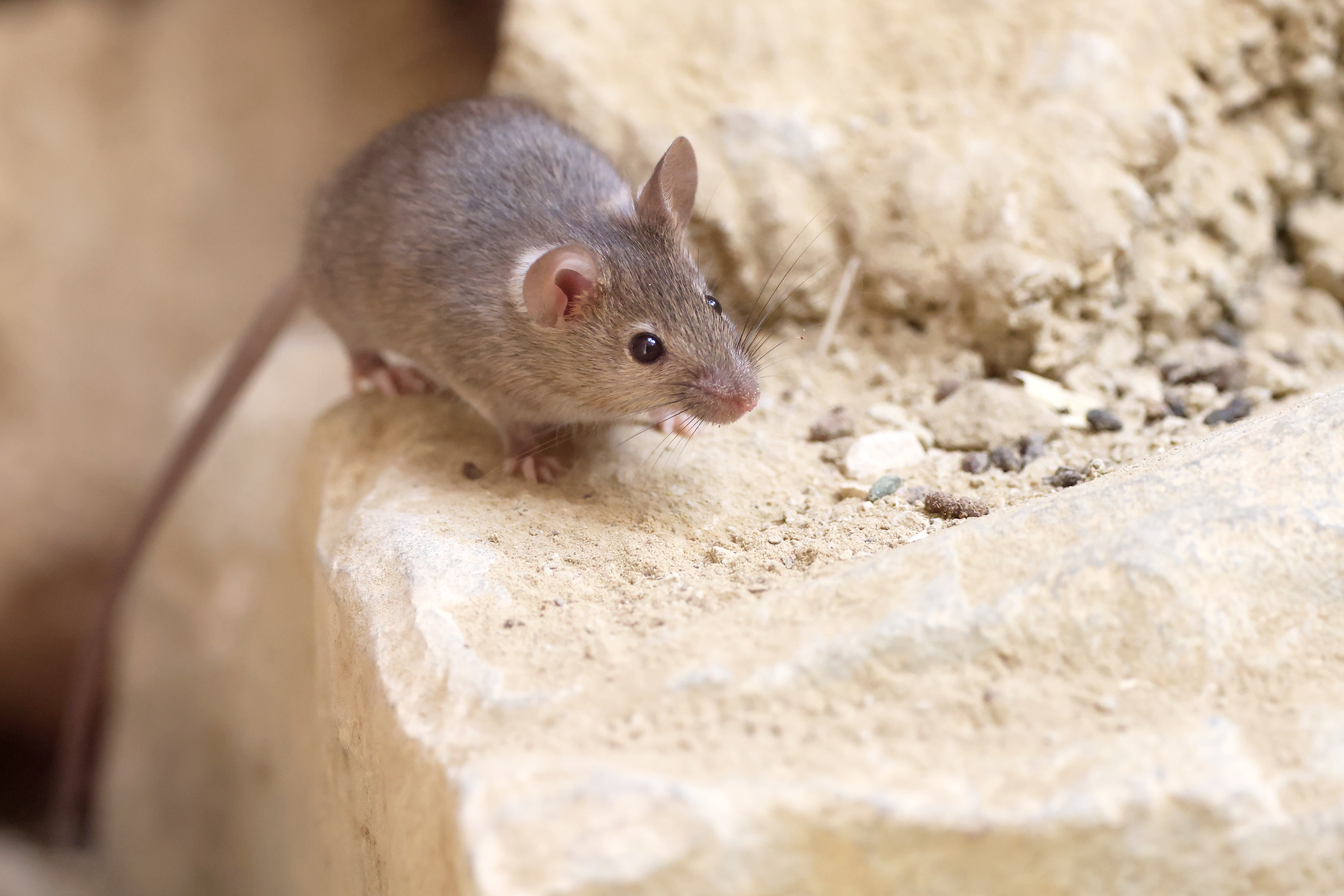
The mouse you’re most likely dealing with is the house mouse. It weighs about half an ounce and is 5 to 7 inches long, including a 3 to 4 inch tail. It is light brown to gray, with fairly large ears and small black eyes. Oregon State University describes it as a non-native mouse found in homes and buildings in Oregon.
How to Keep Mice Out: What You Can Do First
Most of the work to keep mice out is work you can do yourself, and October is the time to do it.
- Cover larger openings with hardware cloth. Use 1/4-inch welded hardware cloth over vents and other openings mice could use.
- Add or replace door sweeps. A door sweep closes the gap at the bottom of exterior doors, including the door from the garage.
- Fill small gaps with steel wool and caulk. The Washington State Department of Health recommends steel wool and caulk for small gaps, like the space around a pipe.
- Put food in sealed containers. Store pantry food, pet food and birdseed in thick plastic or metal containers so there is less to draw mice in.
- Trap first, and set traps the right way. Oregon State University recommends trapping as the first choice. Set several traps in corners and along walls, where mice like to travel. For the first 2 to 3 days, bait the traps but leave them unset, so mice get used to them before you set them.
One honest note on poison bait: Oregon State University says rodenticides need tamper-proof bait stations, and that baits will not solve the problem unless you also remove food sources and seal up the building. Sealing is what keeps new mice from replacing the ones you catch.
When It Is Worth Calling a Professional
If you’ve sealed what you can find and you’re still seeing droppings or catching mice, or you can’t reach the gaps along your foundation and crawl space, it is worth having a professional look. Interstate is third-generation, family-owned since 1963, with a QualityPro-certified team and offices in Portland, Vancouver, Salem, Olympia and Kelso. We use Integrated Pest Management: we find out why pests are getting in, fix what we can, and treat only where it’s needed. Our one-time Rodent Service is $350 for the initial visit and $60 per follow-up, and exclusion work to seal entry points comes with a 1-year warranty on the materials used. If you’d rather stay ahead of mice all year, our All Seasons Rodent Service is $39 a month with a $280 setup, and All Seasons Pest and Rodent is $47 a month with a $280 setup. Both include free re-services between scheduled visits if pests come back. You can compare plans on our year-round prevention page.
Local proof · Portland · Vancouver · Salem · Olympia · Kelso
Pacific Northwest Mouse Help From a Family-Owned Team
Mice start looking for a way in as the nights get colder, and the gaps they use are small. Our technicians start where you would: door thresholds, utility entries, vents, foundation vents and the line where your siding meets the foundation, checking for any gap 1/4 inch or larger. We use Integrated Pest Management: we find out why pests are getting in, fix what we can, and treat only where it’s needed.
Need a one-time fix? Our Rodent Service covers it, and exclusion work comes with a 1-year warranty on the materials used. Want year-round coverage? All Seasons Rodent Service keeps a technician on your schedule.
1963
Third-generation, family-owned since 1963
1/4″
Every gap this size or larger gets checked on a rodent inspection
1-Year
Warranty on the materials used in exclusion work
Free
Re-services between scheduled visits if pests come back

“A house mouse can slip under a gap about the width of a pencil. So when I look at a home, I’m not asking whether there’s a way in. I’m asking where it is. Once the nights turn cold, mice go looking for that spot. Walk your foundation this month: the line where the siding meets it, the places pipes and wires come through, and the bottom of every exterior door. Traps handle the mice already inside. Sealing is what stops the next ones.”
TJ Jackson · Associate Certified Entomologist (ACE), Director of Operations
★★★★★
4.96
average across 8,394 Google reviews
As of September 2026
Family-owned since 1963 · QualityPro certified · Free re-services between scheduled visits
Call your local office
- Portland, OR503-782-1899
- Vancouver, WA360-996-1442
- Salem, OR503-461-0259
- Olympia, WA360-526-8004
- Kelso, WA360-515-3882
- Toll-free888-844-4476
Mouse Questions We Hear Every Fall
What are the signs of mice in the house?
Look for droppings, fresh gnaw marks, tracks, nests made of finely shredded paper or other fiber, and a musky smell. House mouse droppings are black pellets with pointed ends, about 1/8 to 1/4 inch long.
How small a gap can a mouse fit through?
A mouse can get under a gap 1/4 inch tall and through an opening 3/8 inch wide. If a pencil fits, assume a mouse can too.
Is it a house mouse or a deer mouse?
A deer mouse has a sharply two-toned tail, dark on top and white underneath, along with white feet, a white belly and a brown back. Deer mice are more likely to move into buildings next to fields or forest, like garages, sheds and cabins. It is worth knowing the difference, because deer mice carry hantavirus, and people are exposed by breathing dust from droppings or nests that get stirred up during cleanup.
How should I clean up mouse droppings?
Don’t sweep or vacuum them, because that puts dust in the air. Instead, follow the CDC’s steps:
- Open doors and windows and let the area air out for 30 minutes.
- Put on rubber or plastic gloves.
- Wet the droppings with a mix of 1.5 cups of bleach per gallon of water, or with an EPA-registered disinfectant, and let it soak for at least 10 minutes.
- Wipe it up with paper towels and throw them away in a covered garbage can.
- Wash your hands when you’re done.
The Washington State Department of Health adds that a regular dust mask does not protect against hantavirus, and suggests hiring a professional cleanup company for a heavy mess.
Will poison bait get rid of mice?
Not on its own. Oregon State University recommends trapping as the first choice, says rodenticides need tamper-proof bait stations, and notes that baits will not solve the problem unless you also remove food sources and seal up the building.
Does Interstate’s rodent plan cover mice?
Yes. All Seasons Rodent Service is $39 a month with a $280 setup, and All Seasons Pest and Rodent is $47 a month with a $280 setup. Both include free re-services between scheduled visits if pests come back. For a one-time fix, Rodent Service is $350 for the initial visit and $60 per follow-up.
Get Help Keeping Mice Out
Book a visit and a local technician will check your home for the gaps mice use to get in. Prefer to talk it through? Call us toll-free at 888-844-4476.