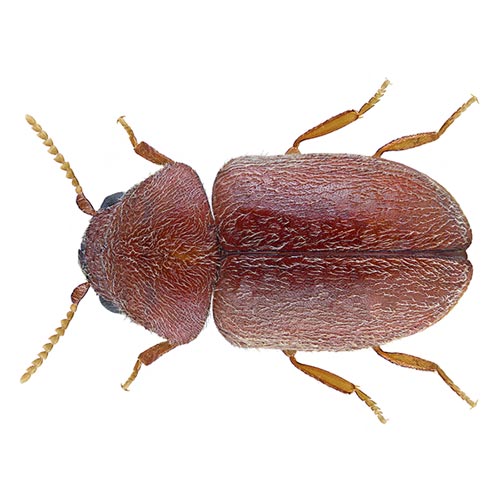
Watch: Tiny Brown Beetles in the Spice Cabinet? Meet the Cigarette Beetle
Cigarette Beetle
Reviewed by TJ Jackson, Associate Certified Entomologist · Updated 2026-11-17
Lasioderma serricorne | Category: Pantry pests | Check the paprika and the dog food
Tiny reddish brown beetles on the windowsill or in the spice cabinet are often cigarette beetles. Despite the name, in homes they show up most in pet food, cereal, nuts, candy and spices like paprika and chili powder. The adults fly toward light, so the beetles you see on a sill may have come from a kitchen across the room. Find the infested item, throw it out and seal the rest.
Tiny beetles in the spices? We can help find the source.
Family-owned since 1963. 4.96 average from 8,500+ Google Reviews.
| Size | About 1/8 in |
|---|---|
| Color | Light reddish brown, fine hairs, smooth shiny wing covers |
| Top ID Marker | Humped back with the head tucked down; saw-toothed antennae |
| Habitat | Spice racks, pet food, cereal, dried peppers and wreaths |
| Activity | Indoors all year; adults fly toward windows and lights |
| Bite Risk | Does not bite; infested food should go |
| Plan Coverage | Covered on the All Seasons Pest Plan |
Quick Answer: The cigarette beetle is a small, light reddish brown beetle about 1/8 inch long with a humped back and the head tucked down. UC IPM says it is more common than the look-alike drugstore beetle and is most often found in homes in pet foods, cereals, nuts and candy, plus dried pepper arrangements, wreaths and spices such as chili powder and paprika. It gets its name from feeding on cured tobacco. The cigarette beetle lays its eggs in the food, and UC IPM puts the time from egg to adult at about six weeks. Adults fly and are attracted to light. To get rid of them, find and discard infested items, vacuum shelves and cracks, and store dry goods in containers with tight-fitting lids. UC IPM says insecticides are not recommended for pantry pests.
Key facts at a glance: About 1/8 inch · Reddish brown, humped · Smooth wing covers · Pet food, spices, cereal, nuts · About six weeks egg to adult · Flies to light · Plan coverage: All Seasons Pest Plan.
Beetles near wood, not food? Cigarette beetles belong to the same family as furniture and powderpost beetles that bore into wood. Small round holes and fine powder below wood point to a wood borer, not a pantry pest. That calls for an inspection.
Frequently Asked Questions
What are the tiny brown beetles in my spices?
Often cigarette beetles. UC IPM says in homes they are most commonly found in pet foods, cereals, nuts and candy, and they also infest spices such as chili powder and paprika.
Why are there little brown beetles on my windowsill?
Cigarette and drugstore beetles fly and are attracted to light, according to the University of Kentucky. Beetles on a sill usually came from infested food somewhere in the house, often the kitchen or a pet food bin.
How do I tell a cigarette beetle from a drugstore beetle?
Look at the wing covers. UC IPM says drugstore beetle wing covers have lengthwise grooves, while cigarette beetle wing covers are smooth. Cigarette beetle antennae are saw-toothed; drugstore beetles have a three-segment club at the tip.
Are cigarette beetles harmful?
They do not bite or sting. They contaminate the food they live in, so anything infested should be thrown out.
How do I get rid of cigarette beetles?
Find every infested item and throw it out. Check spices, pet food, cereal, nuts, dried fruit, dried flower or pepper arrangements and wreaths. Vacuum the shelves and cracks, then store dry goods in sealed containers. UC IPM notes plastic bags are not adequate.
Can I freeze spices or decorations to kill cigarette beetles?
Yes. The University of Kentucky suggests a non-self-defrosting freezer at 0°F for 4 days, or heating items such as dried decorations to 155°F for about 20 minutes.
Do cigarette beetles damage wood?
No. They feed on dry food and plant material. Their wood-boring relatives in the same family, such as furniture beetles, are a different problem and leave round exit holes and powder in wood.
Are cigarette beetles covered on the All Seasons Pest Plan?
Yes. Pantry pests are covered on the All Seasons Pest Plan. We help find the source and treat cracks and shelves where stragglers hide when needed.
Signs You Have Cigarette Beetles
1. Tiny beetles on sills and lights
Small reddish brown beetles at windows, light fixtures and counters, especially near the kitchen.
2. Beetles in spices
Live or dead beetles in paprika, chili powder, red pepper and other ground spices.
3. Pinholes in packages
Tiny round holes in boxes, bags and spice packets.
4. Infested pet food
Beetles or small white grubs in dry dog or cat food, often in bulk bags.
5. Dried decorations
Beetles coming from dried pepper strings, wreaths and flower arrangements.
6. Powdery residue in food
Fine powder and cast skins in the bottom of a package.
Behavior, Biology & Lifecycle
Small and humped
Adults are about 1/8 inch, light reddish brown and oval, with the head bent down so it is hard to see from above.
Named for tobacco
UC IPM notes the cigarette beetle feeds on cured tobacco, cigarettes and cigars, which gave it its name.
Eats almost any dry plant food
It also feeds on dried herbs, spices, nuts, cereals, dried fruit, seeds and some animal products such as dried meat, hair and wool.
Eggs in the food
The female lays eggs directly in the food. Larvae are small, whitish grubs that stay inside the product and are seldom seen.
About six weeks, egg to adult
UC IPM puts development from egg to adult at about six weeks.
Adults fly
Adults fly and are drawn to light, which is how they spread to other packages and turn up on windowsills.
Local Context: Oregon and Washington
Cigarette beetles are almost never reported in Oregon and Washington. Most anobiid beetles we record turn up on wood inspections.
Cigarette beetles live inside food, so almost nobody photographs them. iNaturalist has just 3 verifiable cigarette beetle sightings in Oregon and Washington over the last five years, and 20 of its look-alike, the drugstore beetle. Compare that with 183 Indian meal moth sightings over the same years. Searches for cigarette beetles are too rare to chart.
Our own records tell a related story. Cigarette beetles belong to the anobiid family, which also includes wood-boring furniture and deathwatch beetles. When our technicians recorded an anobiid beetle for a new customer over the last five years, 64% of those first visits were inspections, a general or wood destroying insect inspection, and the same visits often recorded powderpost beetles, termites or carpenter ants. Those are the wood-boring relatives.
Pantry beetles in the kitchen, including cigarette beetles, usually get solved before anyone calls: fewer than 1 in 200 of our visits involve pantry pests of any kind. When people do call about little brown beetles, the first job is finding out which beetle it is, because a beetle in the paprika and a beetle in the floor joists need very different fixes.
Cigarette beetles are too rarely reported to chart, so this is the pantry pest season as a whole.
Each series is its share of the annual total. The orange line is our visits that recorded any pantry pest; the blue line is the most-reported pantry pest, the Indian meal moth.
Blue line: verifiable iNaturalist observations of the Indian meal moth in Oregon and Washington, grouped by the month observed. See the records on iNaturalist.
Rarely seen, often there
A beetle that lives inside a jar of paprika does not get photographed or searched for. Few public records says more about where cigarette beetles live than how common they are.
Worth knowing before you book
Most cigarette beetle problems start with an old spice jar or a big bag of pet food. Go through the spice rack, pet food, cereal and anything decorative made from dried plants, toss what is infested and move the rest into sealed containers. UC IPM says insecticides are not recommended for pantry pests.
If the beetles are near wood instead of food, or you see small round holes with fine powder below them, that is a different job. The chart shows what our anobiid beetle first visits turned out to be: mostly inspections, often alongside other wood-destroying insects.
What our anobiid beetle first visits looked like
Share of new customers with an anobiid beetle recorded on the first visit, over the last five years. Numbers are small, so treat these as a rough picture.
Our records. Inspections include general and wood destroying insect (WDI) inspections. A visit can record more than one pest, so the bars do not add to 100%.

“Little beetles on the windowsill make people worry about the house itself. Most of the time they are coming from the kitchen. Cigarette beetles are so tied to food that there are only 3 public sightings in Oregon and Washington over five years. Start with the spice rack and the pet food, throw out anything with beetles or tiny holes, and seal the rest. If the beetles are near wood instead, call us and we will check for wood borers. Know which beetle it is and the fix is simple.”TJ Jackson · ACE, Director of Operations, Interstate Pest Management
Pantry pests are covered on the All Seasons Pest Plan. If pests come back between scheduled visits, re-services are included in your plan, as needed. QualityPro certified.
Call your local office
- Portland503-782-1899
- Vancouver360-996-1442
- Salem503-461-0259
- Olympia360-526-8004
- Kelso / Longview360-515-3882
Sources: Interstate Pest Management service records, over the last five years, completed visits with pantry pests recorded and new customers with anobiid beetles recorded. Sightings: public iNaturalist records of the cigarette beetle, drugstore beetle and Indian meal moth for Oregon and Washington, over the last five years. Google Trends had no usable search volume for cigarette beetles. Biology: UC Statewide IPM Program, University of Kentucky. Updated November 2026.
DIY Homeowner Steps
Check the spices first
Open and look through paprika, chili powder, red pepper and other ground spices, especially older jars. Toss any with beetles, holes or powder.
Check pet food and decorations
Look through dry pet food, treats, birdseed, dried pepper strings, wreaths and flower arrangements.
Throw out anything infested
Bag infested items and take them outside. Check every package on the same shelf.
Vacuum the shelves and cracks
Vacuum shelves, corners, cracks and under cans, then wipe down. Empty the vacuum outside.
Store in sealed containers
Move spices and dry goods into glass or hard plastic containers with tight lids, and keep rarely used spices in the freezer.
Cigarette Beetles vs. Common Look-Alikes
| Feature | Cigarette Beetle | Drugstore Beetle | Flour Beetle | Carpet Beetle | Furniture Beetle |
|---|---|---|---|---|---|
| Look | Humped, smooth wing covers | Similar, grooved wing covers | Flat, long, reddish brown | Round, mottled or black | Small, brown, cylindrical |
| Antennae | Saw-toothed | Three-segment club | Club at tip | Short club | Club at tip |
| Feeds on | Spices, pet food, cereal, nuts | Bread, flour, spices, drugs | Flour, meal, processed grain | Wool, lint, dead insects | Wood |
| Where you see it | Pantry, spice rack, sills | Pantry, sills | Pantry | Windows, carpet edges | Wood with round holes and powder |
| What it means | Toss the infested food | Toss the infested food | Toss the infested food | Find the fiber source | Book an inspection |
Pantry Pest Help on the All Seasons Plan
All Seasons Pest Plan
$39/month
Setup fee $260 for initial treatment
Pantry pests are covered on the All Seasons Pest Plan. We help find the source, treat the cracks and shelves where stragglers hide, and follow up.
- Help finding the infested package
- Crack and crevice treatment where needed
- Re-services included as needed
- Covers ants, spiders, flies and more
Pest & Rodent Bundle
$47/month
Setup fee $280 for initial treatment
Pantry pests plus mice and rats. Mice and pantry pests often share the same spilled grain and pet food.
- Everything in the All Seasons Pest Plan
- Rodent monitoring and baiting
- Re-services included as needed
- Exclusion quoted separately
What Our Customers Are Saying