Watch: Little Moths in the Kitchen? Check the Birdseed and Pet Food
Indian Meal Moth
Reviewed by TJ Jackson, Associate Certified Entomologist · Updated 2026-11-17
Plodia interpunctella | Category: Pantry pests | The moth in your kitchen came from a package
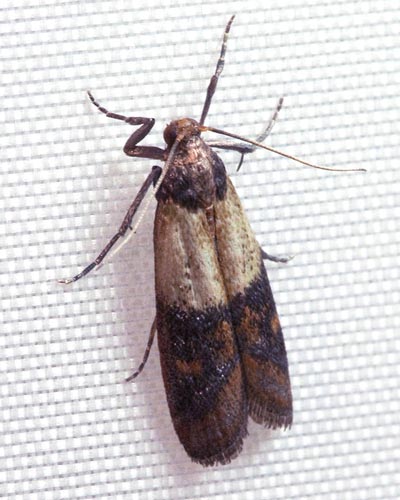
Small moths flying around the kitchen at night are almost always Indian meal moths, the most common moth found in stored food. The adults do not eat. Their larvae do, spinning webbing through cereal, flour, nuts, dried fruit, birdseed and pet food, then crawling up walls and onto ceilings to pupate. Find the package they started in and you have found the problem.
Moths in the kitchen? We can help find the source.
Family-owned since 1963. 4.96 average from 8,500+ Google Reviews.
| Size | 1/3 to 2/5 in long; wingspan about 1/2 to 3/4 in |
|---|---|
| Color | Wings pale gray near the body, coppery reddish brown on the outer part |
| Top ID Marker | Two-tone wings; webbing in food; larvae on walls and ceilings |
| Habitat | Pantries, cupboards, pet food bins, birdseed, decorative grain |
| Activity | Indoors all year; faster in warm months |
| Bite Risk | Does not bite; infested food should go |
| Plan Coverage | Covered on the All Seasons Pest Plan |
Quick Answer: The Indian meal moth is the most common moth found in stored food in homes. Adults are 1/3 to 2/5 inch long with wings that are pale gray near the body and coppery reddish brown on the outer part. The larvae are off-white to pinkish caterpillars up to about 1/2 inch that spin webbing through cereal, flour, grain products, nuts, dried fruit, dry pet food, birdseed, chocolate and powdered milk. When fully grown they leave the food and wander, often onto walls and ceilings, to pupate. To end an infestation, find and throw out every infested item, vacuum shelves and cracks, store dry food in sealed containers, and use pheromone traps to catch remaining males. UC IPM says insecticides are not recommended.
Key facts at a glance: 1/3 to 2/5 inch · Two-tone wings with coppery tips · Larvae spin webbing in food · Larvae climb walls to pupate · Six to eight weeks egg to adult in warm weather · Toss the source · Plan coverage: All Seasons Pest Plan.
Check the birdseed and pet food first. Big bags in the garage or laundry room are easy to forget, and the University of Kentucky lists bird seed and dried dog food among the foods Indian meal moths infest.
Frequently Asked Questions
What are the small moths in my kitchen?
Most likely Indian meal moths. UC IPM calls it the most common moth found on food products in the home. Look for wings that are pale gray near the body and coppery toward the tips.
Where are Indian meal moths coming from?
From a package of dry food. WSU lists cereal, grain products, dried fruit, dry pet food, candy and dried milk among the foods the larvae feed in. Bulk birdseed and pet food stored in a garage or closet are common sources people overlook.
Why are there caterpillars on my ceiling?
When the larvae are ready to pupate, WSU notes they wander considerable distances, often onto walls, countertops and ceilings. Caterpillars on the ceiling mean there is infested food nearby.
Are Indian meal moths the same as clothes moths?
No. UC IPM notes clothes moths are smaller and hairier than pantry moths. Clothes moth larvae feed on wool, fur and feathers, not food. If the moths are in a closet rather than the kitchen, see our carpet beetle guide too.
Do pheromone traps get rid of pantry moths?
They help, but they are not the fix. UC IPM explains the traps attract male moths, not females, so they work best for catching stragglers and checking whether moths are still around after the source is removed.
How long does it take to get rid of Indian meal moths?
UC IPM says the life cycle takes about six to eight weeks in warm weather, and some pantry pests can live for weeks without food. Expect to see a few moths for several weeks after cleaning, and keep food sealed and traps out for a few months.
Can I freeze food to kill pantry moths?
Yes, for items you want to keep. The University of Kentucky suggests a non-self-defrosting freezer at 0°F for 4 days, or heating items like birdseed and decorative corn to 155°F for about 20 minutes.
Are Indian meal moths covered on the All Seasons Pest Plan?
Yes. Pantry pests are covered on the All Seasons Pest Plan. We help track down the source and treat the cracks and shelf edges where larvae hide when needed.
Signs You Have Indian Meal Moths
1. Small moths at night
Little moths fluttering in the kitchen or resting on walls and ceilings near the pantry.
2. Webbing in dry food
Silky webbing and clumps in cereal, flour, nuts, rice, dried fruit, birdseed or pet food.
3. Caterpillars on walls and ceilings
Off-white or pinkish caterpillars crawling away from the food to find a place to pupate.
4. Cocoons in corners and seams
Small silk cocoons in shelf corners, under lids, along cabinet seams and in the folds of packages.
5. Frass in food
Tiny droppings mixed into webbing at the top or corners of a package.
6. Moths near pet food or birdseed
Moths around a pet food bin or a big bag of birdseed in the garage or laundry room.
Behavior, Biology & Lifecycle
A small two-tone moth
Adults are 1/3 to 2/5 inch long with a wingspan around 3/5 inch. The outer two-thirds of the forewings are reddish brown with a coppery luster; the inner part is whitish gray.
The larvae do the eating
Larvae are usually off-white but can be pink, yellowish, greenish or brownish, and reach about 1/2 inch. They spin a great deal of webbing on or near their food.
A wide menu
Larvae feed in cereal, grain products, dried fruit, dry pet food, candy, dried milk, chocolate, nuts and birdseed. The University of Kentucky notes they prefer coarse flours and corn meal.
Wandering to pupate
Mature larvae leave the food and travel some distance to pupate, often on walls, countertops and ceilings.
Six to eight weeks in summer
In warm weather the Indian meal moth takes about six to eight weeks to go from egg to adult; the University of Kentucky notes it can be as short as 25 days.
Adults do not feed on food
The adult moths you see are looking for mates and places to lay eggs. Killing them does not stop larvae already in the food.
Local Context: Oregon and Washington
Indian meal moth sightings and our moth visits both peak in June.
Of the 183 verifiable Indian meal moth sightings logged on iNaturalist in Oregon and Washington over the last five years, June was the busiest month, and 40% came May through August. Sightings also grew, from 19 in 2021 to 46 in 2025, though some of that is more people using the app.
Our moth visits keep nearly the same calendar. Across five years of service records in Portland, Vancouver, Salem, Olympia and Kelso, June was also our busiest month for moths, and 39% of moth visits came May through July. Our technicians record moths without naming the species, so this line includes clothes moths too.
Moth problems tend to be the only problem in the house. 68% of new moth customers had no other pest recorded on the first visit, and 42% of moth visits were re-services on the All Seasons plan. UC IPM notes some pantry pests can live for weeks without food, which is why a second visit is common.
Sightings and our moth visits both peak in early summer.
Each series is its share of the annual total. The orange line is visits where our technicians recorded moths of any kind.
Blue line: verifiable iNaturalist observations of Plodia interpunctella in Oregon and Washington, grouped by the month observed. See the records on iNaturalist.
Summer speeds them up
Indian meal moths live indoors all year, but warm kitchens shorten their life cycle. A few moths in spring can turn into a lot by July.
Worth knowing before you book
Most kitchen moth problems trace back to one forgotten package: a bag of birdseed in the garage, a bin of dog food, a box of crackers at the back of a shelf. Throw that out, check everything near it, vacuum the shelves and move dry goods into sealed containers.
Expect to see a few moths for a couple of weeks after a cleanup, since adults and pupae are already out of the food. Pheromone traps catch those and tell you when it is over. If new caterpillars keep turning up, there is a second source.
Moths through the year
Each row is that source’s share of its own annual total, by month, over the last five years. Darker means a bigger share.
The blue row is public iNaturalist sightings. Orange rows are our records. Values are percent of the year.

“Finding moths and webbing in your food makes the whole kitchen feel dirty, and it is not your fault. These moths almost always come home inside a package. June is our busiest month for moths. What I tell people is to start with the birdseed and pet food, then work through the pantry, toss anything with webbing, and put the rest in sealed jars. Miss one bag and they keep coming back. Get every one and the moths are gone in a few weeks.”TJ Jackson · ACE, Director of Operations, Interstate Pest Management
Pantry pests are covered on the All Seasons Pest Plan. If pests come back between scheduled visits, re-services are included in your plan, as needed. QualityPro certified.
Call your local office
- Portland503-782-1899
- Vancouver360-996-1442
- Salem503-461-0259
- Olympia360-526-8004
- Kelso / Longview360-515-3882
Sources: Interstate Pest Management service records, over the last five years, completed visits with moths recorded and new moth customers. Sightings: public iNaturalist records of the Indian meal moth for Oregon and Washington, over the last five years. Google Trends had no usable search volume for pantry moths in either state. Biology: UC Statewide IPM Program, WSU PestSense, University of Kentucky. Updated November 2026.
DIY Homeowner Steps
Find every infested package
Check cereal, flour, rice, pasta, nuts, dried fruit, chocolate, spices, birdseed and pet food. Look for webbing, clumps and larvae, especially in corners and seams.
Throw it out, sealed
Bag infested food and take it outside to the trash right away so moths do not spread to the next package.
Vacuum and wipe the shelves
Vacuum shelves, corners, cracks, shelf-pin holes and under shelf liners, then wipe down. Empty the vacuum outside.
Move dry goods into sealed containers
Use glass or hard plastic containers with tight-fitting lids. Bags and cardboard boxes are not enough.
Set pheromone traps
Place Indian meal moth traps near the pantry and check them weekly to catch stragglers and confirm the problem is over.
Indian Meal Moths vs. Common Look-Alikes
| Feature | Indian Meal Moth | Clothes Moth | Angoumois Grain Moth |
|---|---|---|---|
| Adult | Two-tone wings: gray inner, coppery outer | Smaller, plain golden, hairier | About 1/2 in, pale yellow brown |
| Larvae feed on | Dry food: grain, nuts, seed, dried fruit, pet food | Wool, fur, feathers | Inside whole kernels and decorative corn |
| Where you see it | Kitchen, pantry, near pet food | Dark closets, stored woolens | Kitchen, near stored grain |
| Telltale sign | Webbing in food, larvae on ceilings | Holes in wool, silk cases | Small holes in kernels |
| What it means | Toss the infested food | Clean and seal woolens | Toss the infested grain |
Pantry Pest Help on the All Seasons Plan
All Seasons Pest Plan
$39/month
Setup fee $260 for initial treatment
Pantry pests are covered on the All Seasons Pest Plan. We help find the source, treat the cracks and shelves where stragglers hide, and follow up.
- Help finding the infested package
- Crack and crevice treatment where needed
- Re-services included as needed
- Covers ants, spiders, flies and more
Pest & Rodent Bundle
$47/month
Setup fee $280 for initial treatment
Pantry pests plus mice and rats. Mice and pantry pests often share the same spilled grain and pet food.
- Everything in the All Seasons Pest Plan
- Rodent monitoring and baiting
- Re-services included as needed
- Exclusion quoted separately
What Our Customers Are Saying