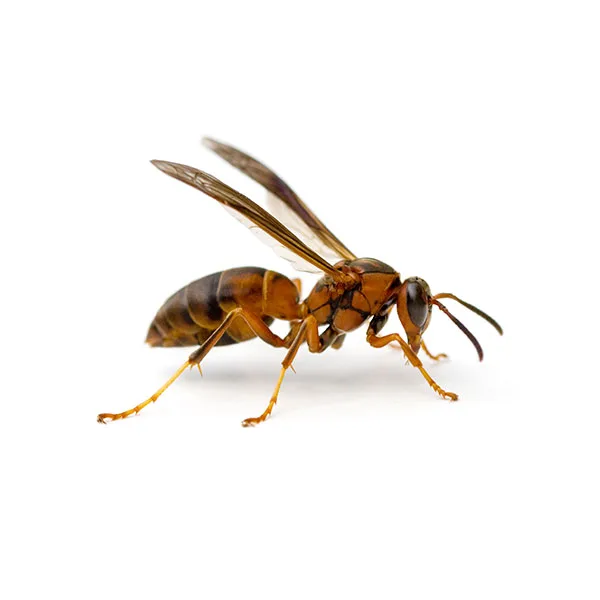
Paper Wasps
Reviewed by TJ, ACE Certified Technician · Updated 2026-05-21
Polistes & Mischocyttarus spp. | Category: Stinging Insects | ✓ Covered: All Seasons Pest Plan
Paper wasps are the wasps you’ve probably seen building those little upside-down paper umbrellas under your eaves. They sit right in the middle of the stinging insect spectrum, more defensive than mud daubers, much less aggressive than yellow jackets. They’re also beneficial garden predators that hunt caterpillars. With paper wasps, the right call isn’t species-driven so much as nest-size-and-timing driven. A small spring nest is a different situation than a mature mid-summer one, and we’ll help you figure out which you’ve got.
| Size | 3/4″ to 1.25″ long (longer & more slender than yellow jackets) |
|---|---|
| Color | Brown to reddish-brown with yellow markings (native); bright yellow-and-black (European) |
| Top ID Marker | Open umbrella-shaped paper nest hanging from a single stalk |
| Active Season | Spring through early fall; peak July–August |
| Nest Sites | Eaves, porch ceilings, tree branches, sheds, outdoor furniture |
| Aggression | Moderate, defensive within ~2 ft of nest; multiple stings possible |
| Plan Coverage | ✓ Covered under All Seasons Pest Plan |
Need help with this pest?
Get A QuoteQuick Answer: Paper wasps (Polistes and Mischocyttarus species) are 3/4 to 1.25 inch long slender wasps that build distinctive umbrella-shaped open-cell paper nests under eaves and in sheltered spots. They sit in the middle of the stinging insect aggression spectrum, more defensive than mud daubers, much less aggressive than yellow jackets, and are beneficial predators of caterpillars and other garden pests. Treatment decisions should depend on nest size and timing, not just species: small early-spring nests can sometimes be handled by confident homeowners, while mature mid-to-late-summer nests warrant professional removal. The European paper wasp (Polistes dominula) is an invasive species now common in the PNW, brighter and easier to confuse with yellow jackets than native species.
Key facts at a glance: Size: 3/4″–1.25″ · Nest: open umbrella, single stalk · Aggression: moderate · Beneficial predator: yes · Multiple stings: yes · Annual colonies: yes · Small DIY-able nests: yes (in spring) · Plan coverage: Yes, All Seasons Pest Plan.
Safety note: Paper wasp stings cause significant localized pain and swelling. For people with insect-sting allergies, stings can trigger anaphylaxis, a medical emergency requiring immediate 911 call and epinephrine if available. Even non-allergic people should seek medical evaluation after multiple stings. If a nest is in a location where household members can’t safely keep distance, removal is warranted regardless of size.
What You Need To Know About Paper Wasps
Our ACE Certified Technician TJ breaks down paper wasps, why nest size and timing should drive your decision more than the species itself.
Frequently Asked Questions
What do paper wasps look like?
Long and slender, 3/4″ to 1.25″, with legs that dangle visibly in flight. Native PNW species are brown to reddish-brown; the invasive European paper wasp is brighter yellow-and-black and looks more like a yellow jacket.
How aggressive are they?
Middle of the road. More defensive than mud daubers, way less aggressive than yellow jackets or bald-faced hornets. They’ll sting if you get within a couple feet of the nest, but mostly ignore people who keep distance.
Can I remove a small nest myself?
Sometimes, and we’ll tell you straight. A small early-spring nest with 1-3 wasps is genuinely DIY-able with a jet-stream wasp spray at dusk. A mature nest with 20+ wasps is a different story, that’s when calling a pro becomes the safer move.
Are they beneficial?
Yes, they’re significant garden predators, hunting caterpillars (including cabbage worms and hornworms), beetles, and other soft-bodied insects. A nest in a remote corner of a shed or yard is often worth leaving alone for the garden benefit.
How do I tell them apart from yellow jackets?
Body shape: paper wasps are longer and more slender with dangling legs in flight. Yellow jackets are shorter and chunkier. Nest type: paper wasp nests are open umbrellas you can see the cells of. Yellow jackets nest in the ground or in walls. Aggression: yellow jackets are dramatically more defensive.
Does the plan cover them?
Yes, included. Our techs assess honestly. If a small nest is in a low-risk spot, we’ll often suggest leaving it. If removal is warranted, it’s covered.
Will they come back to the same spot?
Not the same colony, nests are annual. But the location may attract new founding queens the following spring. Removing abandoned nests in winter and sealing gaps in eaves reduces the appeal.
What’s the European paper wasp?
An invasive species (Polistes dominula) established in the PNW since the 1990s. Brighter yellow-and-black than native paper wasps and the species most likely to be confused for a yellow jacket. Slightly more defensive than natives, but treatment approach is similar.
Signs You Have Paper Wasps
Paper wasps usually announce themselves with the nest before you spot the wasp itself. Here’s what to look for:
1. Umbrella-shaped open paper nest
The defining sign. Small open paper structure hanging from a single short stalk, with hexagonal comb cells visible from below. Usually under an eave, in a soffit, in a shed, or under outdoor furniture.
2. Wasps with dangling legs in flight
Paper wasps in flight have noticeably long legs that hang below the body. Yellow jackets keep their legs tucked. If you see a slender wasp with trailing legs, that’s a paper wasp.
3. Steady traffic at one nest
A few wasps coming and going from the same small spot under the eave. Activity usually starts with one wasp in early spring and grows through summer.
4. Wasps hunting in the garden
Paper wasps actively hunt caterpillars on vegetable plants and shrubs. If you see them grabbing caterpillars off your tomatoes or cabbage, that’s normal, and beneficial.
5. Wasps collecting fibers from wood
A paper wasp scraping wood off an unpainted fence, shed, or weathered surface is collecting fibers to chew into nest material. This is how the nest gets its papery appearance.
6. Old abandoned nests from last year
Faded paper umbrellas without active traffic are last year’s nests. Paper wasps don’t reuse them, but the location can attract new queens. Worth removing in winter.
Behavior, Biology & Lifecycle
Paper wasps follow a predictable annual cycle, understanding it explains why nest size and timing matter so much for treatment decisions:
Solitary start, social peak
A founding queen starts each nest alone in spring, she lays eggs, hunts food, and builds the comb herself for the first weeks. Once worker daughters emerge in early summer, the colony becomes social and grows rapidly. This is why early-spring nests are so much smaller and lower-risk than mid-summer ones.
Multiple PNW species
The Pacific Northwest has native species like the Western paper wasp (Mischocyttarus flavitarsis) and Northern paper wasp (Polistes fuscatus), plus the invasive European paper wasp (Polistes dominula) which has established widely since the 1990s and is now the most commonly encountered in suburban areas.
Beneficial caterpillar predators
Paper wasps are significant predators of garden pest caterpillars, cabbage worms, tomato hornworms, and many others. They chew up caterpillars and feed them to developing larvae. Killing a paper wasp nest near a garden costs you that pest control service.
Open-cell nest architecture
Unlike bald-faced hornets or yellow jackets, paper wasps don’t enclose their nests in a paper envelope. The hexagonal cells are visible from below, and you can usually see the wasps walking on the comb. This is what creates the distinctive umbrella appearance.
Defensive only near the nest
Paper wasps will defend the nest from threats within a foot or two but generally ignore activity beyond that range. Foraging wasps away from the nest are even less reactive. This is why paper wasps in your garden are usually fine and why the only treatment-relevant location is right at the nest itself.
Annual colonies, no reuse
By late fall, workers die off and only newly mated queens overwinter under bark, in attic corners, or in protected gaps. The following spring, those queens start fresh nests in new locations. Old nests are not reused, though the original site sometimes attracts new queens if conditions remain favorable.
DIY Homeowner Steps
Paper wasps are one of the few stinging insects where small DIY can be reasonable, but size and timing matter.
Assess size and timing first
Small early-spring nest (1-3 wasps, comb the size of a quarter) = lower risk. Mature mid-summer nest (20+ wasps, comb fist-sized or larger) = higher risk. Treat these differently.
Consider leaving it alone
If the nest is in a remote spot, tree branch away from the house, back of a shed, unused garage corner, leaving it alone is often the right call. Garden benefit is real.
If DIY a small nest: do it right
Jet-stream wasp spray (not foggers). Treat at dusk or dawn. Long sleeves, pants, eye protection. Stand at the spray’s full range (8-12 ft). Saturate the nest. Have an exit route. Wait 24 hours before knocking it down.
Don’t attempt mature nests
By mid-summer, a nest with dozens of defenders is no longer a reasonable DIY target. A failed spray attempt usually triggers swarming and multi-sting events. Call a pro.
Prevent next year’s nest
After removal or in late winter, scrape old nest sites clean, caulk gaps in eaves where new queens might shelter, and install screens over attic vents. Reduces but doesn’t eliminate return.
Paper Wasps vs. Other Stinging Insects
Paper wasps are most often confused with yellow jackets, especially the invasive European paper wasp, which is similarly colored. Here’s how to tell the difference:
| Feature | Paper Wasp | Yellow Jacket | Bald-Faced Hornet | Mud Dauber |
|---|---|---|---|---|
| Size | 3/4″–1.25″ | ~1/2″ | 12–15 mm | ~1″ |
| Body shape | Long & slender, dangling legs | Short & compact | Compact, sleek | Long with thread-thin waist |
| Nest type | Open umbrella, single stalk | Hidden underground or in walls | Grey paper football, aerial | Mud tubes |
| Aggression | Moderate | Very high | Very high | Very low |
| Multiple stings? | Yes | Yes | Yes | Rare; males can’t sting |
| Small DIY-able? | Yes (small, spring) | No | No | Often unnecessary |
| Beneficial? | Yes (hunts caterpillars) | Mixed (hunts pests, scavenges) | Yes (hunts flies, wasps) | Yes (hunts spiders) |
| Plan coverage | ✓ All Seasons | ✓ All Seasons | ✓ All Seasons | ✓ All Seasons |
Plans That Cover Paper Wasps
All Seasons Pest Plan
$39/month
Setup fee $260 for initial treatment
Year-round protection from the pests Pacific Northwest homeowners deal with most, with stinging insect nest removal included for paper wasps, hornets, yellow jackets, and more.
- Recurring exterior treatments
- Honest size/risk assessment
- Re-services included as needed between visits
Pest & Rodent Bundle
$47/month
Setup fee $280 for initial treatment
The most complete protection for your home. Full pest coverage plus active rodent monitoring, one plan, one team, one less thing to worry about.
- Everything in Pest & Rodent plans
- Best value for whole-home protection
- Re-service guarantee
What Our Customers Are Saying
Real Results From Real Customers
Get help with paper wasps in your area
Interstate Pest Management helps with paper wasps across Oregon and Washington. Choose your area to see local plans, pricing and the number for your nearest team.