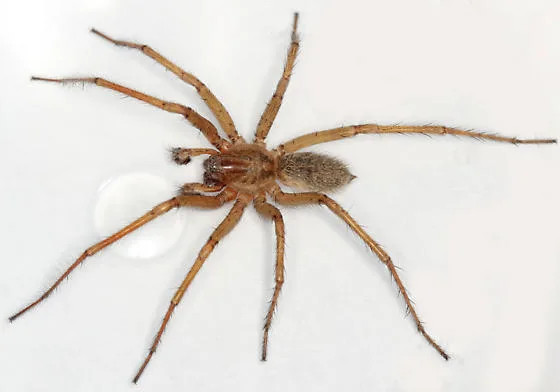
Hobo Spider
Reviewed by TJ, ACE Certified Technician · Updated 2026-06-15
Eratigena agrestis | Category: Spiders | Not medically significant, current science reviewed
The Hobo Spider is a brown funnel-web building spider that has been the subject of one of the most persistent PNW pest myths. For decades it was blamed for necrotic skin wounds, but current research and the CDC no longer support that claim. It is still an unwelcome indoor guest and nearly identical to the Giant House Spider without magnification, but it is not the medical emergency it was once portrayed to be. Here is the accurate picture.
| Size | Leg span 1 to 1.75 inches |
|---|---|
| Color | Brown with distinctive herringbone (chevron) pattern on abdomen |
| Top ID Marker | Herringbone abdomen, flat funnel web at ground level |
| Habitat | Ground level, basements, crawl spaces, dark corners |
| Web | Flat funnel-shaped web with retreat tube |
| Bite Risk | Not medically significant (CDC removed from list) |
| Plan Coverage | ✓ Covered under All Seasons Pest Plan |
Need help with this pest?
Get A QuoteQuick Answer: The Hobo Spider (Eratigena agrestis) is a brown funnel-web spider common in Pacific Northwest basements and crawl spaces. It looks nearly identical to the Giant House Spider without magnification. For decades it was believed to cause necrotic (skin-dying) wounds, but subsequent peer-reviewed research has not been able to reproduce those results, and in 2017 the CDC removed the Hobo Spider from its list of medically significant spiders. Bites are uncommon, defensive, and typically cause mild local irritation similar to a mosquito bite. Still a nuisance to have indoors, but not the medical concern it was once portrayed to be.
Key facts at a glance: Leg span 1 to 1.75 in · Brown with herringbone abdomen · Builds flat funnel webs · Ground-level habitat · Non-aggressive · Not medically significant per current research · Plan coverage: Yes.
What changed: The Hobo Spider was added to the CDC list of medically important arthropods in 1996 based on a limited number of case reports from the 1980s. Subsequent research, including studies attempting to reproduce necrotic lesions in controlled conditions, did not confirm the association. The CDC removed the Hobo Spider from its list in 2017. Most PNW physicians and university extension services now treat Hobo bites as low-risk. If you experience a severe or unusual skin reaction, a doctor can evaluate other likely causes (infection, MRSA, other conditions) that were historically misattributed to spider bites.
What You Need To Know About Hobo Spiders
Our ACE Certified Technician TJ breaks down hobo spiders and giant house spiders, and why neither one is dangerous.
Frequently Asked Questions
Are Hobo Spider bites dangerous?
Current peer-reviewed research does not support the older claim that Hobo Spider bites cause necrotic wounds. The CDC removed the Hobo Spider from its list of medically significant arthropods in 2017. Bites are uncommon, defensive, and typically cause mild local irritation. Severe or unusual skin reactions should be evaluated by a physician for other causes.
How do I tell a Hobo Spider from a Giant House Spider?
They are nearly identical without magnification. Both are brown funnel-web builders in the same genus (Eratigena). Distinguishing features require a microscope look at the male palps or female epigynum. For practical purposes, homeowners can treat them the same.
Where do Hobo Spiders hide?
Ground-level dark spots. Basements, crawl spaces, corners near the floor, under stored items, in unfinished garages. They rarely climb, unlike Giant House Spiders which are more common in upper corners.
Are Hobo Spiders native to the PNW?
No. Hobo Spiders are native to Europe and were introduced to the Pacific Northwest in the 1930s via commercial shipping. They have been established here for many decades.
Are Hobo Spiders aggressive?
No. Despite the older common name Aggressive House Spider (a misinterpretation of the scientific name), Hobo Spiders are not aggressive. Their fast movement when disturbed is a defensive escape, not attack behavior.
Does the All Seasons Pest Plan cover Hobo Spiders?
Yes. Spider control including web sweeping, exterior treatment, and interior treatment is covered under the plan.
Signs You Have Hobo Spiders
Hobo Spiders live at ground level and rarely climb, so what you see and where you see it are strong ID clues:
1. Flat funnel webs at floor level
Hobo webs are horizontal sheets with a funnel-shaped retreat off to one side. Almost always along baseboards, floor corners, wood piles, or in the seam between floor and wall.
2. Fast-moving brown spider on the floor
A brown spider sprinting across the floor at high speed is very often a Hobo or a Giant House Spider. Hobos are typically at ground level, Giant House Spiders climb higher.
3. Herringbone pattern on abdomen
Under close inspection, the abdomen shows a repeating chevron or herringbone pattern. This is a useful but not definitive identifier since other spiders have similar patterns.
4. Basement and crawl space concentrations
Multiple webs in one dark ground-level area, especially a basement or crawl space, strongly suggests Hobos. They favor cool, dark, undisturbed spots.
5. Male wanderers in fall
Male Hobo Spiders wander widely in late summer and fall looking for females. They are the ones most often seen sprinting across floors and turning up in strange spots like sinks or tubs.
6. Egg sacs stuck to walls or objects
Whitish papery sacs attached to walls, under stored items, or on the underside of furniture. Each sac can contain 100 or more eggs. Finding sacs means an active female is nearby.
Behavior, Biology & Lifecycle
Introduced from Europe
Hobo Spiders arrived in the Pacific Northwest in the 1930s and have been the dominant funnel-web builder in the region ever since. In Europe, where they have coexisted with humans for centuries, they have never been associated with medical harm.
Funnel-web hunter
The spider builds a flat sheet with a tubular retreat, then waits inside. When prey lands on the sheet, the spider rushes out, delivers a bite, and drags the prey back into the retreat.
Ground-level specialist
Unlike Giant House Spiders which climb walls, Hobos rarely leave the ground. This is why finding a fast brown spider high on a wall is more likely a Giant House Spider than a Hobo.
The necrotic-bite claim
The Hobo-causes-necrosis hypothesis originated with 1980s case reports where necrotic lesions were attributed to Hobo bites. Follow-up research could not reproduce the effect and later work identified other causes (MRSA, other skin infections) for many of the original cases.
Lifespan and reproduction
Females live 2 to 3 years, males typically 1 year. Females produce 1 to 4 egg sacs each fall, each containing 100 or more eggs. Population density is limited primarily by web sites and prey availability.
Displaced by Giant House Spider
In many PNW areas, the closely related Giant House Spider has been outcompeting Hobos, in part because Giant House Spiders sometimes eat Hobos. So the actual population of Hobos may be lower than the historical fear suggests.
Local context: Oregon and Washington
Hobo spider searches spike every August. Verified bites do not.
Across five years of spider service records in Portland, Vancouver, Salem, Olympia and Kelso, our spider calls peak in September at 17.1% of the year, with 43% in August through October. Our records tag spiders as a group rather than by species, so the orange line below is every spider we treat.
Hobo spider searches follow almost the same curve, with 24.6% of the year’s search interest in August and another 20.2% in September. What does not follow is the injury. A review of verified Oregon spider bites found 33 confirmed bites with no significant medical symptoms and no tissue damage, and the Pacific Northwest Pest Management Handbooks note the CDC removed this spider from its list of medically important species.
The identification gap is just as big. Across Oregon and Washington, 611 hobo spider sightings were logged between 2021 and 2025 against 4,609 giant house spider sightings, roughly seven to one. Most fast brown spiders in a PNW house are giant house spiders, and telling them apart takes a hand lens, not a guess.
Hobo spider searches and our spider calls run on the same calendar
Each series is its share of the annual total, so the two are directly comparable. The orange line is all spider calls; our records do not break out species.
Blue line: Google search interest in Oregon and Washington, over the last five years. See it in Google Trends.
Searches vs. bites
Search volume measures worry. The verified-bite record measures harm. They disagree sharply for this species: August brings a quarter of the year’s hobo searches, while the Oregon bite review found no case of tissue damage in 33 confirmed bites. We would rather tell you that than sell against a myth.
What actually earns a call
A fast brown spider in the tub is not a medical problem, but a house producing them all fall usually has a gap problem: crawl space vents, garage thresholds, and the space under siding where funnel webs sit. That is what we treat and what we tell you to seal.
If someone has been bitten and the skin reaction is spreading, that is a question for a doctor rather than a pest company. Take a photo of the spider if you can, since identification changes the answer.
When each spider’s season actually lands
One row per spider, twelve months of Google search interest in Oregon and Washington, over the last five years, with August, September and October banded. Our own spider calls are the bottom row.
Each row is one spider’s year, darkest in its busiest month. The right column is how much of that spider’s year lands in the three banded months. See these five terms in Google Trends.

“Hobo spiders get blamed for a lot that they do not do. In the Northwest the verified bite record does not support the horror stories, and most of the spiders people show me as hobos are giant house spiders. What I tell homeowners is to treat it like any other funnel weaver: seal the crawl space vents and the gaps under the siding, knock the webs down, and keep the exterior treated in late summer when they are most active.”TJ Jackson · ACE, Director of Operations, Interstate Pest Management
Re-services included as needed if they come back between scheduled visits. Hobo spiders are covered under the All Seasons Pest Plan from $39/month: interior and exterior treatments. QualityPro certified.
Book before the fall peak
- Portland503-782-1899
- Vancouver360-996-1442
- Salem503-461-0259
- Olympia360-526-8004
- Kelso / Longview360-515-3882
Sources: Interstate Pest Management service records, over the last five years, new customers only, all spider species combined. Search interest: Google Trends, Oregon and Washington, over the last five years. The two states are combined in proportion to their population. Sightings: public iNaturalist records for Oregon and Washington, over the last five years, counted by the month each spider was seen. Bite review and species notes: Oregon Department of Agriculture, Oregon Spiders: Facts and Fiction, and the Pacific Northwest Pest Management Handbooks. Updated September 2026.
DIY Homeowner Steps
Sweep webs regularly
Funnel webs get rebuilt fast if the spider is still there. Sweeping every week or two along basement corners and crawl space edges is very effective for keeping populations down.
Reduce ground-level clutter
Bag stored items in sealed plastic, elevate boxes off the floor in basements and crawl spaces. Hobos hide in ground clutter and cardboard.
Seal entry gaps at foundation level
Weather stripping on doors, screens on crawl space vents, caulk around utility penetrations. Hobos enter through the same low gaps mice and ants do.
Shake out shoes and gloves stored in garage
If you have not touched something in weeks, a Hobo may have moved in. The rare bite happens when a spider is trapped against skin, usually when someone puts on a stored item.
Vacuum sightings, then dispose
A shop vac with a long hose is the safest removal method. Empty the vac outside immediately after. Do not attempt to handle a Hobo by hand.
Hobo Spider vs. Other PNW Spiders
Hobos are one of the most commonly misidentified PNW spiders. Here is how they compare to the species they are most often confused with:
| Feature | Hobo Spider | Giant House Spider | Western Black Widow | Wolf Spider |
|---|---|---|---|---|
| Leg span | 1 to 1.75 in | Up to 4 in | Up to 1.5 in | Up to 4 in |
| Color | Brown, herringbone abdomen | Mottled brown | Shiny black, red hourglass | Grey-brown, hairy |
| Web | Flat funnel | Flat funnel (larger) | Irregular tangle | None |
| Typical location | Ground level, basements | Basement to ceiling corners | Woodpiles, sheds, meter boxes | Ground, sprinting across floor |
| Bite risk | Not medically significant | Not medically significant | Medically significant | Not medically significant |
| Plan coverage | ✓ All Seasons | ✓ All Seasons | ✓ All Seasons | ✓ All Seasons |
Plans That Cover Hobo Spider Control
All Seasons Pest Plan
$39/month
Setup fee $260 for initial treatment
Year-round protection from the pests Pacific Northwest homeowners deal with most, including spider control, exterior web removal, and harborage treatment.
- Recurring exterior treatments
- Exterior web removal with every visit
- Re-services included as needed between visits
Pest & Rodent Bundle
$47/month
Setup fee $280 for initial treatment
The most complete protection for your home. Full pest coverage plus active rodent monitoring, one plan, one team, one less thing to worry about.
- Everything in Pest & Rodent plans
- Best value for whole-home protection
- Re-service guarantee
What Our Customers Are Saying
Real Results From Real Customers
Get help with hobo spiders in your area
Interstate Pest Management helps with hobo spiders across Oregon and Washington. Choose your area to see local plans, pricing and the number for your nearest team.