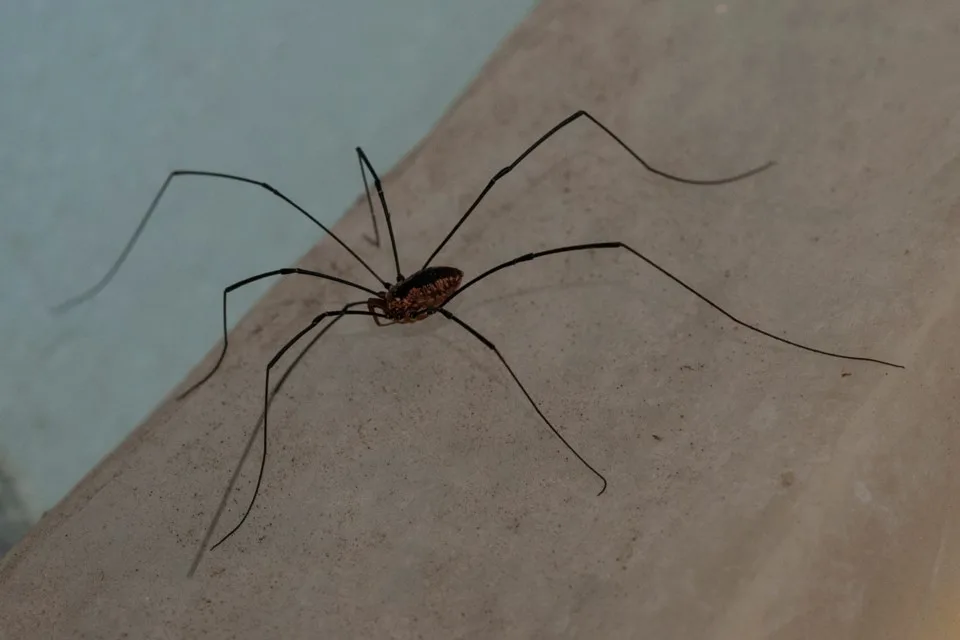
Harvestman (Daddy Long-Legs)
Reviewed by TJ Jackson, Certified ACE · Updated 2026-07-23
Order Opiliones | Category: Arachnids | ✓ Covered: All Seasons Pest Plan
Harvestmen are one of the most misunderstood creatures in the Pacific Northwest. They’re called daddy long-legs, mistaken for spiders, and widely believed to be the world’s most venomous animal. None of that is accurate. They’re not spiders, they have no venom, and they can’t bite you. What they are is one of the more interesting and harmless arachnids you’ll find around your home.
What You Need To Know About Harvestmen
Our ACE Certified Technician TJ clears up the daddy long-legs confusion — what a harvestman actually is, and why the venom myth is completely false.
Frequently Asked Questions
Is a harvestman actually a spider?
No. Harvestmen are arachnids, like spiders, but they belong to a completely different order (Opiliones). They have no venom glands, no fangs, no silk glands, and their body is fused into one oval segment rather than the two distinct sections spiders have. They cannot bite and cannot spin webs.
What’s the difference between a harvestman and a cellar spider?
Both get called daddy long-legs. Cellar spiders are true spiders — they build webs, produce silk, and have two body sections. Harvestmen have one fused oval body and walk the ground or walls with no web. If it’s hanging upside down in a basement web, it’s a cellar spider. If it’s walking across the floor, it’s a harvestman.
Are daddy long-legs really the most venomous spider?
No — this myth has no scientific basis. Harvestmen have zero venom. Cellar spiders have mild venom but it is not medically significant to humans. UC Riverside’s entomology department has confirmed there is no evidence for this claim. The myth likely spread from a misidentified anecdote and has never been scientifically tested.
Are harvestmen beneficial?
Yes. Harvestmen are scavengers and generalist predators — they eat mites, small insects, fungal spores, and decaying organic matter. They are entirely harmless to humans and genuinely useful around the exterior of homes and in gardens.
Does the All Seasons Pest Plan cover harvestmen?
Yes — harvestmen and all spider-adjacent arachnids are covered, with re-service visits as needed if activity returns between scheduled treatments.
Quick Answer: Harvestmen are arachnids that are commonly — and incorrectly — called daddy long-legs and mistaken for spiders. They belong to the order Opiliones, a completely separate group from spiders. They have no venom, no fangs, no silk glands, and a body fused into a single oval segment. They cannot bite you. The widely repeated claim that they are the world’s most venomous animal is false. They are harmless, beneficial scavengers. Treatment is rarely necessary.
Key distinction from spiders: Spiders have two distinct body sections and fangs. Harvestmen have one fused body section and no fangs. If it has a waist, it’s a spider.
Biology & Behavior
Harvestmen are among the oldest arachnids on Earth — fossil records place their ancestors over 400 million years ago, predating even some dinosaurs. Despite their long history and worldwide presence, they remain poorly understood compared to spiders, largely because they don’t produce silk and are harder to study in captivity.
In the Pacific Northwest, harvestmen are most visible in late summer and fall. They are primarily nocturnal scavengers, spending the day tucked into crevices, under bark, or in dense vegetation. At night they range widely across vertical surfaces and ground level, picking at dead insects, mites, plant material, and fungal growth.
Their extremely long legs serve an important sensory function — harvestmen use them to detect vibrations and chemical signals in the environment. When threatened, they can detach a leg voluntarily (autotomy), which continues to twitch and distract a predator while the harvestman escapes. This is one reason you’ll occasionally find harvestmen with fewer than eight legs.
According to research from Oregon State University’s Department of Entomology, harvestmen play a useful role in ecosystem nutrient cycling and are considered beneficial in both agricultural and residential settings. They are not pests in any meaningful sense of the word.
What To Do If You Have Harvestmen
In most cases, nothing. Harvestmen are harmless, beneficial, and don’t reproduce indoors. Seeing one or two inside — especially in fall — is normal. If you’d prefer to reduce their presence:
Seal ground-level entry points
Door sweeps, foundation gaps, and crawl space vents are the main routes in. Sealing these reduces harvestmen and all other ground-level arachnids.
Reduce exterior clutter
Woodpiles, leaf litter, and dense vegetation against the foundation are harvestman habitat. Moving these away from the house reduces harborage.
Catch and release
A cup and a piece of paper is all you need. They cannot bite. Catch-and-release outdoors is easy, safe, and takes about ten seconds.
Recurring exterior treatment
If you’re seeing large numbers, a recurring exterior treatment plan addresses the full arachnid and insect population around your home — harvestmen included.
Plans That Cover All PNW Spider Species
All Seasons Pest Plan
$39/month
Setup fee $260 for initial treatment
Year-round protection from the pests Pacific Northwest homeowners deal with most — spiders, harvestmen, ants, wasps, box elder bugs, and more. Includes exterior web removal with every visit.
- Recurring exterior treatments
- Exterior web removal
- Re-services included as needed between visits
Pest & Rodent Bundle
$47/month
Setup fee $280 for initial treatment
The most complete protection for your home. Full pest coverage plus active rodent monitoring — one plan, one team, one less thing to worry about.
- Everything in Pest & Rodent plans
- Best value for whole-home protection
- Re-service guarantee
Get help with harvestmen in your area
Interstate Pest Management helps with harvestmen across Oregon and Washington. Choose your area to see local plans, pricing and the number for your nearest team.