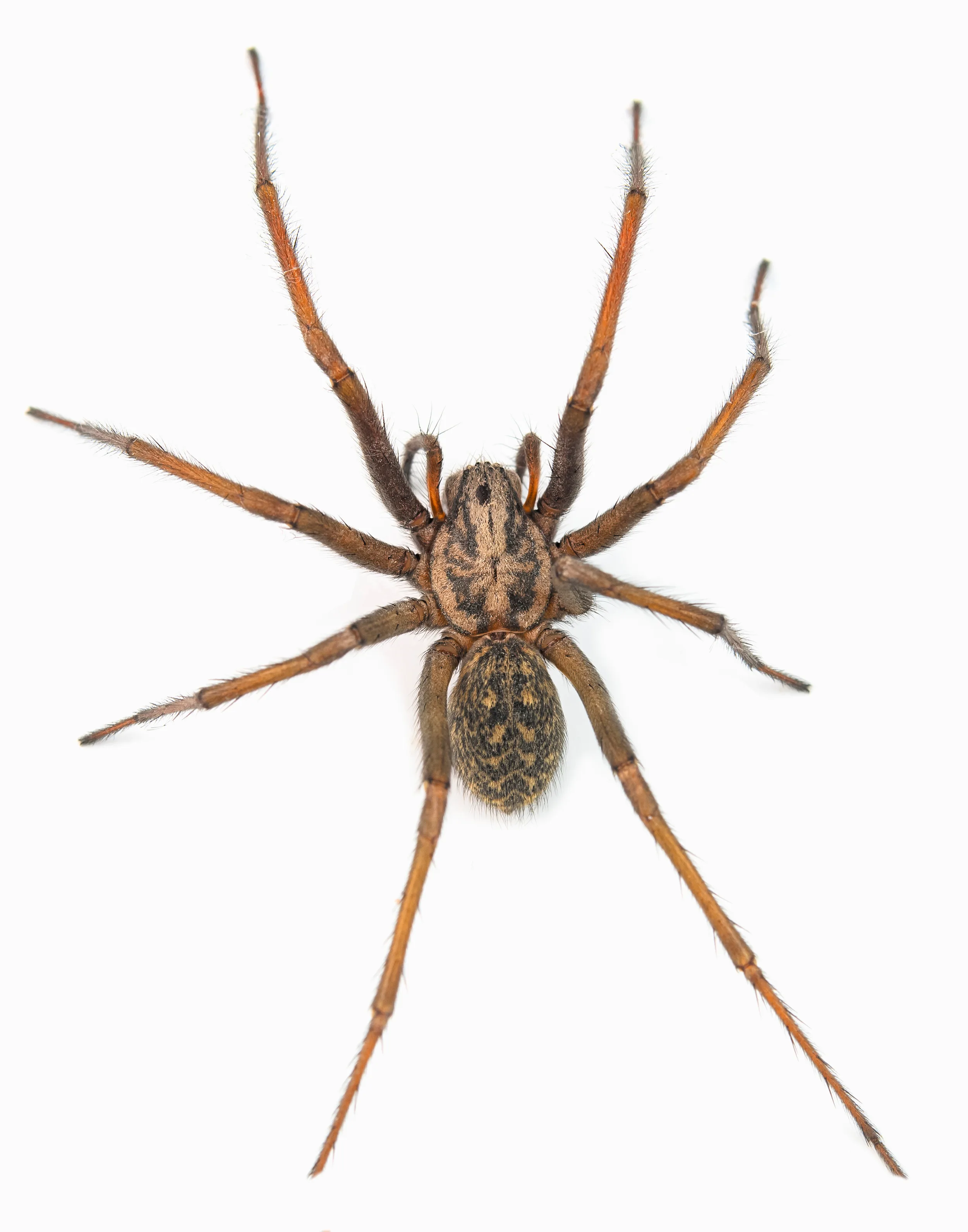
Giant House Spider
Reviewed by TJ, ACE Certified Technician · Updated 2026-06-15
Eratigena atrica | Category: Spiders | Large, fast, but harmless
The Giant House Spider is the big brown spider most PNW homeowners see sprinting across the floor in late summer. It is the largest spider people commonly encounter indoors here, with a leg span that can reach four inches. Despite the size and speed, it is not medically significant. It is also the species most commonly confused with the Hobo Spider, since they are close relatives in the same genus. Here is how to identify it and why our default recommendation is usually to leave them alone if they are not in a problem location.
| Size | Leg span up to 4 inches |
|---|---|
| Color | Mottled brown with banded legs |
| Top ID Marker | Very large size, funnel web in corners |
| Habitat | Basements, crawl spaces, corners (floor to ceiling), garages |
| Web | Flat funnel-shaped, often quite large |
| Bite Risk | Not medically significant |
| Plan Coverage | ✓ Covered under All Seasons Pest Plan |
Need help with this pest?
Get A QuoteQuick Answer: The Giant House Spider (Eratigena atrica) is the large fast-moving brown spider most PNW homeowners encounter indoors, particularly in late summer when males wander looking for mates. It builds flat funnel-shaped webs in corners of basements, crawl spaces, and garages, and can reach a four-inch leg span. It is closely related to the Hobo Spider and nearly identical to it without magnification. Neither spider is medically significant, both are considered nuisance pests. Giant House Spiders are actually somewhat beneficial, they prey on other spiders (including Hobos) and other household insects. Startling to see, but harmless.
Key facts at a glance: Leg span up to 4 in · Mottled brown · Fast · Builds funnel webs · Very common indoors · Not medically significant · Beneficial predator · Plan coverage: Yes.
Actually helpful: Giant House Spiders eat other spiders (including Hobo Spiders) and household insects. In basements, garages, and unfinished storage areas, they are effectively free pest control. If one is not in a problem location, leaving it alone is a reasonable choice.
What You Need To Know About Giant House Spiders
Our ACE Certified Technician TJ breaks down giant house spiders and hobo spiders, and why neither one is dangerous.
Frequently Asked Questions
Are Giant House Spiders dangerous?
No. Giant House Spiders are not medically significant. They can bite defensively if trapped against skin, but bites are extremely rare and cause at most brief local irritation similar to a mosquito bite. Despite the alarming size and speed, they pose no real threat.
How do I tell a Giant House Spider from a Hobo Spider?
Without magnification, you often cannot. Both are brown funnel-web builders in genus Eratigena. Giant House Spiders tend to be larger and more comfortable climbing walls. Hobos usually stay at ground level. Positive ID requires microscope work.
Why do I see them in fall?
Mature males wander in late summer and fall looking for females. The dramatic sprints across floors are almost always males on their mating quests.
Are Giant House Spiders beneficial?
In a sense, yes. They prey on other spiders including Hobo Spiders and they consume household insects. In utility areas they function as free pest control.
How long do Giant House Spiders live?
Females can live 2 to 6 years. The big spider in your basement corner may have been there for years.
Does the All Seasons Plan cover them?
Yes. Web sweeping, exterior treatment, and interior spider control are all covered.
Signs You Have Giant House Spiders
Giant House Spiders make themselves known through size, speed, and the trailheads of their funnel webs:
1. Very large brown spider on the wall
A brown spider with a leg span the size of a coaster is almost always a Giant House Spider. That size is the giveaway – nothing else common indoors gets that big.
2. Funnel webs in corners
A flat sheet with a tunnel retreat in the corner of a basement or crawl space is signature Giant House Spider. Their webs can be substantially larger than Hobo webs.
3. Fast sprints across the floor
Giant House Spiders can move up to 2 feet per second in short bursts. If a brown spider crossed your floor at alarming speed, it was probably one of these.
4. Male wanderers in late summer
Late-summer and fall bring mating season. Homeowners often notice males suddenly showing up in bathtubs, on ceilings, and in unexpected spots as they search for females.
5. Fewer Hobo Spiders than expected
Giant House Spiders eat Hobos. Homes with strong Giant House Spider populations often have surprisingly few Hobos.
6. Egg sacs and molted skins
Silky egg sacs attached to walls or the underside of shelves, plus cast skins from molts, indicate an active female with a long-term residence.
Behavior, Biology & Lifecycle
Introduced from Europe
Like the Hobo Spider, the Giant House Spider was introduced to the PNW from Europe. It has thrived here for over a century and is now one of the region\’s most abundant indoor spiders.
Long-lived by spider standards
Females can live 2 to 6 years, unusually long for a spider. This means a single female can occupy a corner of your home for a very long time. Males live shorter lives and die shortly after mating.
Genuinely fast
Giant House Spiders can sprint up to 2 feet per second in short bursts, one of the fastest speeds recorded for a spider. This is why they seem to disappear before you can react.
Habitat: corners, high and low
Unlike the ground-hugging Hobo, Giant House Spiders comfortably climb walls and build webs in upper corners of basements, garages, and crawl spaces. They are equally at home floor to ceiling.
Predators of other spiders
Giant House Spiders will catch and eat Hobo Spiders and other spiders that wander into their webs. In areas with strong Giant House Spider populations, Hobos are often notably absent.
Reproduction
Females produce multiple egg sacs during their long lives, each containing dozens of eggs. Development from egg to adult takes 1 to 2 years.
Local context: Oregon and Washington
The spider in your bathtub in August is on a schedule
Across five years of spider service records in Portland, Vancouver, Salem, Olympia and Kelso, our spider calls peak in September at 17.1% of the year, with 43% landing in August, September and October. January and December sit near 2%. Our records tag spiders as a group rather than by species, so that orange line is every spider we treat, not giant house spiders alone.
The public record for this species is sharper. Of 4,609 giant house spider sightings logged in Oregon and Washington between 2021 and 2025, 21.9% came in August and another 18.6% in September. Google searches for the species are more lopsided still: 88% of the year’s search interest falls in August, September and October, the most concentrated of the five spiders we track.
The reason is mating season, not an invasion. Males leave their webs in late summer to look for females, which is why you find one sprinting across the floor or stuck in a tub in August rather than tucked in a corner web. This is also the species most people mean when they say they have hobo spiders, and it is harmless either way.
Sightings peak in August, our spider calls peak in September
Each series is its share of the annual total, so the two are directly comparable. The orange line is all spider calls; our records do not break out species.
Blue line: spider sightings the public logged in Oregon and Washington, over the last five years. See the records on iNaturalist.
Sightings vs. calls
Sightings tell you when the spiders are moving. Our service records tell you when homeowners decided they needed help. The two line up closely here, with the calls running about a month behind the August sighting peak. That month is the window where sealing and an exterior treatment do the most good.
One month earlier than you think
Because the males move in August and our calls peak in September, most people book after the spider they remember has already been inside the wall void for weeks. Treating and sealing in late July or early August gets ahead of the roaming, which is the whole game with this species.
Compared with the other four spiders on our pages, giant house spider interest is the most tightly packed into the fall. Black widow searches, by contrast, run nearly flat all year.
When each spider’s season actually lands
One row per spider, twelve months of Google search interest in Oregon and Washington, over the last five years, with August, September and October banded. Our own spider calls are the bottom row.
Each row is one spider’s year, darkest in its busiest month. The right column is how much of that spider’s year lands in the three banded months. See these five terms in Google Trends.

“Giant house spiders are the ones we get called about most, and almost always in August and September when the males are out looking for a mate. They are not dangerous and they are not hobo spiders, but nobody enjoys finding one in the tub. If you want fewer of them inside, the work happens in late summer: seal the gaps around doors and crawl space vents, clear webs off the siding, and get the exterior treated before the roaming starts.”TJ Jackson · ACE, Director of Operations, Interstate Pest Management
Re-services included as needed if they come back between scheduled visits. Giant house spiders are covered under the All Seasons Pest Plan from $39/month: interior and exterior treatments. QualityPro certified.
Book before the fall peak
- Portland503-782-1899
- Vancouver360-996-1442
- Salem503-461-0259
- Olympia360-526-8004
- Kelso / Longview360-515-3882
Sources: Interstate Pest Management service records, over the last five years, new customers only, all spider species combined. Sightings: public iNaturalist records for Oregon and Washington, over the last five years, counted by the month each spider was seen. Search interest: Google Trends, Oregon and Washington, over the last five years. The two states are combined in proportion to their population. Species notes: Oregon Department of Agriculture, Oregon Spiders: Facts and Fiction. Updated September 2026.
DIY Homeowner Steps
Sweep webs regularly
Funnel webs get rebuilt fast if the spider is still there. Sweeping every week or two along basement corners and crawl space edges is very effective for keeping populations down.
Reduce ground-level clutter
Bag stored items in sealed plastic, elevate boxes off the floor in basements and crawl spaces. Giant House Spiders hide in ground clutter and cardboard.
Seal entry gaps at foundation level
Weather stripping on doors, screens on crawl space vents, caulk around utility penetrations. Giant House Spiders enter through the same low gaps mice and ants do.
Shake out shoes and gloves stored in garage
If you have not touched something in weeks, a Giant House Spider may have moved in. The rare bite happens when a spider is trapped against skin, usually when someone puts on a stored item.
Vacuum sightings, then dispose
A shop vac with a long hose is the safest removal method. Empty the vac outside immediately after. Do not attempt to handle a Giant House Spider by hand.
Giant House Spider vs. Other PNW Spiders
Giant House Spiders are among the most commonly mistaken PNW spiders. Here is how they compare to species they are confused with:
| Feature | Giant House Spider | Hobo Spider | Wolf Spider | Western Black Widow |
|---|---|---|---|---|
| Leg span | Up to 4 in (largest) | 1 to 1.75 in | Up to 4 in | Up to 1.5 in |
| Color | Mottled brown, banded legs | Brown, herringbone abdomen | Grey-brown, hairy | Shiny black, red hourglass |
| Web | Large flat funnel | Smaller flat funnel | None (hunts) | Irregular tangle |
| Climbs walls? | Yes, floor to ceiling | Rarely, ground level | No, ground hunter | Rarely |
| Bite risk | Not medically significant | Not medically significant | Not medically significant | Medically significant |
| Plan coverage | ✓ All Seasons | ✓ All Seasons | ✓ All Seasons | ✓ All Seasons |
Plans That Cover Giant House Spider Control
All Seasons Pest Plan
$39/month
Setup fee $260 for initial treatment
Year-round protection from the pests Pacific Northwest homeowners deal with most, including spider control, exterior web removal, and harborage treatment.
- Recurring exterior treatments
- Exterior web removal with every visit
- Re-services included as needed between visits
Pest & Rodent Bundle
$47/month
Setup fee $280 for initial treatment
The most complete protection for your home. Full pest coverage plus active rodent monitoring, one plan, one team, one less thing to worry about.
- Everything in Pest & Rodent plans
- Best value for whole-home protection
- Re-service guarantee
What Our Customers Are Saying
Real Results From Real Customers
Get help with giant house spiders in your area
Interstate Pest Management helps with giant house spiders across Oregon and Washington. Choose your area to see local plans, pricing and the number for your nearest team.