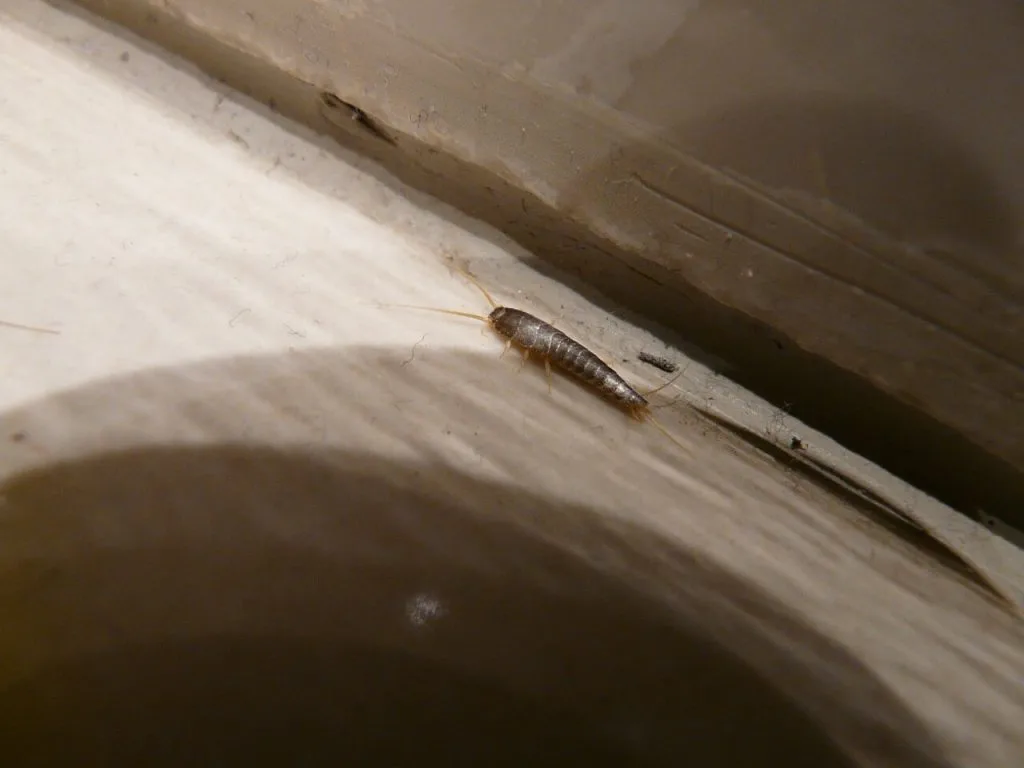
Silverfish
Reviewed by TJ Jackson, Associate Certified Entomologist · Updated 2026-10-09
Lepisma saccharina and relatives | Category: Nuisance pests | A moisture pest that does not keep a season
Silverfish are the fast, shiny, carrot-shaped insects that dart out of the bathtub, the basement or a box of old books. They need humid air, eat starch, paper glue and dust, and can live for years. They do not bite and are a nuisance rather than a health risk, but they can scrape holes in paper, wallpaper and book bindings. They show up in any month, and they stay as long as the room stays humid.
Silverfish turning up month after month?
4.96 stars from 8,394 Google reviews · Family-owned since 1963
| Size | About 1/2 in, up to 3/4 in |
|---|---|
| Color | Shiny silver to pearl gray, covered in fine scales |
| Top ID Marker | Carrot-shaped body with three long tail filaments |
| Habitat | Bathrooms, basements, laundry rooms, closets, bookshelves and storage boxes |
| Activity | Active at night, year-round indoors |
| Bite Risk | Does not bite, can damage paper and starchy items |
| Plan Coverage | Covered by the All Seasons Pest Plan |
Quick Answer: Silverfish are wingless, shiny silver-gray insects about 1/2 inch long with a tapered body and three long tail filaments. In Oregon and Washington homes they live in humid rooms such as bathrooms, basements and laundry rooms, hide in cracks during the day and feed at night on starchy material: paper glue, book bindings, wallpaper paste, cereal and dust. They do not bite or spread disease, but they can leave irregular holes and grazed patches on paper. They live for years and do not keep a season, so they turn up in any month. Lowering humidity, fixing leaks and removing clutter work better than sprays.
Key facts at a glance: About 1/2 inch · Silver-gray, carrot-shaped · Three tail filaments · Needs humid rooms · Active at night, year-round · No bites · Plan coverage: All Seasons Pest Plan.
Found one in the bathtub? It fell in from above. Silverfish that wander into tubs and sinks cannot climb the smooth sides back out, so the one you see points to humid hiding spots nearby.
Frequently Asked Questions
Do silverfish bite or carry disease?
No. Silverfish do not bite people or pets, and they are not known to spread disease. Their jaws are built for scraping. The harm they do is to paper, book bindings, wallpaper and starchy food.
Why do I have silverfish in my bathroom?
Silverfish need humid air. Bathrooms, basements and laundry rooms hold moisture, and the cracks around tubs, baseboards and pipes give them places to hide during the day. They travel along pipes and through wall openings, so a damp spot anywhere nearby can feed the problem.
Do silverfish come up through the drain?
No. Silverfish found in tubs and sinks fell in from above and cannot climb the smooth sides to get out. They do not live in or come out of drains.
What do silverfish eat and damage?
Starch and protein: paper glue and paste, book bindings, wallpaper sizing, starch in clothing, cereal, flour, pet food, dust and dead insects. Damage shows up as irregular holes and grazed, thinned patches on paper and labels.
How long do silverfish live?
A long time for an insect. UC IPM puts the common silverfish at about three years, and some sources report longer. They keep molting their whole lives, so a small population can stick around for years if the conditions stay humid.
What is the difference between silverfish and firebrats?
Firebrats are a close relative with mottled gray and brown scales. They like it hot and dry, near furnaces, ovens, water heaters and in summer attics, while silverfish prefer cooler, humid rooms like basements and bathrooms.
Will sprays or bug bombs get rid of silverfish?
Not on their own. UC IPM notes sprays fail unless the moisture, food and hiding spots are dealt with, and foggers are not recommended. Drying out the space and removing clutter does most of the work.
Does the All Seasons Pest Plan cover silverfish?
Yes. Silverfish are covered under the All Seasons Pest Plan along with spiders, ants and other common household pests, with re-services included as needed between scheduled visits.
Signs You Have Silverfish
1. Quick silver insects at night
Turn on the bathroom or basement light late at night and see something shiny dart for a crack. Silverfish move fast and stay low.
2. Silverfish stuck in tubs and sinks
They fall in and cannot climb out. Finding them there in the morning is one of the most common first signs.
3. Irregular holes and grazed paper
Notched edges, irregular holes and thin, grazed patches on paper, book pages, labels and wallpaper, sometimes with missing letters.
4. Ragged book bindings
They feed on the glue and paste in bindings and boxes, so stored books and papers in basements and closets take the damage.
5. Tiny scales, shed skins and droppings
Silvery scales, shed skins and small dark droppings on or near damaged items. The scales stick to surfaces and are a giveaway.
6. Damp rooms and clutter
Musty basements, bathrooms with poor ventilation, leaky plumbing and stacks of cardboard or paper are where silverfish build up.
Behavior, Biology & Lifecycle
How to know it is a silverfish
Adults are about 1/2 inch long, sometimes up to 3/4, shiny silver to pearl gray, with two long antennae and three long tail filaments. The flattened, carrot-shaped body lets them squeeze into very small cracks.
Built for humid rooms
Silverfish do best between about 71 and 90°F, and in warmer conditions they need relative humidity above 75%. That is why they gather in bathrooms, basements and laundry rooms.
A slow, long life
Females lay eggs a few at a time in cracks and crevices, often 100 or more over a lifetime, and the eggs hatch in about 19 to 32 days. Growing to adulthood can take as little as two months in warm rooms or more than a year in cool ones.
They never stop molting
Silverfish keep molting their whole lives, through as many as 45 to 60 stages, and the common silverfish lives about three years. That is part of why a small population hangs on.
Starch and protein eaters
They eat cereal, flour, pasta, pet food, paper glue, wallpaper sizing, book bindings, starch in clothing, dust and dead insects, and can go months without food.
The firebrat cousin
Firebrats look similar but are mottled gray and brown. They need heat, preferring temperatures near 100°F, so they turn up near furnaces, ovens, hot water pipes and in hot attics.
Local Context: Oregon and Washington
Silverfish do not have a season. No month brings in more than 16% of our silverfish calls.
Silverfish barely keep a season. Of the 517 verifiable silverfish sightings logged on iNaturalist in Oregon and Washington over the last five years, the busiest month, May, holds just 14%. Google searches for silverfish in the two states never top 13% in any month.
Our records agree. Across five years of service records in Portland, Vancouver, Salem, Olympia and Kelso, no single month accounts for more than 16% of the visits where technicians recorded silverfish, and the three busiest months together come to 41%. Stink bugs and boxelder bugs pack about two thirds of their visits into three months.
Silverfish live indoors, where the climate is the same all year. What they need is humidity: UC IPM notes they need relative humidity above 75% in warmer conditions. A damp basement in July is just as good as one in January. They also rarely come alone: 57% of new silverfish customers also had spiders recorded on the first visit, and 35% had ants.
Both lines stay low and flat. Silverfish are an all-year pest.
Each series is its share of the annual total, so the two are directly comparable. The orange line is service visits where our technicians recorded silverfish.
Blue line: verifiable iNaturalist observations of the silverfish family (Lepismatidae) in Oregon and Washington, grouped by the month observed. See the records on iNaturalist.
Why a flat line matters
A flat line means waiting for the season to end will not help. Silverfish in a humid room in March will still be there in November. Recorded sightings grew from 75 in 2021 to 147 in 2025, though some of that is more people using the app.
Worth knowing before you book
Silverfish problems are moisture problems. When we look at the homes where they keep coming back, we usually find a damp basement or crawl space, a bathroom without a working fan, or boxes of paper stored on a concrete floor.
That changes what a fix looks like. A treatment of the cracks and voids where they hide knocks the population down, but the humidity decides whether they rebuild. About 1 in 3 of our silverfish visits were re-service calls, which is usually a sign the damp spot is still there. Dry it out and the treatment holds.
How seasonal is each pest?
Share of each pest’s service visits that fall in its three busiest months, over the last five years. A pest spread evenly across the year would score 25%.
Every completed visit where technicians recorded the pest, Portland, Vancouver, Salem, Olympia and Kelso/Longview. Lower means less seasonal.

“Silverfish in the tub every few weeks wears on people, and a lot of them have already sprayed once and watched them come back. Silverfish follow humidity, so they show up in any month. About 1 in 3 of our silverfish visits are re-service calls, which tells me the damp spot usually has not been fixed. So we do both: we treat where they hide, and we show you what is feeding them, whether that is a weak bath fan, a dehumidifier that quit or a crawl space with no vapor barrier. Dry it out and the treatment holds.”TJ Jackson · ACE, Director of Operations, Interstate Pest Management
Silverfish are covered on the All Seasons Pest Plan, with re-services included as needed between visits if they come back. QualityPro certified.
Call your local office
- Portland503-782-1899
- Vancouver360-996-1442
- Salem503-461-0259
- Olympia360-526-8004
- Kelso / Longview360-515-3882
Sources: Interstate Pest Management service records, over the last five years, completed visits with silverfish and other pests recorded. Sightings: public iNaturalist records of the silverfish family (Lepismatidae) for Oregon and Washington, over the last five years. Search interest: Google Trends for silverfish, Oregon and Washington, over the last five years, combined in proportion to population. Biology: UC Statewide IPM Program, NC State Extension, WSU PestSense, Penn State Extension. Updated October 2026.
DIY Homeowner Steps
Dry out the rooms they live in
Run a dehumidifier in the basement, use the bathroom fan during and after showers, and fix dripping pipes and leaks. Dry air is the single biggest step.
Clear out paper and cardboard
Move stored books, papers and clothing out of cardboard boxes in damp areas and into sealed plastic bins. Rotate and check stored books now and then.
Seal food and seal gaps
Store cereal, flour, pasta and pet food in containers with tight lids. Caulk gaps around pipes, baseboards and tubs where silverfish hide and travel.
Monitor with a jar trap
Wrap the outside of a small glass jar with masking tape so they can climb in, and add a pinch of flour or oatmeal. Silverfish that fall in cannot climb the smooth glass back out. Sticky traps work too.
Skip the bug bomb
UC IPM notes sprays fail unless moisture, food and hiding spots are dealt with, and foggers are not recommended. Fix the conditions first.
Silverfish vs. Common Look-Alikes
| Feature | Silverfish | Firebrat | Jumping Bristletail | Earwig | Springtail |
|---|---|---|---|---|---|
| Body | Flat, silver-gray, carrot-shaped | Flat, mottled gray and brown | Humped back, large eyes, jumps when disturbed | Flat, reddish brown | Tiny, 1/8 in or less |
| Tail end | Three long filaments | Three long filaments | Three tail filaments | Pincers | Springs off a tail lever |
| Where you see it | Bathrooms, basements, books | Near furnaces, ovens, hot pipes | Outdoors in leaf litter | Mulch, pots, damp rooms in summer | Damp soil, houseplants, damp rooms |
| Season | Year-round | Year-round, near heat | Outdoors, warm months | Mostly July and August indoors | Wet fall, winter and spring |
| Damage | Scrapes paper and glue | Scrapes paper and glue | None | None indoors | None |
| What it means | Lower humidity, remove clutter | Check hot, dry spots | Leave it outside | Dry out the foundation zone | Find the moisture |
Plans That Cover Silverfish
All Seasons Pest Plan
$39/month
Setup fee $260 for initial treatment
Year-round coverage for the pests Northwest homes deal with most, including silverfish, spiders and ants, with treatment of the cracks and voids where they hide.
- Recurring treatments
- Silverfish, spiders and ants covered
- Re-services included as needed between visits
Pest & Rodent Bundle
$47/month
Setup fee $280 for initial treatment
The same coverage plus rodent protection. Damp basements and crawl spaces that hold silverfish are often the same spaces mice move into in the fall.
- Everything in the Pest Plan
- Rodent monitoring and control
- Re-services included as needed between visits
What Our Customers Are Saying
Real Results From Real Customers
Get help with silverfish in your area
Interstate Pest Management helps with silverfish across Oregon and Washington. Choose your area to see local plans, pricing and the number for your nearest team.