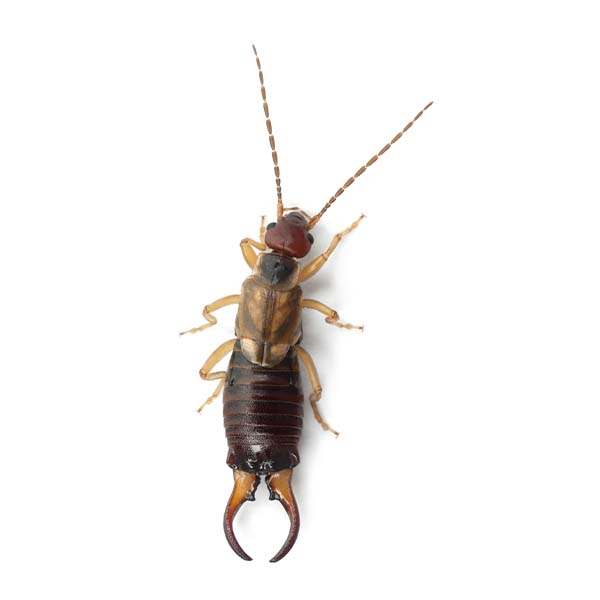
Earwigs
Reviewed by TJ Jackson, Associate Certified Entomologist · Updated 2026-10-09
Forficula auricularia | Category: Nuisance pests | A garden insect that moves indoors in the summer heat
If you are finding earwigs under flower pots and in the bathroom sink, you are looking at the European earwig, an import that reached Seattle in 1907 and Portland soon after. It lives outside in damp mulch and soil, eats aphids as well as your dahlias, and comes indoors when the yard turns hot and dry. Earwigs can pinch, but they are not dangerous and they do not crawl into ears. The fix is mostly outside: pull mulch back from the foundation, fix the wet spots and trap in the garden in early summer.
Earwigs in the bathroom every July?
4.96 stars from 8,394 Google reviews · Family-owned since 1963
| Size | About 1/2 to 3/4 in long |
|---|---|
| Color | Reddish brown, flat and long |
| Top ID Marker | Pincers at the tail end, curved in males and straighter in females |
| Habitat | Mulch, soil, boards, pots and dense plants; damp bathrooms and basements indoors |
| Activity | Active at night; moves indoors most in July and August |
| Bite Risk | Can pinch, not harmful, carries no disease |
| Plan Coverage | Covered by the All Seasons Pest Plan |
Quick Answer: The earwigs found in Oregon and Washington homes are European earwigs (Forficula auricularia), flat, reddish-brown insects about 1/2 to 3/4 inch long with pincers at the tail end. They live outdoors in mulch, soil and plant debris, feed at night on aphids, plants and soft fruit, and lay their eggs in the soil. They come indoors when it gets too hot or dry outside, which in the Northwest means July and August. Earwigs can pinch if trapped but are not harmful, do not spread disease and do not crawl into ears. Indoors they eventually die for lack of food. Drying out the foundation zone, trapping them in the garden and sealing gaps work better than indoor sprays.
Key facts at a glance: 1/2 to 3/4 inch · Reddish brown with tail pincers · Active at night · Lives in damp mulch and soil · Comes indoors in hot, dry weather · Pinches, does not harm people · Plan coverage: All Seasons Pest Plan.
Found one in the bathroom in July? That is the usual pattern. In our records, 52% of the visits where technicians noted earwigs came in July and August, when the yard dries out and the house becomes the damp spot.
Frequently Asked Questions
Do earwigs crawl into people’s ears?
No. That is an old myth, and it is where the name comes from. WSU Extension notes the story may date back to when people slept on the ground. Earwigs hide in dark, damp cracks.
Do earwigs bite or pinch?
They can give a slight pinch with their tail pincers if they are trapped in clothing or you sit on one. They are not harmful to people, they do not spread disease, and they may give off a bad-smelling liquid when disturbed.
Why are earwigs coming into my house in the summer?
Earwigs spend the day in cool, damp hiding spots. When the yard gets too hot and dry, they move indoors looking for moisture, and outdoor lights draw them toward doors. In our records, July alone brings about a third of the visits where we find earwigs.
Will earwigs take over my house?
No. Earwigs lay their eggs in small chambers in the soil outdoors, and the ones that wander inside eventually die for lack of food. A lot of earwigs indoors means a lot of earwigs right outside, usually in mulch or debris against the foundation.
Are earwigs good or bad for my garden?
Both. Earwigs eat aphids, mites and insect eggs, and in moderate numbers they likely do more good than harm. In large numbers they chew seedlings, flowers like dahlias and marigolds, soft fruit like strawberries and raspberries, and corn silks.
How do I get rid of earwigs in the garden without spraying?
Trap them. Set out rolled-up damp newspaper, short pieces of garden hose or a low can with a half inch of vegetable oil at dusk, then empty the traps into soapy water each morning. Pull mulch and leaf litter back from the house and water in the morning so the soil surface dries by night.
Where did earwigs in the Northwest come from?
The European earwig is native to Europe, western Asia and North Africa. Its first North American record was in Seattle in 1907, and it was reported in Oregon two years later. Portland had an infestation covering a few city blocks in 1915 that had spread to about 800 blocks by 1923.
Does the All Seasons Pest Plan cover earwigs?
Yes. Earwigs are covered under the All Seasons Pest Plan along with spiders, ants and other common invaders. If earwigs come back between scheduled visits, we come back too, as part of your plan.
Signs You Have Earwigs
1. Earwigs under pots and boards
Lift a flower pot, doormat, board or stepping stone in summer and earwigs scatter from the damp soil underneath. That is where they spend the day.
2. Ragged holes in leaves and petals
Irregular holes and chewed edges on seedlings, lettuce and flowers like dahlias and marigolds. Unlike slug damage, there is no slime trail.
3. Gouged soft fruit
Small, shallow gouges in strawberries, raspberries and ripe stone fruit, often with earwigs tucked inside the damage.
4. Earwigs in damp rooms in midsummer
Bathrooms, laundry rooms, basements and kitchen sinks in July and August. They come in looking for moisture.
5. Clusters and a faint odor
Earwigs gather in groups in tight, damp spaces and can give off an unpleasant smell when disturbed.
6. Activity after dark
Go out with a flashlight an hour after dark. If earwigs are feeding on your plants or crawling up the siding, you will see them.
Behavior, Biology & Lifecycle
An early import to the Northwest
The European earwig was first recorded in North America in Seattle in 1907 and reported in Oregon by 1909. A Portland infestation of a few city blocks in 1915 had spread to about 800 blocks by 1923.
How to know it is an earwig
Adults are about 1/2 to 3/4 inch long, flattened and reddish brown, with pincers at the tail end. Males have curved pincers and females have straighter ones. Their wings fold under short covers and they rarely fly.
Mothers that guard the nest
In fall and winter, females dig small chambers a couple of inches into the soil and lay 30 to 60 eggs. The mother stays with the eggs, keeps them clean and feeds the young until their first molt. A second, smaller batch often follows.
One generation a year
Young earwigs look like small, wingless adults. They grow through four nymphal stages and reach adulthood by late summer. Adults spend the winter in the soil.
Night workers that like it damp
Earwigs feed at night and spend the day in cool, damp hiding spots. They leave a scent in their droppings that draws other earwigs, which is why you find them in groups.
Why the heat brings them in
When it gets too dry or hot outside, earwigs move indoors looking for moisture. They find little to eat in the house and eventually die there, so indoor earwigs point to a population right outside.
Local Context: Oregon and Washington
Earwig sightings start in April. Our earwig calls wait for the heat of July.
Public data spreads the earwig season across spring and early summer. Of the 2,570 verifiable earwig sightings logged on iNaturalist in Oregon and Washington over the last five years, 58% fall between April and July, with each of those months carrying a similar share. Google searches for earwig in the two states bunch into June and July.
Our service records put earwigs in a much tighter window. Across five years of service records in Portland, Vancouver, Salem, Olympia and Kelso, 52% of the visits where technicians recorded earwigs came in July and August, and July alone carried 32%. From November through February we almost never see them.
Earwigs spend the day in damp mulch and soil, and UC IPM notes they come indoors when it gets too dry or hot outside. When the beds dry out in midsummer, a bathroom or basement becomes the damp spot. They also rarely come alone: 19 in 20 new customers who had earwigs on the first visit had at least one other pest recorded, most often spiders or ants.
Earwigs are out all spring. They come inside in midsummer.
Each series is its share of the annual total, so the two are directly comparable. The orange line is service visits where our technicians recorded earwigs.
Blue line: verifiable iNaturalist observations of the Forficula auricularia complex in Oregon and Washington, grouped by the month observed. See the records on iNaturalist.
Outdoors vs. indoors
Sightings track earwigs in the garden, where they live from spring on. Our visits track the weeks they move into the house. The gap between April and July is the yard drying out. Recorded sightings also grew from 240 in 2021 to 623 in 2025, though some of that is more people using the app.
Worth knowing before you book
Earwigs are a midsummer callback pest. Almost half of the visits where we recorded them were re-service calls from plan customers between scheduled visits, usually in July after a hot, dry stretch.
That makes the fix seasonal. Earwigs breed in the soil outside, so the population you see in August was in your flower beds in May. Pulling mulch back from the foundation, fixing wet spots and trapping in the garden in early summer cut down how many reach the house. An exterior treatment handles the rest, and anything that slips through in July is covered on the plan.
Who sees earwigs when
Each row is that source’s share of its own annual total, by month, over the last five years. Darker means a bigger share.
Blue rows are public data (iNaturalist sightings, Google searches). The orange row is service visits in our records. Values are percent of the year.

“Finding earwigs in the bathroom sink every July gets old fast, and people start to wonder if the house is infested. What is happening is the yard dried out and they came in looking for moisture. About half of our earwig visits land in July and August, and we usually find thick mulch or ivy right against the foundation. Pull the mulch back a foot, fix any gutters that drip, and we treat the outside of the house. If they come back between visits, so do we, and the visit is included in your plan.”TJ Jackson · ACE, Director of Operations, Interstate Pest Management
Earwigs are covered on the All Seasons Pest Plan, with re-services included as needed between visits if they come back in the summer heat. QualityPro certified.
Call your local office
- Portland503-782-1899
- Vancouver360-996-1442
- Salem503-461-0259
- Olympia360-526-8004
- Kelso / Longview360-515-3882
Sources: Interstate Pest Management service records, over the last five years, completed visits with earwigs recorded. Sightings: public iNaturalist records of the Forficula auricularia complex for Oregon and Washington, over the last five years. Search interest: Google Trends for earwig, Oregon and Washington, over the last five years, combined in proportion to population; weekly volume in each state is low, so single weeks are noisy. Biology: UC Statewide IPM Program, UF/IFAS Extension, PNW Pest Management Handbooks, WSU HortSense, Oregon Agricultural College (1924). Updated October 2026.
DIY Homeowner Steps
Trap them in the garden
At dusk, set out rolled-up damp newspaper, short pieces of garden hose or bamboo near plants. In the morning, shake the earwigs into a bucket of soapy water. Check traps daily.
Try an oil can trap
Sink a low can, like a tuna can, to soil level and add about a half inch of vegetable oil with a drop of bacon grease or fish oil. Earwigs crawl in and cannot get out. Empty it every few days.
Pull mulch back from the house
Rake mulch, leaves, ivy and debris back from the foundation and keep the strip next to the house bare and dry. Water in the morning, or use drip irrigation, so the soil surface dries by night.
Fix the damp spots and seal gaps
Clean gutters, move downspout water away from the foundation, and caulk cracks around doors, windows and siding. Switch outdoor lights to yellow bulbs so fewer earwigs are drawn to the doors.
Vacuum indoors, skip the spray
Vacuum the earwigs you find inside. UC IPM notes indoor pesticides do not keep earwigs from coming in, so the work belongs outside.
Earwigs vs. Common Look-Alikes
| Feature | European Earwig | Rove Beetle | Silverfish | House Centipede |
|---|---|---|---|---|
| Body | Flat, reddish brown, 1/2 to 3/4 in | Long, slender, usually dark | Silver-gray, carrot-shaped, about 1/2 in | Grayish yellow with dark stripes, 1 to 1.5 in |
| Tail end | Pair of pincers | No pincers; often raises the abdomen | Three long bristles | Long legs trailing behind |
| Wings | Short wing covers, rarely flies | Short, squarish wing covers | None | None |
| Legs | Six | Six | Six | 15 pairs, very long |
| Where you see it | Damp mulch, pots, bathrooms in summer | Leaf litter, compost, damp soil | Bathrooms, basements, books, year-round | Basements, bathrooms, damp rooms |
| Harm to people | Can pinch, harmless | Can jab if handled; some cause skin irritation | Harmless | Can bite if handled |
| What it means | Dry out the foundation zone, trap, seal | Leave it outside | Lower indoor humidity | Reduce moisture and the insects it eats |
Plans That Cover Earwigs
All Seasons Pest Plan
$39/month
Setup fee $260 for initial treatment
Year-round coverage for the pests Northwest homes deal with most, including earwigs in the summer, spiders and ants, and the fall invaders that follow.
- Recurring exterior treatments
- Earwigs, spiders and ants covered
- Re-services included as needed between visits
Pest & Rodent Bundle
$47/month
Setup fee $280 for initial treatment
The same coverage plus rodent protection. The damp, cluttered strip along a foundation that shelters earwigs in summer often shelters mice in the fall.
- Everything in the Pest Plan
- Rodent monitoring and control
- Re-services included as needed between visits
What Our Customers Are Saying
Real Results From Real Customers
Get help with earwigs in your area
Interstate Pest Management helps with earwigs across Oregon and Washington. Choose your area to see local plans, pricing and the number for your nearest team.