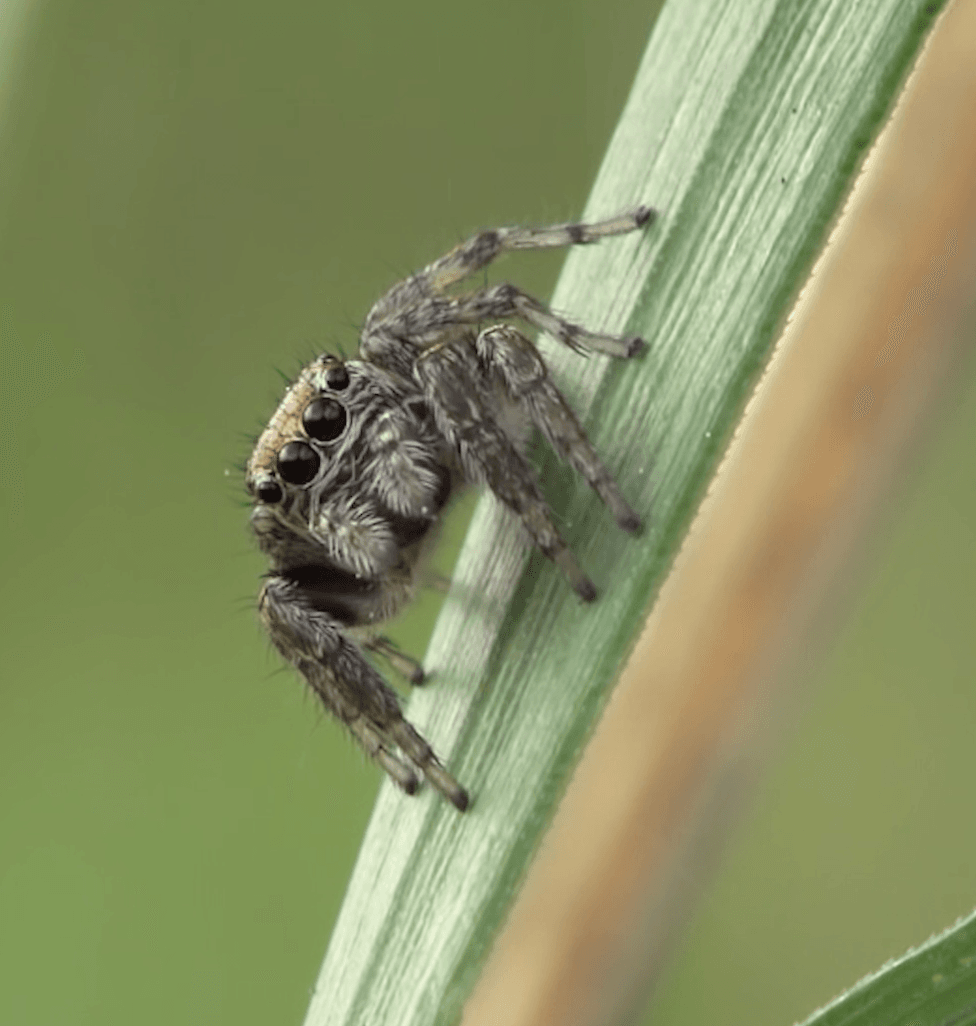
Jumping Spider
Reviewed by TJ Jackson, Certified ACE · Updated 2026-07-14
Family Salticidae | Category: Spiders | ✓ Covered: All Seasons Pest Plan
If a spider has ever stopped, turned, and looked directly at you — it was almost certainly a jumping spider. They don’t build webs. They hunt. And unlike most spiders that flee when disturbed, jumping spiders tend to stand their ground and investigate. Alarming at first. Harmless in practice.
Quick Answer: Jumping spiders are small, compact, extremely agile hunters with four large forward-facing eyes that give them the best vision of any spider in the PNW. They don’t build prey-catching webs — they stalk and pounce. They are completely harmless, genuinely beneficial (they eat pest insects), and one of the few spiders that will actively turn to look at you rather than flee. Seeing one or two inside is normal and not a sign of an infestation. They follow insects indoors, particularly to sunny windows.
Bottom line: Jumping spiders are beneficial and pose no risk. Treatment is rarely necessary. If you’re seeing large numbers regularly, address the underlying insect population that’s drawing them in.
What You Need To Know About Jumping Spiders
Our ACE Certified Technician TJ breaks down jumping spiders — how to ID them, why they look back at you, and when they’re actually a concern.
Frequently Asked Questions
Why do jumping spiders look at you?
Their four large forward-facing eyes give them exceptional depth perception and 360° awareness. When something large moves nearby, they rotate to assess the threat. Unlike most spiders that flee, jumping spiders are curious — this is an evaluation, not aggression.
Are jumping spiders dangerous?
No — one of the most harmless spiders in the PNW. Bites are extremely rare and produce only mild local irritation. The only PNW spider with real medical risk is the black widow.
Why are jumping spiders inside my house?
They follow insects. Where there are flies, gnats, and other small bugs, jumping spiders follow. Sunny windows are particularly attractive because that’s where insects congregate. One or two indoors is completely normal.
Should I remove them?
That’s your call. Jumping spiders eat pest insects and pose zero risk — many people leave them alone. Catch-and-release outdoors is simple if you prefer not to share the space. For large numbers, the underlying insect problem is what needs attention.
Does the All Seasons Pest Plan cover jumping spiders?
Yes — all spider species are covered, with re-service visits as needed if activity returns between appointments.
Behavior & Biology
Jumping spiders are in the family Salticidae — the largest family of spiders in the world, with over 6,000 species. The Pacific Northwest is home to several common species, though most homeowners simply know them as “the fuzzy spider that looked at me.”
Unlike web-building spiders, jumping spiders are active hunters. They rely on their extraordinary vision to stalk prey — moving slowly, adjusting position, then pouncing with accuracy. Their front two principal eyes are large enough to give them nearly human-like depth perception at close range. The remaining three pairs of eyes provide wide peripheral awareness, which is why they seem to always know you’re there.
They do produce silk — but not to catch prey. Their silk is used for draglines (a safety line when jumping), small retreat sacs for sleeping and molting, and egg cases. You won’t find sticky webs from a jumping spider.
Active during the day, jumping spiders are most visible in sunny spots — window sills, exterior walls, and garden plants. Fall is when you’re most likely to see them inside as they seek shelter from dropping temperatures.
What To Do If You Have Jumping Spiders
Jumping spiders are genuinely beneficial — they’re predators of flies, gnats, mosquitoes, and other pest insects. In most cases, the right answer is to leave them alone or relocate them outside. But if you’d prefer to keep them out:
Seal entry points
Door sweeps, window screens, and gaps around pipes are the main entry routes. Sealing these reduces all spider species, not just jumping spiders.
Address the insect population
Jumping spiders follow their food source. Reducing interior insects — particularly around windows and lights — reduces the reason they come inside.
Catch and release
A cup and a piece of paper is all you need. Jumping spiders are calm and slow to bite — catch-and-release is easy and safe.
Exterior treatment
If you’re seeing large numbers regularly, a recurring exterior treatment plan addresses the full spider population — including species that are less welcome than jumping spiders.
Plans That Cover All PNW Spider Species
All Seasons Pest Plan
$39/month
Setup fee $260 for initial treatment
Year-round protection from the pests Pacific Northwest homeowners deal with most — spiders, ants, wasps, box elder bugs, and more. Includes exterior web removal with every visit.
- Recurring exterior treatments
- Exterior web removal
- Re-services included as needed between visits
Pest & Rodent Bundle
$47/month
Setup fee $280 for initial treatment
The most complete protection for your home. Full pest coverage plus active rodent monitoring — one plan, one team, one less thing to worry about.
- Everything in Pest & Rodent plans
- Best value for whole-home protection
- Re-service guarantee
Get help with jumping spiders in your area
Interstate Pest Management helps with jumping spiders across Oregon and Washington. Choose your area to see local plans, pricing and the number for your nearest team.