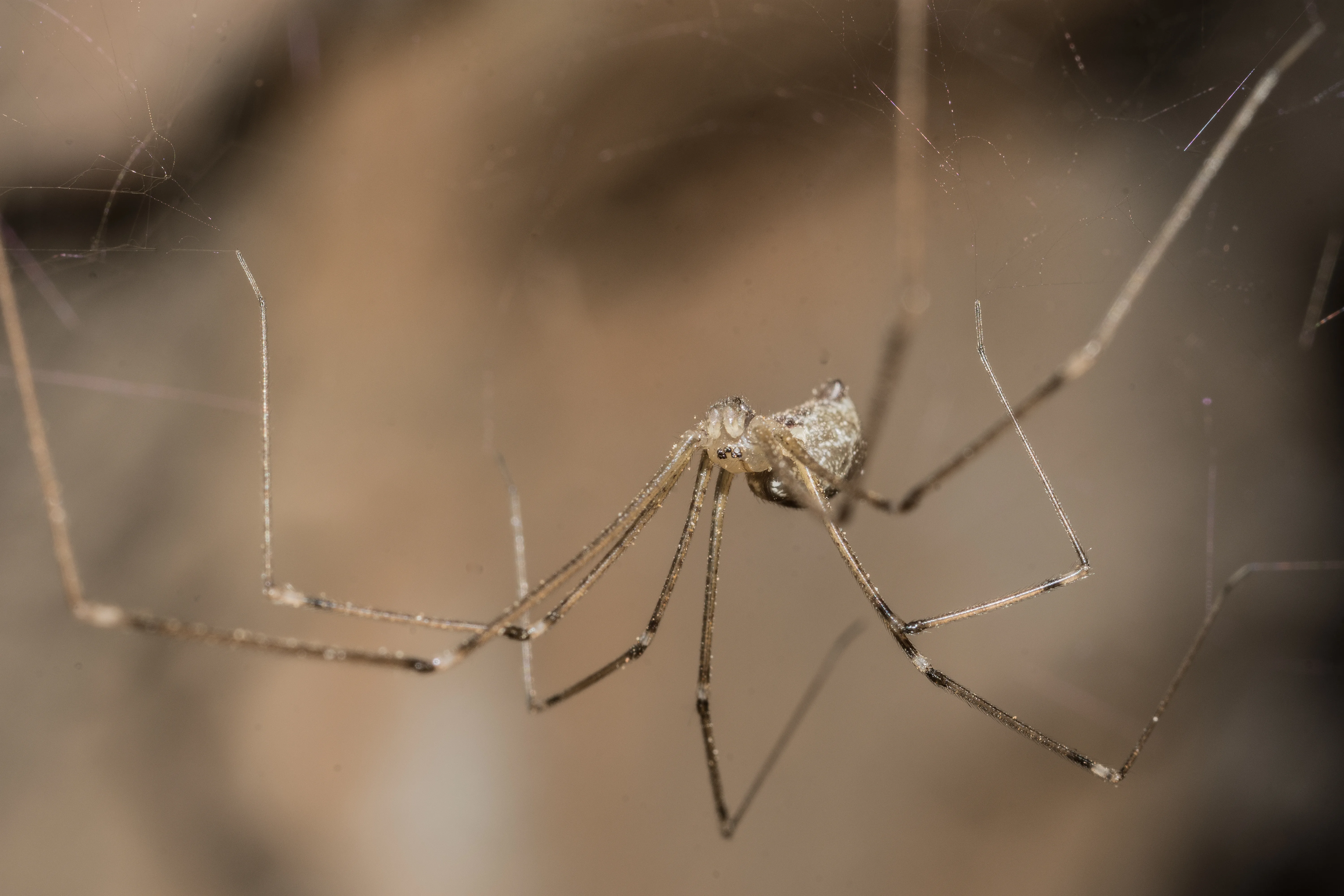
Cellar Spider
Reviewed by TJ, ACE Certified Technician · Updated 2026-06-15
Family Pholcidae | Category: Spiders | Long legs, harmless, actually helpful
The Cellar Spider is the fragile little spider hanging upside down in the corner of your basement, with a tiny body and legs that seem impossibly long. It is the spider most people call a “daddy long-legs,” and it is the subject of a persistent myth that its venom is deadly (but its fangs cannot pierce skin). That is not true. Cellar Spiders are harmless, and they are also one of the more useful spiders you can have in the house. They eat other spiders, including Hobos.
| Size | Body 0.25 in; leg span up to 2 in |
|---|---|
| Color | Pale tan to grey, translucent |
| Top ID Marker | Tiny body, extremely long thin legs, hangs upside down |
| Habitat | Basements, crawl spaces, garages, ceiling corners |
| Web | Loose messy tangle, no clear structure |
| Bite Risk | Not medically significant (myth is false) |
| Plan Coverage | ✓ Covered under All Seasons Pest Plan |
Need help with this pest?
Get A QuoteQuick Answer: Cellar Spiders (family Pholcidae), commonly called “daddy long-legs spiders,” are the pale delicate spiders with tiny bodies and extremely long legs that hang upside-down in the corners of basements and crawl spaces. They are not medically significant. The popular myth that they are “the most venomous spider but their fangs cannot pierce skin” is false, laboratory testing has confirmed their venom has very mild effects on mammals. Cellar Spiders are actually beneficial: they prey on other spiders including Hobo Spiders, and they consume small household insects.
Key facts at a glance: Body 1/4 in · Long thin legs · Pale · Messy tangle web · Hangs upside down · Eats other spiders · Not medically significant · Plan coverage: Yes.
The most useful spider: Cellar Spiders prey on other spiders (including medically insignificant nuisance species AND the Hobo Spider). They also invade the webs of other spiders, mimic prey vibrations, and attack the resident spider. In a basement or garage, they function as an anti-spider service.
Myth correction
You may have heard that Cellar Spiders are “the most venomous spider in the world, but their fangs cannot pierce human skin.” This is false. Their venom has been laboratory tested and is very mild in its effects on mammals, and their fangs can pierce human skin (though bites are still extremely rare and cause only brief mild burning if they happen). The Mythbusters TV show also tested and debunked this claim in 2004.
Frequently Asked Questions
Are Cellar Spiders dangerous?
No. Their venom is very mild for mammals and defensive bites are extremely rare. The popular myth that they are the most venomous spider is false.
Is the daddy long-legs venom myth true?
No. The claim has been laboratory tested and debunked. Both the venom potency claim and the fang-length claim are false. Mythbusters tested and disproved this in 2004.
Are Cellar Spiders and harvestmen the same?
Both are called daddy long-legs, but they are different. Cellar Spiders (Pholcidae) are true spiders with 2 body segments and webs. Harvestmen (Opiliones) have 1 fused body segment and no venom or silk.
Why do they vibrate when I disturb them?
Cellar Spiders whirl their bodies rapidly in their webs when threatened, creating a blur that confuses predators.
Do they really eat other spiders?
Yes. Cellar Spiders invade other spiders\’ webs, imitate trapped-prey vibrations to lure the resident spider closer, then attack. They can defeat Hobo Spiders this way.
Does the All Seasons Plan cover them?
Yes. Web sweeping in basements, crawl spaces, and garages, plus general interior spider control, is covered.
Signs You Have Cellar Spiders
Cellar Spiders leave abundant, messy evidence. Their webs never get cleaned and just keep accumulating:
1. Messy loose webs in ceiling corners
Cellar Spider webs are unstructured tangles with no clear shape. Found in basement ceiling corners, garage rafters, and undisturbed nooks.
2. Spider hanging upside-down
Cellar Spiders spend nearly their entire adult lives hanging upside-down in their webs. If it looks like it is dangling, it is right-side up from its perspective.
3. Whirl behavior when disturbed
Touch the web (gently) and the spider will vibrate rapidly, blurring itself into a fuzzy oval. This behavior is diagnostic.
4. Egg sacs carried in fangs
Unlike most spiders, Cellar Spider females carry their egg sacs in their fangs (chelicerae) rather than attaching them to the web or spinnerets. The clear ball of eggs is visible.
5. Web accumulation
Cellar Spiders do not eat old webs or clean up. Old webs stack up over months and years, catching dust and forming the classic gauzy cobwebs that hang from basement ceilings.
6. Fewer other spiders in the room
Rooms with strong Cellar Spider populations often have surprisingly few Hobos or other spiders. They actively hunt down and eat their competitors.
Behavior, Biology & Lifecycle
The most common house spider worldwide
Cellar Spiders are one of the most successful house-associated spider species on the planet. Wherever humans live, Cellar Spiders live too.
Prefer stable indoor conditions
Cellar Spiders cannot survive freezing temperatures and rarely live outdoors in the PNW. They are found almost exclusively inside heated structures, with basements and crawl spaces as their preferred habitat.
Aggressive mimicry hunters
Cellar Spiders invade the webs of other spiders and pluck the strands to mimic prey vibrations. When the resident spider approaches to feed, the Cellar Spider attacks. This makes them dangerous to other spiders far larger than themselves.
Long lifespan
In stable indoor conditions Cellar Spiders can live up to 2 years, unusually long for a small spider. This is why webs in basements often persist and grow for years.
Fang-carried egg sacs
Females hold their egg sacs in their fangs. When the eggs hatch, spiderlings cluster in the mother\’s web for a few days before dispersing.
“Skull spider” in medieval buildings
In some European traditions Cellar Spiders were nicknamed skull spiders because their body was said to resemble a tiny skull. The abdomen shape can indeed appear skull-like in the right light.
DIY Homeowner Steps
Sweep webs regularly
Funnel webs get rebuilt fast if the spider is still there. Sweeping every week or two along basement corners and crawl space edges is very effective for keeping populations down.
Reduce ground-level clutter
Bag stored items in sealed plastic, elevate boxes off the floor in basements and crawl spaces. Cellar Spiders hide in ground clutter and cardboard.
Seal entry gaps at foundation level
Weather stripping on doors, screens on crawl space vents, caulk around utility penetrations. Cellar Spiders enter through the same low gaps mice and ants do.
Shake out shoes and gloves stored in garage
If you have not touched something in weeks, a Cellar Spider may have moved in. The rare bite happens when a spider is trapped against skin, usually when someone puts on a stored item.
Vacuum sightings, then dispose
A shop vac with a long hose is the safest removal method. Empty the vac outside immediately after. Do not attempt to handle a Cellar Spider by hand.
Cellar Spider vs. Other Common Indoor Spiders
The tiny body and long thin legs distinguish Cellar Spiders from every other indoor spider. Here is the comparison:
| Feature | Cellar Spider | Hobo Spider | Giant House Spider | Jumping Spider |
|---|---|---|---|---|
| Body size | Tiny (1/4 in) | 1/2 in | 3/4 in + | 1/4 to 3/4 in |
| Legs | Extremely long, thin | Long, sturdy | Long, sturdy | Short, compact |
| Web | Loose messy tangle | Flat funnel | Large flat funnel | None |
| Position | Upside down in web | In funnel at ground level | In funnel, any height | On walls, active hunting |
| Where you find it | Ceiling corners of basements | Ground level basements | Basements to ceiling corners | Windows, sunny walls |
| Eats other spiders? | Yes (specialty) | Occasional | Yes (eats Hobos) | Yes (hunts them) |
| Bite risk | Not medically significant | Not medically significant | Not medically significant | Not medically significant |
Plans That Cover Cellar Spider Control
All Seasons Pest Plan
$39/month
Setup fee $260 for initial treatment
Year-round protection from the pests Pacific Northwest homeowners deal with most, including spider control, exterior web removal, and harborage treatment.
- Recurring exterior treatments
- Exterior web removal with every visit
- Re-services included as needed between visits
Pest & Rodent Bundle
$47/month
Setup fee $280 for initial treatment
The most complete protection for your home. Full pest coverage plus active rodent monitoring, one plan, one team, one less thing to worry about.
- Everything in Pest & Rodent plans
- Best value for whole-home protection
- Re-service guarantee
What Our Customers Are Saying
Real Results From Real Customers
Get help with cellar spiders in your area
Interstate Pest Management helps with cellar spiders across Oregon and Washington. Choose your area to see local plans, pricing and the number for your nearest team.