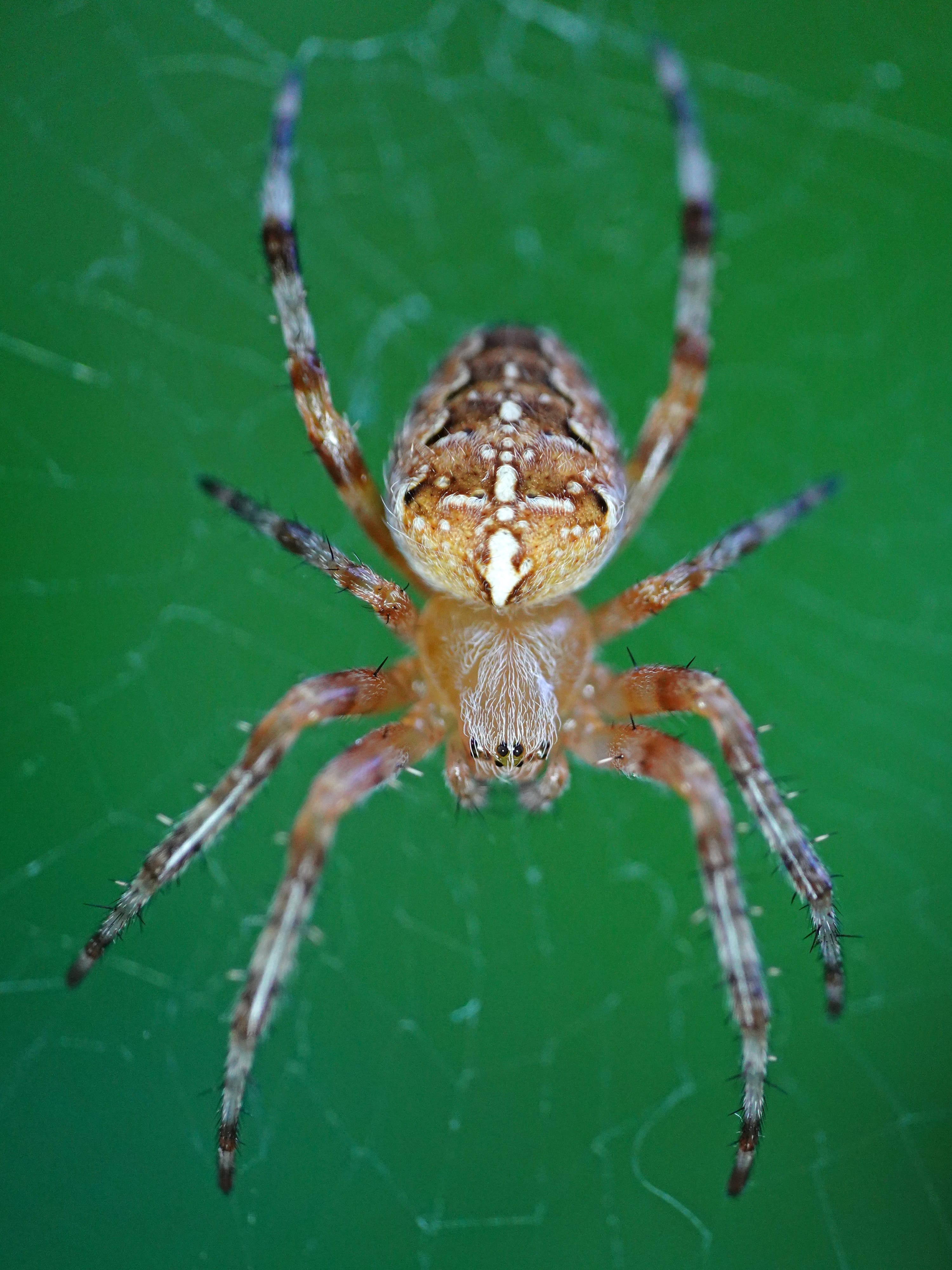
Cross Orb Weaver
Reviewed by TJ, ACE Certified Technician · Updated 2026-06-15
Araneus diadematus | Category: Spiders | The classic garden wheel-web spider
The Cross Orb Weaver is the plump brown spider that builds those beautiful wheel-shaped webs across your garden path each fall. The white cross pattern on its abdomen gives it the name, and its web-building skill has made it one of the most-studied spiders in the world. Cross Orb Weavers are outdoor spiders, not house residents. They are also completely harmless to humans and are effective predators of flying garden pests. This page will help you identify them and understand why we usually recommend leaving them where they are.
| Size | Females 0.25 to 0.75 in body; males smaller |
|---|---|
| Color | Brown to reddish-brown with white cross on back |
| Top ID Marker | White cross pattern on abdomen, wheel web |
| Habitat | Gardens, porches, eaves, between shrubs (outdoors) |
| Web | Classic wheel-shaped orb, rebuilt daily |
| Bite Risk | Not medically significant |
| Plan Coverage | ✓ Covered under All Seasons Pest Plan |
Need help with this pest?
Get A QuoteQuick Answer: The Cross Orb Weaver (Araneus diadematus) is a common outdoor garden spider in the Pacific Northwest, named for the white cross-shaped pattern of dots on its abdomen. It builds classic wheel-shaped orb webs between shrubs, on porches, and around eaves. Cross Orb Weavers are not medically significant, and their webs are highly effective at capturing flying pests like mosquitoes, flies, and moths. They rarely enter homes, when they do it is accidental. They are also called European Garden Spiders since they were originally introduced from Europe.
Key facts at a glance: Body under 3/4 in · Brown with white cross · Wheel-shaped orb web · Outdoors · Not medically significant · Beneficial for gardens · Plan coverage: Yes.
Garden ally: A single Cross Orb Weaver can consume hundreds of mosquitoes, flies, and moths over a summer. If a web is not in a walking path, leaving it alone is usually the right call. Where webs are truly in the way, removing the web (with a broom) will typically cause the spider to rebuild in a less inconvenient spot.
Frequently Asked Questions
Are Cross Orb Weavers dangerous?
No. They are not medically significant. They almost never bite humans, they retreat when disturbed.
Why is there a huge web across my walkway?
Late summer and fall are peak orb-weaver season. Cross Orb Weavers rebuild their web every day. If you walk through one, the spider will likely build a new one in the same spot overnight.
Does removing the web hurt the spider?
No. Cross Orb Weavers naturally rebuild their web daily. Sweeping down a web sends the spider looking for a new location.
How long do Cross Orb Weavers live?
About one year. Females hatch in spring, mature over summer, mate and lay eggs in fall, then die at first frost.
Do they come inside?
Rarely. Cross Orb Weavers are outdoor spiders and cannot survive long indoors.
Does the All Seasons Plan cover them?
Yes. Exterior web sweeping and treatment around eaves, porches, and entryways is covered.
Signs You Have Cross Orb Weavers
Cross Orb Weavers make themselves obvious through their webs. These are the most identifiable spider webs in North America:
1. Wheel-shaped web outdoors
A perfect wheel-shaped web strung between plants, on a porch, or spanning a walkway is a Cross Orb Weaver web. These are the classic Halloween-decoration spider webs.
2. Plump spider in web center
During the day the spider often sits head-down at the center of its web, waiting for prey. The plump round abdomen with the white cross pattern confirms ID.
3. Rebuilt web overnight
Cross Orb Weavers eat their old web at dusk (recycling the silk) and rebuild fresh overnight. A destroyed web that reappears the next morning is diagnostic.
4. Under-eave silk retreats
During cold or windy weather the spider retreats to a silk cell tucked under eaves, siding, or a nearby leaf. Look for a small silk pocket at the end of a signal thread leading to the web.
5. Fall population explosion
Cross Orb Weavers are small and hidden most of the year, then become dramatically visible in late summer and fall when females reach full size and build large webs.
6. Round silk egg sacs on siding
In fall, females lay round tan silk egg sacs on siding, under eaves, and in sheltered corners. These overwinter, spiderlings emerge in spring.
Behavior, Biology & Lifecycle
European origin
Introduced to North America centuries ago, Cross Orb Weavers are now widespread across the continent. In the PNW they are one of the most common outdoor spiders.
Engineering marvels
An orb web contains up to 60 feet of silk and takes about an hour to build. The spider uses different silk types for different parts, sticky spiral for capture, non-sticky radials for structure, and reinforced anchor lines.
Daily silk recycling
Each evening the spider eats its old web, recovering the amino acids in the silk, and produces a new web overnight. This cycle continues throughout the spider’s adult life.
Signal thread system
A signal thread leads from the web center to a hidden retreat. The spider stays in the retreat and feels vibrations through the thread, only running out when prey hits the web.
Prey specialization
Orb webs are optimized for flying prey, mosquitoes, moths, flies, and beetles. In a garden setting, a single mature female can consume hundreds of pest insects across her lifetime.
One-year lifespan
Cross Orb Weavers live one year. Eggs overwinter in silk sacs, hatch in spring, spiders grow through summer, mate and lay eggs in fall, then adults die at first frost.
Local context: Oregon and Washington
The big web across your porch has a three-week season
Across five years of spider service records in Portland, Vancouver, Salem, Olympia and Kelso, our spider calls peak in September at 17.1% of the year, with 43% in August through October. Our records tag spiders as a group rather than by species, so the orange line is every spider we treat.
Orb weavers are the most visible spider in that window and the most photographed spider in the region. Of 11,374 cross orbweaver sightings logged in Oregon and Washington between 2021 and 2025, 30.9% came in September and another 24% in October. Search interest agrees: 76% of the year’s orb weaver searches land in August through October.
What the spike is not is an infestation. Orb weavers spent the summer small and unnoticed in the shrubs. By September the females are full sized and building the big face-height webs across walkways, doorways and porch lights, which is when everybody suddenly has them. They come apart with a broom and they die back with the first hard frost.
Orb weaver sightings and our spider calls peak in the same month
Each series is its share of the annual total, so the two are directly comparable. The orange line is all spider calls; our records do not break out species.
Blue line: spider sightings the public logged in Oregon and Washington, over the last five years. See the records on iNaturalist.
Attention vs. pressure
Sightings measure attention, and orb weavers get plenty of it: they are large, they build in your doorway and they sit still for photos. Our service records measure pressure, meaning homeowners who wanted help. Both peak in September, but orb weavers are the species where the honest answer is most often a broom and a porch light moved, not a treatment.
Worth knowing before you book
An orb weaver web across the walkway is a nuisance, not a structural problem, and the spider does not want to be indoors. Sweeping webs down each evening for a week usually moves her along, and turning off or relocating the porch light that draws her insects works better than anything sprayed.
Where a service earns its keep is a house that gets webs across every door and window every September, or an entry that guests use. We treat the eaves, frames and light fixtures where the anchor lines attach, and that reduces rebuilding. The spiders themselves are harmless and their bites are not medically significant.
When each spider’s season actually lands
One row per spider, twelve months of Google search interest in Oregon and Washington, over the last five years, with August, September and October banded. Our own spider calls are the bottom row.
Each row is one spider’s year, darkest in its busiest month. The right column is how much of that spider’s year lands in the three banded months. See these five terms in Google Trends.

“Orb weavers are the September spider. They are the big ones with the wheel web across your front door, and they are completely harmless to you and to your house. Most of the time I tell people to knock the web down a few nights in a row and move the porch light. If you are getting them across every door and window every fall, we treat the eaves and the frames where the web anchors, which is what keeps them from rebuilding in the same spot.”TJ Jackson · ACE, Director of Operations, Interstate Pest Management
Re-services included as needed if they come back between scheduled visits. Orb weavers are covered under the All Seasons Pest Plan from $39/month: interior and exterior treatments. QualityPro certified.
Book before the fall peak
- Portland503-782-1899
- Vancouver360-996-1442
- Salem503-461-0259
- Olympia360-526-8004
- Kelso / Longview360-515-3882
Sources: Interstate Pest Management service records, over the last five years, new customers only, all spider species combined. Sightings: public iNaturalist records for Oregon and Washington, over the last five years, counted by the month each spider was seen. Search interest: Google Trends, Oregon and Washington, over the last five years. The two states are combined in proportion to their population. Species notes: Oregon Department of Agriculture, Oregon Spiders: Facts and Fiction. Updated September 2026.
DIY Homeowner Steps
Knock the web down in the evening
Orb weavers take their web down and rebuild it around dusk. Sweeping it away with a broom at night, several nights in a row, usually convinces her to move to a quieter spot. You will not hurt her, and you do not need to touch her.
Change the porch light
The spider builds where the insects are, and the insects are at your light. Swap to a warm yellow or amber LED, put the fixture on a motion sensor, or turn it off after bedtime. Fewer moths at the door means fewer webs across it.
Trim back the anchor points
Orb webs hang from shrubs, railings and eaves on either side of a path. Cutting plants back 12 to 18 inches from doorways and walkways leaves her nothing to string a web between.
Leave the garden webs alone
A web between two shrubs in the back yard is doing pest control for free. If it is not in a walkway or across a door, the best move is usually to leave it.
Brush off egg sacs in late fall
After the first frost, look for round tan silk sacs under eaves, window trim and siding. Brushing them into a bag or vacuuming them up reduces the number of spiderlings near your doors next spring.
Cross Orb Weaver vs. Other Outdoor PNW Spiders
Orb-web spiders are distinctive because of their webs. Here is how the Cross Orb Weaver compares to the others you may see outside:
| Feature | Cross Orb Weaver | Yellow Garden Spider | Hobo Spider | Wolf Spider |
|---|---|---|---|---|
| Web type | Wheel orb | Wheel orb with zigzag | Flat funnel | None |
| Color | Brown with white cross | Yellow and black | Brown, herringbone | Grey-brown, hairy |
| Where you find it | Gardens, porches, eaves | Tall grass, meadows | Basements, ground level | Ground level |
| Body shape | Round, plump | Round, plump | Elongated | Compact, hairy |
| Time of year most visible | Late summer to fall | Late summer to fall | Fall | Fall |
| Bite risk | Not medically significant | Not medically significant | Not medically significant | Not medically significant |
Plans That Cover Cross Orb Weaver Control
All Seasons Pest Plan
$39/month
Setup fee $260 for initial treatment
Year-round protection from the pests Pacific Northwest homeowners deal with most, including spider control, exterior web removal, and harborage treatment.
- Recurring exterior treatments
- Exterior web removal with every visit
- Re-services included as needed between visits
Pest & Rodent Bundle
$47/month
Setup fee $280 for initial treatment
The most complete protection for your home. Full pest coverage plus active rodent monitoring, one plan, one team, one less thing to worry about.
- Everything in Pest & Rodent plans
- Best value for whole-home protection
- Re-service guarantee
What Our Customers Are Saying
Real Results From Real Customers
Get help with orb weavers in your area
Interstate Pest Management helps with orb weavers across Oregon and Washington. Choose your area to see local plans, pricing and the number for your nearest team.