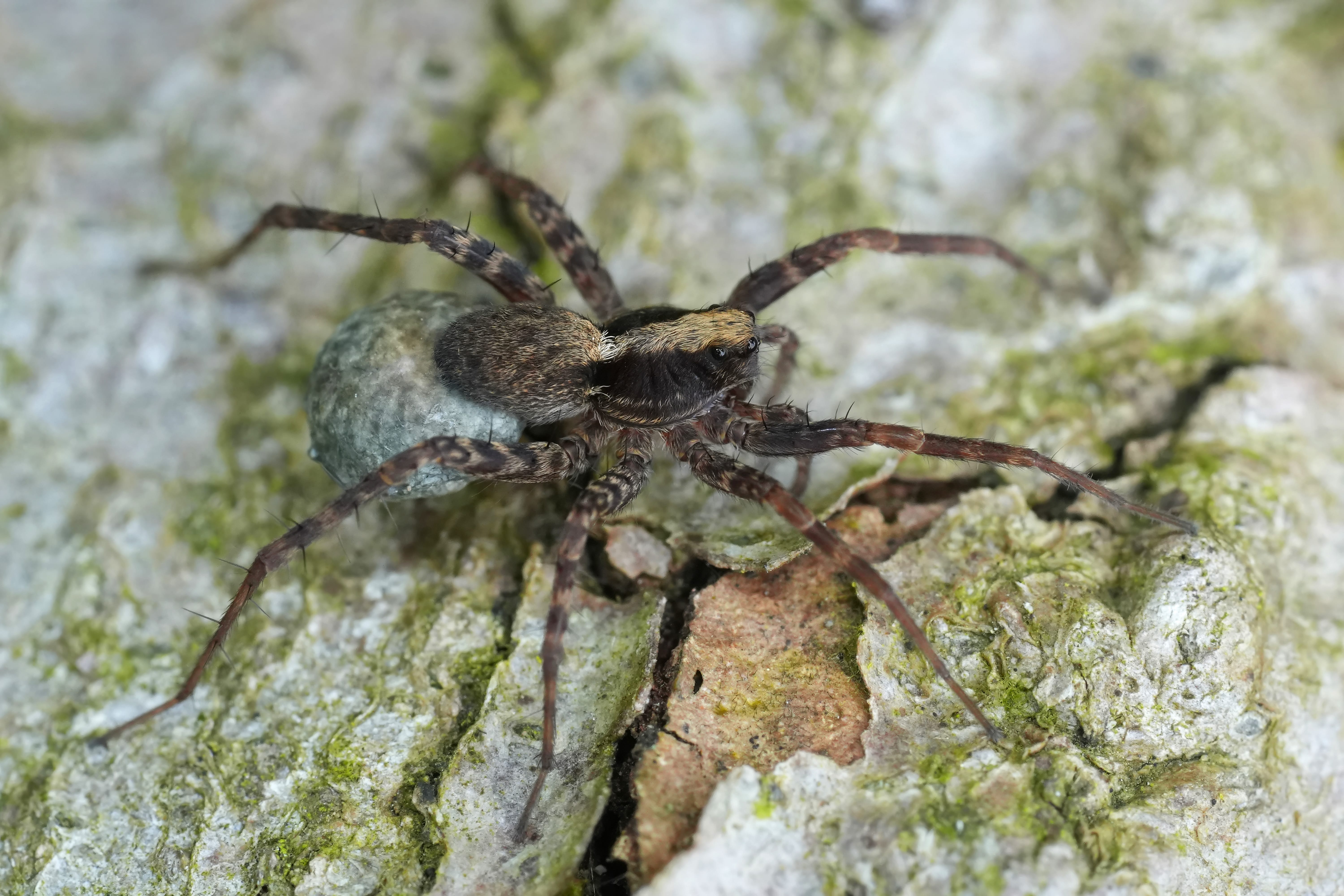
Wolf Spider
Reviewed by TJ, ACE Certified Technician · Updated 2026-06-15
Family Lycosidae | Category: Spiders | The hunter that came in from the cold
Wolf Spiders are the large hairy spiders that occasionally wander into PNW homes, especially in fall when temperatures drop. Unlike most house spiders, Wolf Spiders do not build webs. They are active hunters with exceptional eyesight, chasing down prey on foot the way their namesake wolves chase deer. That hunting lifestyle is why the ones you see indoors are almost always found on the floor, not in corners. They look alarming, but they are not medically significant.
| Size | Leg span 1 to 4 inches (species vary) |
|---|---|
| Color | Grey-brown, mottled, very hairy |
| Top ID Marker | Eight eyes in 3 rows, eye shine at night |
| Habitat | Ground level: floors, garages, basements, ground-floor windows |
| Web | None, active hunter |
| Bite Risk | Not medically significant |
| Plan Coverage | ✓ Covered under All Seasons Pest Plan |
Need help with this pest?
Get A QuoteWhat You Need To Know About Wolf Spiders
Our ACE Certified Technician TJ breaks down wolf spiders — how to ID them, why they come inside, and when they’re actually a concern.
Frequently Asked Questions
What does a wolf spider look like?
Large, stocky, and hairy — up to 4″ leg span. Brown with darker markings. No web. Fastest way to confirm: it’s sprinting across the floor with no web attached. Females carry their egg sac on their abdomen.
Are wolf spiders dangerous?
No. They can bite if directly handled and pressed against skin, but bites are rare and produce only mild localized symptoms. The only medically significant spider in the PNW is the black widow — not the wolf spider.
Why do wolf spiders come inside?
They follow their food source. Wolf spiders hunt insects, so if you have an insect problem they will follow. They also move inside in fall as temperatures drop. Ground-level entry points are their main route in.
How do I tell a wolf spider from a hobo spider?
Size and behavior. Wolf spiders are much larger and stockier, with no web. Hobo spiders are smaller and build flat funnel-shaped webs. If it’s big, fast, and running across open floor with no web — wolf spider.
Does the All Seasons Pest Plan cover wolf spiders?
Yes — fully covered, including re-service visits as needed if they return between appointments.
Quick Answer: Wolf Spiders (family Lycosidae) are large hairy grey-brown ground-hunting spiders common in PNW yards and occasionally found in homes. They do not build webs, instead chasing prey on foot with excellent eyesight. They typically enter homes in fall while hunting or seeking shelter. Wolf Spider bites are rare and cause at most brief local irritation, they are not medically significant. Females carry their egg sacs attached to their spinnerets and later carry the tiny babies on their backs, a unique behavior in the spider world.
Key facts at a glance: Leg span 1 to 4 in · Grey-brown hairy · No web · Ground hunter · Excellent eyesight · Females carry young · Not medically significant · Plan coverage: Yes.
Ecological role: Wolf Spiders are top-tier ground predators of insects, spiders, and other small arthropods. In gardens and yards they consume large numbers of pest insects. Removing them from outdoor spaces is discouraged, indoor interception at entry points is the sensible approach.
Frequently Asked Questions
Are Wolf Spiders dangerous?
No. Wolf Spiders are not medically significant. Their bite may cause brief local pain and redness similar to a bee sting, but no lasting effects. They only bite defensively when handled or trapped against skin.
Why is there a Wolf Spider in my house?
Wolf Spiders wander indoors while hunting or when seeking shelter from cold or wet weather. Fall is the peak season for indoor sightings in the PNW.
How do I identify a Wolf Spider?
Look for a large hairy grey-brown spider on the floor with no web nearby. The eye arrangement is diagnostic: two very large forward-facing eyes, two medium eyes above them, and four smaller eyes in a row below.
Are those babies on its back?
Yes. Female Wolf Spiders are among the very few spiders that carry their young. After hatching, dozens of spiderlings ride on the mother\’s back for a week or two before dispersing.
Do Wolf Spiders build webs?
No. Wolf Spiders are active hunters. A large spider found on your floor without a web nearby is very likely a Wolf Spider.
Does the All Seasons Plan cover them?
Yes. Perimeter treatment, exterior spider control, and interior treatment for occasional invaders are all covered.
Signs You Have Wolf Spiders
Wolf Spiders leave few traces since they do not build webs. The signs are the spiders themselves and the places they turn up:
1. Large hairy spider on the floor
A big grey-brown hairy spider crossing a floor with no web nearby is the classic Wolf Spider sighting.
2. Fall sightings indoors
Wolf Spiders wander into homes primarily in fall when temperatures drop. Repeated fall sightings suggest a nearby population and entry points near ground level.
3. Eye shine in yard flashlight
At night, a flashlight held near your eyes will make Wolf Spider eyes reflect back as small green sparks in the grass. If you see many, you have a strong outdoor population.
4. Females with egg sacs or babies
A Wolf Spider dragging a marble-sized silky ball is carrying her egg sac. A Wolf Spider with a fuzzy shifting mass on her back is carrying dozens of newly hatched young.
5. Burrows near foundations
Some Wolf Spider species dig burrows in soil, especially near foundations and under debris. A round hole about a half-inch across, sometimes silk-lined, may house one.
6. Around basement doors and garages
Wolf Spiders enter through ground-level gaps. Basement door thresholds, garage doors, and crawl-space vents are the usual entry points.
Behavior, Biology & Lifecycle
A large family
Family Lycosidae contains around 2,400 species worldwide. Multiple Wolf Spider species live in the PNW, ranging from small dime-sized species to large ones with a 4-inch leg span.
Exceptional eyesight
Wolf Spiders have some of the best vision in the spider world (second only to Jumping Spiders). Two very large forward-facing eyes give them excellent binocular vision for hunting.
Unique maternal care
Females attach the egg sac to their spinnerets and carry it everywhere. After hatching, the mother lets the spiderlings climb onto her back and carries them for a week or two, a level of parental care unusual in spiders.
Ambush and pursuit hunters
Some species wait in burrows and ambush passing prey. Others actively chase down insects on foot. They use their large eyes to spot prey from a distance and their speed to close the gap.
Nocturnal by default
Most Wolf Spiders hunt at night. During the day they hide under rocks, boards, mulch, and leaf litter. A Wolf Spider seen indoors during the day is usually a lost wanderer.
Cold weather triggers indoor movement
Wolf Spiders do not want to be indoors, they are outdoor hunters. But cold and wet fall weather drives them under objects and eventually into structures through ground-level gaps.
DIY Homeowner Steps
Sweep webs regularly
Funnel webs get rebuilt fast if the spider is still there. Sweeping every week or two along basement corners and crawl space edges is very effective for keeping populations down.
Reduce ground-level clutter
Bag stored items in sealed plastic, elevate boxes off the floor in basements and crawl spaces. Wolf Spiders hide in ground clutter and cardboard.
Seal entry gaps at foundation level
Weather stripping on doors, screens on crawl space vents, caulk around utility penetrations. Wolf Spiders enter through the same low gaps mice and ants do.
Shake out shoes and gloves stored in garage
If you have not touched something in weeks, a Wolf Spider may have moved in. The rare bite happens when a spider is trapped against skin, usually when someone puts on a stored item.
Vacuum sightings, then dispose
A shop vac with a long hose is the safest removal method. Empty the vac outside immediately after. Do not attempt to handle a Wolf Spider by hand.
Wolf Spider vs. Other Large PNW Spiders
Wolf Spiders are commonly confused with the funnel-web spiders (Hobo and Giant House). The absence of a web is the fastest tell:
| Feature | Wolf Spider | Giant House Spider | Hobo Spider | Western Black Widow |
|---|---|---|---|---|
| Web | None (hunts on foot) | Large flat funnel | Smaller flat funnel | Irregular tangle |
| Body texture | Very hairy | Smooth-ish | Smooth-ish | Smooth, shiny |
| Eye arrangement | 3 rows (2+2+4), diagnostic | 2 rows of 4 | 2 rows of 4 | 2 rows of 4 |
| Where you find it | On the floor | In corners, on walls | Near baseboards | Undisturbed low spots |
| Carries young? | Yes | No | No | No |
| Bite risk | Not medically significant | Not medically significant | Not medically significant | Medically significant |
Plans That Cover Wolf Spider Control
All Seasons Pest Plan
$39/month
Setup fee $260 for initial treatment
Year-round protection from the pests Pacific Northwest homeowners deal with most, including spider control, exterior web removal, and harborage treatment.
- Recurring exterior treatments
- Exterior web removal with every visit
- Re-services included as needed between visits
Pest & Rodent Bundle
$47/month
Setup fee $280 for initial treatment
The most complete protection for your home. Full pest coverage plus active rodent monitoring, one plan, one team, one less thing to worry about.
- Everything in Pest & Rodent plans
- Best value for whole-home protection
- Re-service guarantee
What Our Customers Are Saying
Real Results From Real Customers
Get help with wolf spiders in your area
Interstate Pest Management helps with wolf spiders across Oregon and Washington. Choose your area to see local plans, pricing and the number for your nearest team.