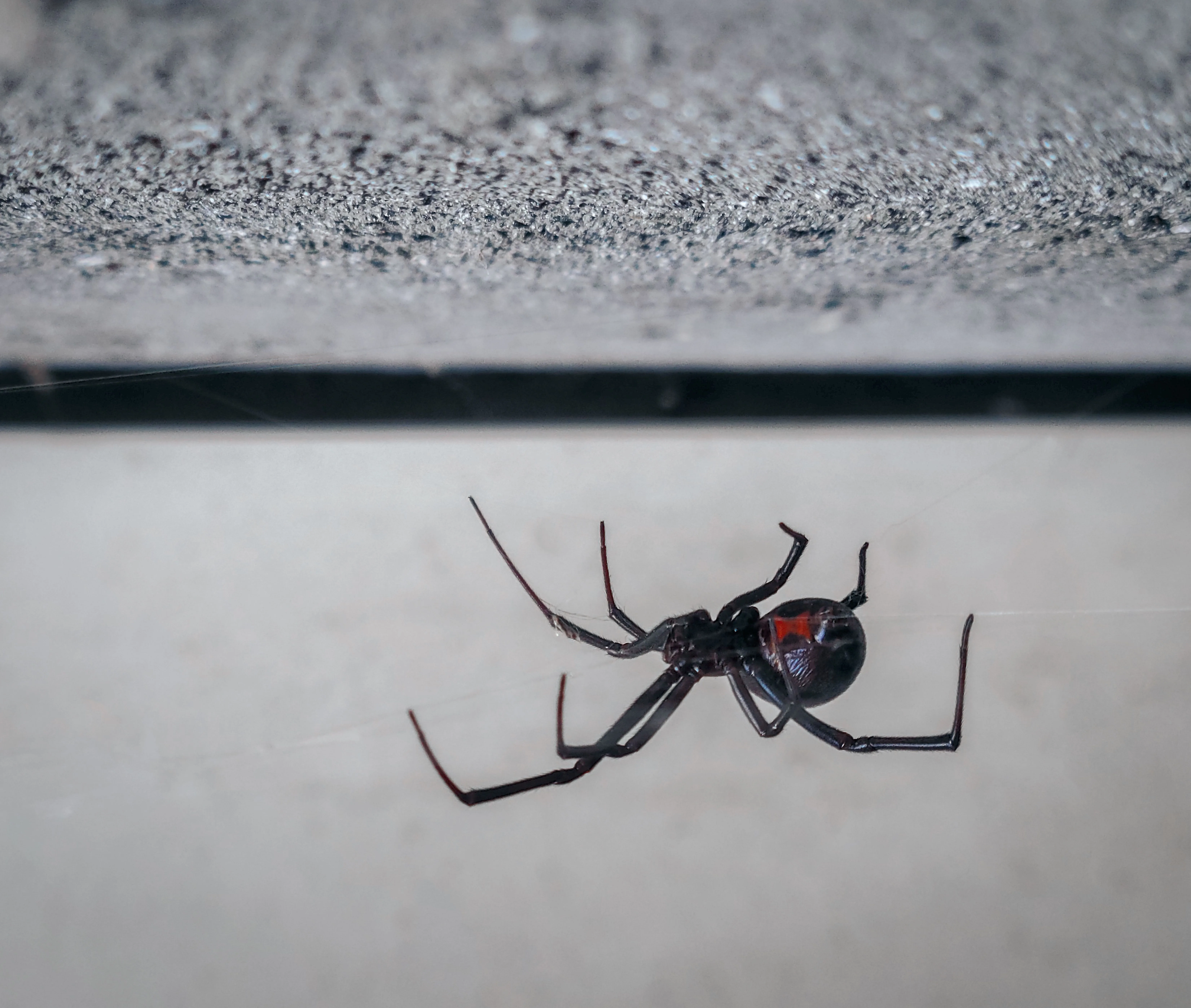
Western Black Widow
Reviewed by TJ, ACE Certified Technician · Updated 2026-06-15
Latrodectus hesperus | Category: Spiders | The only medically significant spider in OR & WA
If you have found a shiny black spider with a red hourglass under a woodpile, in a shed, or tucked into a garage corner, that is a Western Black Widow. It is the only PNW spider whose bite requires medical attention, and it lives quietly in dry, undisturbed spots across Oregon and Washington. Widows are not aggressive, they bite defensively when accidentally trapped or handled. Knowing where they hide and how to handle a suspected sighting is genuinely important safety knowledge for anyone with a garage, shed, crawl space, or firewood pile.
| Size (female) | Body 3/8 to 5/8 inch, leg span up to 1.5 inches |
|---|---|
| Color | Shiny jet black with a bright red hourglass on the underside |
| Top ID Marker | Red hourglass on shiny black abdomen (adult female) |
| Habitat | Dry, sheltered spots: woodpiles, sheds, garages, crawl spaces, meter boxes |
| Web | Irregular tangle, strong crackly silk, usually low to the ground |
| Bite Risk | Medically significant, requires care |
| Plan Coverage | ✓ Covered under All Seasons Pest Plan |
Need help with this pest?
Get A QuoteQuick Answer: The Western Black Widow (Latrodectus hesperus) is the only spider in Oregon and Washington whose bite is medically significant. Adult females are shiny black with a bright red hourglass on the underside of the abdomen, and are commonly found in dry, sheltered spots like woodpiles, sheds, meter boxes, and crawl spaces. Widows are not aggressive, they only bite defensively when trapped against skin. Bites cause severe muscle pain, cramping, and sweating within an hour and require prompt medical evaluation. Fatalities are extremely rare with modern care, but every suspected bite is a call to a doctor.
Key facts at a glance: Female body 3/8 to 5/8 inch · Shiny black with red hourglass · Prefers dry sheltered spots · Bites are defensive only · Bite venom is a neurotoxin · Requires medical attention · Plan coverage: Yes, All Seasons Pest Plan.
If you are bitten: Wash the area with soap and water and apply a cool compress. Do NOT apply ice directly to skin, do NOT cut the wound, do NOT attempt to suck out venom. Symptoms typically appear within 30 to 60 minutes: intense pain radiating from the bite, muscle cramps (often in the abdomen or back), sweating, high blood pressure, nausea. Call your doctor, urgent care, or the Oregon or Washington Poison Center at 1-800-222-1222 for guidance. Go to an emergency room if you experience severe pain, breathing difficulty, or symptoms in a child, an elderly adult, or someone with heart conditions.
Where they are found in the PNW: Western Black Widows are more common in the drier parts of the region, eastern Oregon, eastern Washington, and southern Oregon. They also occur in western Oregon and western Washington but are less frequent in wet coastal areas. Anywhere with a warm, dry microhabitat (garages, sheds, garbage bin storage areas, meter cabinets) can support a widow population regardless of the surrounding climate.
What You Need To Know About Western Black Widows
Our ACE Certified Technician TJ breaks down how to identify a Western Black Widow and what to do if you find one.
Frequently Asked Questions
How do I identify a Western Black Widow?
Adult females are shiny jet black with a bright red hourglass on the underside of the round abdomen. Body 3/8 to 5/8 inch, leg span up to 1.5 inches. Males and juveniles look different (smaller, brown with lighter markings) but rarely bite. If you see the red hourglass on a black spider, it is a widow.
Are they common in Oregon and Washington?
More common in the drier parts of the region (eastern OR and WA, southern OR) and less common in wet coastal zones. But warm dry microhabitats like garages, sheds, and meter cabinets can support widows anywhere in the state.
Are Western Black Widow bites deadly?
Fatalities are extremely rare with modern medical care. The venom is a neurotoxin that causes severe pain, muscle cramping, sweating, and elevated blood pressure. Children, elderly adults, and people with heart conditions are at higher risk. Every suspected bite warrants a call to your doctor or the Poison Center (1-800-222-1222) and an ER visit if symptoms are severe.
Are they aggressive?
No. Widows are shy and will retreat when disturbed. Bites happen when a spider is trapped against skin, usually when someone reaches into a woodpile, puts on a stored glove or shoe, or moves a stored item. Never handle a widow directly.
Where do they hide in and around my home?
Dry, sheltered, undisturbed spots. Woodpiles, sheds, detached garages, crawl spaces, under decks, in meter boxes, around outdoor storage bins, in stored shoes or gloves in a garage. Rarely in the main living areas of a home. If your garage is cluttered and rarely used, that is prime widow territory.
Does the All Seasons Pest Plan cover widow control?
Yes. Spider control including Western Black Widow removal, web sweeping, and exterior treatment is covered under the All Seasons Pest Plan. Recurring exterior visits knock down webs and reduce the harborage widows depend on.
What should I do if I find a widow?
Do not attempt to handle. If you can safely photograph from a distance and step back, do that. If the widow is in a busy area (near an entrance, playroom, etc.) call a professional. If it is in a remote spot and you are confident, a long-handled tool and a sealed container works. Do not squash on siding, the crushed spider will still contain venom.
Signs You Have Western Black Widows
Widows do not swarm or trail, they live individually in quiet corners. Here is what tips off our technicians when we check a property:
1. Irregular tangled webs near the ground
Widow webs are a chaotic tangle, not a neat orb. Strong crackly silk, often anchored to a wall, a wood stack, a rock, or the underside of a step. Almost always within a foot or two of the floor.
2. Round papery egg sacs
Off-white or tan, roughly the size of a large pea, hanging in the web. A female can produce 4 to 9 sacs per season with hundreds of eggs each. Finding sacs means an active adult female is nearby.
3. Prey remains in the web
Widows leave visible remains: cricket legs, beetle shells, even small vertebrate bones in older webs. If you see debris caught in a tangle web low to the ground, look carefully before reaching in.
4. Location match
Dry, sheltered, undisturbed. Firewood pile that has not been moved in months, corner of a shed, meter box, patio storage bin, unused garage. If the answer to “when was this last disturbed?” is “months ago,” treat it as widow-possible.
5. Molted skins and males
Male widows are much smaller, brown, and often mistaken for a different species. Finding a male suggests females are nearby. Also look for cast skins that indicate molting activity.
6. Direct sighting
If you saw the red hourglass, it was a widow. That is the definitive marker. Photograph from a safe distance and call for professional identification and removal.
Behavior, Biology & Lifecycle
Understanding the widow lifecycle explains where you find them and why exclusion works so well:
Solitary and shy
Widows do not form colonies. Each female defends her own web and prey. Males wander in search of females and typically die within weeks of maturity. Population density in a given spot is usually low.
Nocturnal
Widows hide in a retreat during the day (often a folded leaf, wood crevice, or corner of their web) and hunt at night. This is why they are so easy to disturb accidentally when reaching into stored items in daylight.
Lifespan and reproduction
Adult females live 1 to 3 years and produce 4 to 9 egg sacs per season. Each sac contains 200 to 900 eggs, though most spiderlings do not survive to adulthood. Females can produce fertile eggs from a single mating for years.
Diet: whatever the web catches
Ground-active insects, beetles, crickets, other spiders, and occasionally small vertebrates. A widow web near a light source or vent tends to attract more prey and support a bigger, longer-lived female.
Venom: a neurotoxin
Widow venom contains alpha-latrotoxin, which triggers massive neurotransmitter release at nerve endings. That is why bites cause muscle cramps, sweating, and elevated blood pressure. The bite itself is often a sharp pinprick sensation, sometimes not felt at all.
Only the female is a concern
Male Western Black Widows are small, brown, and their fangs cannot reliably pierce human skin. Juveniles are similarly non-threatening. Every medically significant widow bite comes from an adult female.
Local context: Oregon and Washington
Black widow worry runs all year. The spider mostly lives east of the Cascades.
Across five years of spider service records in Portland, Vancouver, Salem, Olympia and Kelso, our spider calls peak in September at 17.1% of the year and drop to about 2% in midwinter. Our records tag spiders as a group rather than by species, so the orange line is every spider we treat.
Black widow searches do not swing like that. The busiest month, September, carries 14.4% of the year’s interest and the quietest still holds 2%, which makes this the flattest search curve of the five spiders on our pages: 41.5% of searches fall in August through October, against 88% for giant house spiders. People look this spider up whenever they are worried, not when it is out.
Where it actually turns up is the more useful fact. Of 645 verifiable widow sightings in Oregon and Washington over the last five years, 443 were east of the Cascade crest, roughly two in three. The Oregon Department of Agriculture puts them as most common in southwestern and eastern Oregon, with occasional finds in the Willamette Valley on dry, rocky, south-facing ground.
Search interest stays flat while our spider calls swing with the season
Each series is its share of the annual total, so the two are directly comparable. The orange line is all spider calls; our records do not break out species.
Blue line: Google search interest in Oregon and Washington, over the last five years. See it in Google Trends.
Fear vs. footprint
Search volume measures worry, and widow worry is steady all year. Sightings and our own service work measure footprint, and that is concentrated: drier country east and south, and dry, sheltered spots west of the mountains. This is the one spider on our pages where the venom is genuinely medically significant, so the honest answer is not that it is harmless, it is that it is uncommon here and predictable about where it sits.
Where to look, west of the mountains
Widows want dry, undisturbed, sheltered spots close to the ground: firewood stacks, crawl space corners, meter boxes, the underside of patio furniture and the back of a garage shelf. The web is a tangle rather than a wheel, and it is strong enough that you notice the texture when you brush it.
Wear gloves when you move firewood or reach into a crawl space, and keep stacks off the foundation. If you find one and want it identified, photograph it rather than handling it. The Pacific Northwest Pest Management Handbooks note the venom is neurotoxic and can cause systemic symptoms, so a suspected bite is a medical question, not a pest control one.
When each spider’s season actually lands
One row per spider, twelve months of Google search interest in Oregon and Washington, over the last five years, with August, September and October banded. Our own spider calls are the bottom row.
Each row is one spider’s year, darkest in its busiest month. The right column is how much of that spider’s year lands in the three banded months. See these five terms in Google Trends.

“Black widows are the spider people are most afraid of and the one I find least often on this side of the Cascades. When we do turn one up it is almost always somewhere dry and undisturbed: a firewood pile, a crawl space corner, the back of a meter box. Wear gloves when you move wood, keep the stack off the house, and if you think you have found one, take a picture instead of moving it and call us to confirm.”TJ Jackson · ACE, Director of Operations, Interstate Pest Management
Re-services included as needed if they come back between scheduled visits. Black widows are covered under the All Seasons Pest Plan from $39/month: interior and exterior treatments. QualityPro certified.
Book an inspection
- Portland503-782-1899
- Vancouver360-996-1442
- Salem503-461-0259
- Olympia360-526-8004
- Kelso / Longview360-515-3882
Sources: Interstate Pest Management service records, over the last five years, new customers only, all spider species combined. Search interest: Google Trends, Oregon and Washington, over the last five years. The two states are combined in proportion to their population. Sightings: public iNaturalist records for Oregon and Washington, over the last five years, counted by the month each spider was seen. East and west of the Cascade crest split at longitude 121.4 degrees west. Species notes: Oregon Department of Agriculture, Oregon Spiders: Facts and Fiction, and the Pacific Northwest Pest Management Handbooks. Updated September 2026.
Homeowner Safety Steps
Widows are one of the few pests we tell homeowners not to handle. Prevention and exclusion are the right first steps.
Wear gloves when working outdoors
Anytime you move firewood, reach into a shed, or handle stored items in a garage or crawl space, wear thick gloves and shake out shoes and gloves that have been stored for a while.
Reduce clutter in garages and sheds
Widows love undisturbed storage. Bag stored items in sealed plastic, get things off the floor, sweep webs regularly. If the garage is used every day, widows rarely establish.
Move firewood away from the house
Firewood piles are prime widow habitat. Store at least 20 feet from the house, elevated off the ground, and check what you carry inside before bringing it near the door.
Seal potential entry points
Weather stripping on garage doors, screens on crawl space vents, caulk around utility penetrations. Widows enter the same gaps mice and ants do.
Do not handle a widow directly
If you find one, do not try to catch or crush it by hand. Photograph from a distance, call a professional, or if in a remote spot use a long-handled tool. Bites happen when a spider is trapped against skin.
Western Black Widow vs. Other PNW Spiders
Widows are unique among PNW spiders in both appearance and bite risk. Here is how they compare to the other spiders homeowners commonly find:
| Feature | Western Black Widow | Giant House Spider | Hobo Spider | Wolf Spider |
|---|---|---|---|---|
| Size | Body 3/8 to 5/8 in | Leg span up to 4 in | Leg span 1 to 1.75 in | Leg span up to 4 in |
| Color | Shiny black, red hourglass | Mottled brown | Brown with herringbone abdomen | Grey-brown, hairy |
| Web | Irregular tangle near ground | Flat funnel | Flat funnel | No web, hunts on ground |
| Typical location | Woodpiles, sheds, meter boxes | Basements, corners, crawl spaces | Ground level, basements | Ground level, sprinting across floor |
| Bite risk | Medically significant | Not considered medically significant | Not medically significant (CDC removed from list) | Not medically significant |
| Aggression | Very low, defensive only | Fast but non-aggressive | Non-aggressive | Non-aggressive despite fast movement |
| Plan coverage | ✓ All Seasons | ✓ All Seasons | ✓ All Seasons | ✓ All Seasons |
Plans That Cover Western Black Widow Control
All Seasons Pest Plan
$39/month
Setup fee $260 for initial treatment
Year-round protection from the pests Pacific Northwest homeowners deal with most, including spider control, exterior web removal, and harborage treatment.
- Recurring exterior treatments
- Exterior web removal with every visit
- Re-services included as needed between visits
Pest & Rodent Bundle
$47/month
Setup fee $280 for initial treatment
The most complete protection for your home. Full pest coverage plus active rodent monitoring, one plan, one team, one less thing to worry about.
- Everything in Pest & Rodent plans
- Best value for whole-home protection
- Re-service guarantee
What Our Customers Are Saying
Real Results From Real Customers
Get help with black widows in your area
Interstate Pest Management helps with black widows across Oregon and Washington. Choose your area to see local plans, pricing and the number for your nearest team.