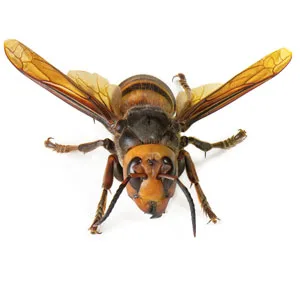
Murder Hornets
Now officially called Northern Giant Hornets (Vespa mandarinia)
Reviewed by TJ, ACE Certified Technician · Updated 2026-05-21
Vespa mandarinia | Category: Stinging Insects | Status: Eradicated from WA (Dec 2024)
If you remember the 2020 panic about “murder hornets” arriving in Washington state, here’s the update: in December 2024, the Washington State Department of Agriculture officially declared the species eradicated after three consecutive years without a confirmed detection. The story has a happy ending. That said, people in Oregon and Washington still occasionally spot big hornets and wonder if they’re looking at a survivor, the answer is almost always no, but the question is fair. Here’s the current status, how to know what you’re really seeing, and how to report it if you think it’s the real thing.
| Size | 1.5″ to 2″ long (world’s largest hornet) |
|---|---|
| Color | Large solid orange head, dark brown/black and orange-striped body |
| Top ID Marker | Massively oversized orange head with prominent eyes |
| Native Range | East & Southeast Asia (China, Japan, Korea, Russian Far East) |
| US Status | No known established population, WA population eradicated Dec 2024 |
| Detection History (WA) | First confirmed Dec 2019, last confirmed 2021, eradicated Dec 2024 |
| Suspected Sighting? | Report to WSDA: agr.wa.gov/hornets |
Not sure what you saw?
Get A QuoteQuick Answer: “Murder hornets”, officially renamed Northern Giant Hornets (Vespa mandarinia) by the Entomological Society of America in 2022, were declared eradicated from Washington state by the WSDA in December 2024. The species was first confirmed in Whatcom County, WA in December 2019, with the last confirmed detection in 2021. Following three consecutive years of no detections, the Washington population was officially declared eliminated. There is no known established Northern Giant Hornet population anywhere in the United States as of May 2026. Almost all current PNW “murder hornet” sightings turn out to be misidentified bald-faced hornets, European hornets, or large queen yellow jackets. WSDA continues to monitor and accepts public reports of suspected sightings.
Key facts at a glance: Current status: eradicated from WA · Last WA detection: 2021 · Eradication declared: December 2024 · Established population in OR: never · Size: 1.5″–2″ (much larger than common hornets) · Tell-tale sign: large solid orange head · Report sightings: WSDA (agr.wa.gov/hornets).
Eradication confirmed (December 2024): After a multi-year effort by the Washington State Department of Agriculture, USDA APHIS, and local beekeepers, including extensive trapping, public reporting, and the destruction of four nests between 2020 and 2021, WSDA officially declared Northern Giant Hornets eradicated from Washington in December 2024. The agency continues to monitor and accept public reports in case of reintroduction from British Columbia or international shipping.
If you think you’ve seen one: Take a clear photo from a safe distance if possible. Report to the Washington State Department of Agriculture at agr.wa.gov/hornets or call 1-800-443-6684. Oregon residents can also report through ODA. Submitting a photo with your report dramatically speeds up identification. Most reports turn out to be common large hornets, but every report helps maintain surveillance.
What You Need To Know About Murder Hornets
Frequently Asked Questions
Are murder hornets still in WA?
No. WSDA declared the species eradicated from Washington in December 2024 after three years of no detections. The last confirmed sighting was in 2021. There is no known established population anywhere in the US right now.
What’s the correct name now?
Northern Giant Hornet (Vespa mandarinia). The Entomological Society of America renamed it in 2022 to replace “Asian Giant Hornet.” “Murder hornet” was a 2020 journalistic nickname and isn’t preferred by scientists, though it’s still what most people search for.
I think I saw one, what now?
Almost certainly it was a different species, bald-faced hornet, European hornet, queen yellow jacket, or cicada killer wasp are the usual misidentifications. But report it anyway with a photo if you have one. Contact WSDA at agr.wa.gov/hornets or 1-800-443-6684.
How big are they really?
Huge. Workers are 1.5″ long; queens can reach 2″ with a 3″ wingspan. Most large PNW hornets like bald-faced hornets are about 1/2″, three or four times smaller. If you’re looking at something under an inch, it’s not this species.
Are their stings actually deadly?
They can cause fatalities, mostly from multiple stings or in allergic individuals. Japan sees 30–50 deaths per year. A single sting to a non-allergic person is intensely painful but rarely life-threatening on its own. Not a practical concern in the PNW after the 2021 nest destructions.
Were they ever in Oregon?
No. No confirmed detections in Oregon ever. The species was only found in northern Washington (Whatcom County) and a small area of British Columbia. The population never spread south.
Why were they a threat to honey bees?
Northern Giant Hornets specialize in attacking honey bee colonies. A small group can kill thousands of bees in hours and occupy the hive. European honey bees (used in US commercial pollination) have no evolved defense against them, which is why establishment would have been a serious agricultural concern.
Does Interstate Pest treat them?
Northern Giant Hornet response is handled by state agriculture agencies, not pest control companies. Report directly to WSDA. We help with identification, and treat the actual common hornets that 99% of murder hornet calls turn out to be.
The Story: 2019 to 2024 Eradication
The Northern Giant Hornet situation in the Pacific Northwest is one of the more interesting recent invasive-species stories. Here’s how it unfolded:
December 2019: First US detection
A single dead specimen was confirmed near Blaine, Washington in Whatcom County, just south of the Canadian border. British Columbia had detected the species earlier the same fall. The first live US capture came in May 2020.
2020: National attention
A New York Times article in May 2020 coined “murder hornet” and the story went viral. WSDA launched intensive trapping, public reporting campaigns, and coordination with USDA APHIS and local beekeepers.
Fall 2020 & 2021: Nest destruction
WSDA located and destroyed four Northern Giant Hornet nests in Whatcom County across 2020 and 2021, the only nests ever confirmed in the United States. The last confirmed live hornet detection in WA was August 2021.
2022: Renamed by ESA
The Entomological Society of America renamed the species “Northern Giant Hornet” in July 2022 as part of an initiative to retire common names referencing geographic or ethnic origin.
2022–2024: Three years no detections
WSDA maintained traps and public reporting throughout 2022, 2023, and 2024. No live hornets were found in Washington during this period. WSDA followed standard invasive species protocol requiring multiple years of negative detections before declaring eradication.
December 2024: Eradication declared
WSDA officially announced the eradication of Northern Giant Hornets from Washington state, one of the few successful invasive insect eradications in recent US history. Monitoring continues in case of future reintroductions.
What You’re Probably Actually Seeing
After 2020, anything large and intimidating gets called a “murder hornet.” Here are the species PNW homeowners actually see most often and mistake for Northern Giant Hornets:
Bald-faced hornets
Black with bold white markings on the face and abdomen. Build the iconic grey football-shaped paper nests hanging from trees and eaves. About 1/2″ long, large for a wasp but much smaller than a Northern Giant Hornet. Very common in OR and WA.
European hornets
Reddish-brown head and thorax with dull yellow abdominal stripes. Up to 1.4″ long, legitimately big, and the closest PNW species to Northern Giant Hornet in size. Uncommon in the PNW but does occur. Nocturnal, attracted to porch lights.
Queen yellow jackets in spring
Newly emerged queens in early spring are significantly larger than the workers most people are familiar with, up to 1″ long. Often misidentified because the size seems unusual. Yellow-and-black banding distinguishes them from giant hornets.
Cicada killer wasps
Large solitary wasps (up to 1.5″) that hunt cicadas. Black with yellow stripes, occasionally mistaken for giant hornets due to size. Despite the menacing appearance, they’re docile and rarely sting people. Rare in the PNW but possible.
Horntails & large wood wasps
Large non-stinging wood wasps occasionally found in the PNW. The female’s ovipositor looks like a fearsome stinger but is used for laying eggs in wood, not stinging. Size and appearance can be alarming but harmless.
The diagnostic test: the head
Northern Giant Hornets have a distinctly massive solid orange head, oversized even relative to their large body, with very prominent compound eyes. No common PNW species has this combination. If the head doesn’t look unusually large and orange, it’s almost certainly something else.
How to Report a Suspected Sighting
Keep distance and observe
Don’t approach or attempt to capture. Stay at least 15-20 feet away. Note the time, location, and what the hornet is doing (foraging, on a flower, near a nest).
Take a clear photo if safely possible
A photo dramatically speeds up identification. Try to capture the head and body. Don’t risk getting close enough to be stung.
Report to WSDA (Washington)
Visit agr.wa.gov/hornets or call 1-800-443-6684. Submit the photo with your report. WSDA evaluates every submission.
Report to ODA (Oregon)
Oregon residents can report through the Oregon Department of Agriculture. There has never been a confirmed Oregon detection, so any report is treated as a priority.
If it’s actually a common hornet, call us
If the report confirms it’s a bald-faced hornet, European hornet, or yellow jacket, species we treat regularly, that’s when we step in. Most calls about “murder hornets” turn into our standard stinging insect service.
Northern Giant Hornet vs. Common PNW Large Hornets
If you see a big hornet and wonder which species you’re looking at, this comparison should resolve it quickly:
| Feature | Northern Giant Hornet | European Hornet | Bald-Faced Hornet | Queen Yellow Jacket |
|---|---|---|---|---|
| Size | 1.5″–2″ (huge) | 1/2″–1.4″ | ~1/2″ | Up to 1″ |
| Head color | Large solid orange | Reddish-brown with pale face | Black with white face | Yellow & black |
| Body color | Dark brown/black & orange stripes | Reddish-brown & dull yellow | Black & white | Yellow & black banded |
| PNW status | Eradicated from WA (Dec 2024) | Uncommon but present | Very common | Very common |
| Nest type | Underground cavity | Tree hollow, attic, barn | Aerial grey paper football | Underground or wall void |
| Active at night? | Mainly daytime | Yes (unique) | No | No |
| Response agency | WSDA / ODA (state) | Pest control | Pest control | Pest control |
| Plan coverage | Not applicable (state-handled) | ✓ All Seasons | ✓ All Seasons | ✓ All Seasons |
Plans That Cover Common Hornets & Wasps
If you suspect a Northern Giant Hornet, report directly to WSDA. For the bald-faced hornets, European hornets, and yellow jackets that most sightings turn out to be, our plans have you covered.
All Seasons Pest Plan
$39/month
Setup fee $260 for initial treatment
Year-round protection from the pests Pacific Northwest homeowners actually deal with most, including stinging insect nest removal for the common large hornets that get mistaken for murder hornets.
- Hornet & wasp nest removal
- Expert identification on-site
- Re-services included as needed between visits
Pest & Rodent Bundle
$47/month
Setup fee $280 for initial treatment
The most complete protection for your home. Full pest coverage plus active rodent monitoring, one plan, one team, one less thing to worry about.
- Everything in Pest & Rodent plans
- Best value for whole-home protection
- Re-service guarantee
What Our Customers Are Saying