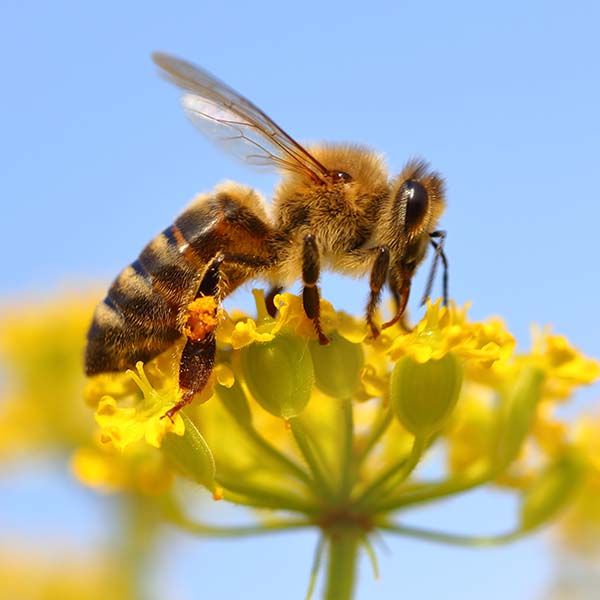
Honey Bees
Reviewed by TJ, ACE Certified Technician · Updated 2026-05-21
Apis mellifera | Category: Stinging Insects | First call: a beekeeper, not pest control
If you’ve found a cluster of bees on a tree branch, a steady stream of golden-brown insects coming out of a wall void, or a swarm hanging from your eave, we’ll be straight with you: this is one of the few situations where the answer almost certainly isn’t pest control. Honey bees are critically important pollinators, mostly docile, and in nearly all cases a local beekeeper is who you actually want to call. We can help you figure out what you have, but most of this page is about pointing you in the right direction, not selling you a treatment.
| Size | About 1/2″ long (workers); queens slightly larger |
|---|---|
| Color | Golden-brown to amber with darker abdominal bands |
| Top ID Marker | Fuzzy/hairy body, very different from sleek yellow jackets |
| Active Season | Spring through fall; colonies overwinter and are perennial |
| Nest Sites | Tree hollows, wall voids, chimneys, beekeeper hive boxes |
| Aggression | Low, defensive only when nest is threatened; swarms are docile |
| Recommended Action | ✓ Call a local beekeeper first |
Not sure what you have?
Get A QuoteQuick Answer: Honey bees (Apis mellifera) are fuzzy, golden-brown insects about 1/2 inch long, critically important pollinators that should not be exterminated as a first response. If you have a swarm or established colony on your property, the right call is a local beekeeper, who will often remove the bees for free or low cost because they want them. Pest control is appropriate only in rare cases where the colony is structurally inaccessible AND a beekeeper has declined. Honey bees are not naturally aggressive, swarms in transit are particularly docile because they have no hive to defend. Africanized or “killer” bees are NOT established in the Pacific Northwest.
Key facts at a glance: Size: 1/2″ · Color: fuzzy golden-brown · Aggression: low · Critical pollinator: yes · “Killer bees” in PNW: no · First call: beekeeper, not pest control · Sting count: one (then dies) · Anaphylaxis risk: yes for allergic individuals.
The honest answer: Honey bees are one of the only stinging insects where we’ll usually recommend you don’t hire us. Local beekeepers in Oregon and Washington often remove swarms and accessible colonies for free, and they get a productive hive in return. Start with your state beekeeping association, the Oregon State Beekeepers Association (ORSBA) and Washington State Beekeepers Association (WASBA) both maintain county-by-county swarm contact lists. Your county extension office can also point you to the right people. If you’ve already tried that route and have a colony in an inaccessible structural location, that’s when our team can help with a targeted assessment.
Safety note: Honey bees rarely sting unless directly threatened, but stings still pose a real risk to people with insect-sting allergies. Anaphylaxis symptoms after a sting, difficulty breathing, throat swelling, hives away from the sting site, rapid pulse, dizziness, are a medical emergency. Call 911. Use a prescribed epinephrine auto-injector if available. Stinger removal: scrape sideways with a credit card or fingernail rather than pinching, which can squeeze additional venom into the wound.
What You Need To Know About Honey Bees
Frequently Asked Questions
What do honey bees look like?
About 1/2″ long, fuzzy/hairy, golden-brown to amber with darker abdominal bands. The fuzz is the key, that’s what makes them effective pollinators. Yellow jackets are smooth and sleek; honey bees are hairy.
Should I call you about honey bees?
Honestly, usually not first. Local beekeepers are who you actually want, they’ll often remove swarms and accessible colonies for free because they want the bees. Call us if the colony is structurally inaccessible AND a beekeeper has declined to extract it.
How do I find a beekeeper?
Oregon State Beekeepers Association (ORSBA) and Washington State Beekeepers Association (WASBA) both publish swarm contact lists by county. Your county extension office can also point you to the right people. Most beekeepers respond within hours during swarm season.
Are honey bees aggressive?
Not usually. Their stinger is barbed, they can only sting once and they die after, so it’s not behavior they engage in casually. Swarms in transit are particularly docile because they have no hive or honey to defend. Established colonies will defend the entrance if disturbed.
What’s a swarm vs an established hive?
A swarm is a temporary cluster, thousands of bees around a queen, looking for a new home. They usually settle on a branch, fence, or wall for hours to a few days while scouts search for a permanent site. Established hives have built combs, stored honey, and brood, and are usually inside a wall void or tree hollow. Swarms are easy removals; hives are more involved.
Are killer bees in the PNW?
No. Africanized honey bees aren’t established in Oregon or Washington, their range is the southern US (Texas, Arizona, parts of California). PNW honey bees are European honey bees, the same species used in commercial pollination and managed beekeeping. Standard, well-understood, generally docile.
Will IPM’s pest plan kill honey bees?
No. Honey bees aren’t treated under our standard plan, and our techs avoid spraying around them. If you have honey bees on your property, our first response is always to point you to a beekeeper. We only get involved in rare structural cases where live removal isn’t possible.
Why do they show up in spring?
Swarm season. As populations grow rapidly in spring, established colonies split, the old queen leaves with about half the workers to find a new home, while a new queen takes over the original hive. Swarm clusters are what most PNW homeowners spot, usually moving on within 1–3 days.
Signs You Have Honey Bees (Not Yellow Jackets)
The most consequential thing you can do here is correctly identify what you’re looking at. Misidentifying yellow jackets as honey bees (or vice versa) leads to either dangerous DIY removal or unnecessary harm to pollinators:
1. Fuzzy body, muted earth tones
Up close, honey bees are clearly hairy, the fuzz catches pollen. Coloring is golden-brown to amber with darker bands. Yellow jackets are smooth, sleek, and bright yellow-and-black.
2. Visiting flowers, not garbage cans
Honey bees forage flowers for nectar and pollen. Yellow jackets at trash cans, soda cans, or picnic food in late summer are not honey bees, that behavior is yellow jacket territory.
3. A cluster, not a paper or mud nest
A swarm looks like a dense ball or hanging cluster of bees, often the size of a football or larger. There’s no paper football (bald-faced hornet), umbrella nest (paper wasp), or mud tubes (mud dauber).
4. Hive in a wall void or tree hollow
If you see steady bee traffic at a small opening leading into a wall, soffit, chimney, or tree hollow, that’s likely an established hive. Beeswax comb is sometimes visible from the outside near the entrance.
5. Wax or honey staining
Established hives produce honey and wax. Yellow-brown staining on walls or ceilings near a hive entrance can indicate the colony has been in place long enough to build significant comb behind the wall.
6. Calm behavior near the cluster
Bees that ignore you when you walk near them are almost certainly honey bees. Yellow jackets are aggressive and react quickly to nearby movement. If your neighbor is standing 5 feet from a cluster without getting stung, those aren’t yellow jackets.
Behavior, Biology & Why They Matter
Understanding a few key things about honey bee biology explains why they get handled so differently from other stinging insects:
Critical agricultural pollinators
Honey bees are responsible for pollinating a huge portion of the food we eat, the USDA estimates roughly one-third of US food crops depend on pollinator activity, with honey bees doing much of the work. Losing a colony to pest control when a beekeeper could have saved it is a real ecological cost.
Perennial colonies, not annual
Unlike yellow jackets and most other social wasps, honey bee colonies survive winter and persist for years. The colony huddles in the hive during cold months, consuming stored honey for energy and warmth. A honey bee hive in your wall this fall will likely still be there next spring, and the next.
One sting, then death
Honey bee stingers are barbed, they lodge in skin and tear free from the bee’s abdomen when she pulls away. The bee dies within minutes. This biological cost is why honey bees almost never sting casually. Stinging is a final-defense behavior for the colony, not an everyday response.
Swarm season is spring
From late March through June in the PNW, established colonies produce new queens and split. The original queen leaves with thousands of workers to find a new home, temporarily clustering on a visible surface while scouts search. This is when most homeowners notice them, and it’s also the easiest situation for a beekeeper to capture.
Drones don’t sting at all
A honey bee colony contains workers (sterile females, all the bees you usually see), one queen, and drones (males). Drones cannot sting, they have no stinger. The bees you might encounter foraging are workers; the only time you’d see drones is around the hive entrance during their mating flight season.
Hive cavity, comb, and honey stores
An established honey bee hive contains tens of pounds of beeswax comb and honey. If a colony in a wall void is killed by pest control alone without removing the comb, the abandoned wax and honey can drip through ceilings, attract other pests, and create lasting problems. Live removal includes the comb, another reason beekeepers are better suited for the job.
Homeowner Steps
For honey bees, the steps are about getting to the right resource, not DIY removal.
Confirm what you’re actually seeing
Fuzzy and golden-brown = honey bees. Smooth and bright yellow-and-black = yellow jackets. This is the most important step. Get a clear photo at a safe distance if you can.
Determine: swarm or established hive?
A loose cluster on a branch, fence, or wall = swarm in transit (usually leaves within 1–3 days). Steady traffic at a hole in a wall, tree, or chimney = established hive (needs removal).
Contact a local beekeeper
Oregon State Beekeepers Association (ORSBA) and Washington State Beekeepers Association (WASBA) maintain swarm contact lists. County extension offices can help. Most beekeepers respond within hours during swarm season, often for free.
Keep the area clear and don’t spray
Stay 10–15 feet from the cluster or hive entrance. Brief the household. Don’t spray, hose, smoke, or otherwise disturb the bees, it changes their behavior and complicates removal.
Call us only as last resort
Pest control involvement makes sense only if (a) the colony is structurally inaccessible, (b) a beekeeper has assessed and declined, and (c) there’s a documented reason removal is necessary. Otherwise the beekeeper route is the right path.
Honey Bees vs. Other Stinging Insects
Most honey bee mistakes come from confusion with yellow jackets. This comparison should resolve that quickly:
| Feature | Honey Bee | Bumble Bee | Carpenter Bee | Yellow Jacket |
|---|---|---|---|---|
| Size | ~1/2″ | 1/2″–1″ | Up to 1″ | ~1/2″ |
| Body | Fuzzy, golden-brown | Fuzzy, yellow & black | Mostly black, shiny abdomen | Smooth, bright yellow & black |
| Social or solitary? | Social (large colonies) | Social (small colonies) | Solitary | Social (large colonies) |
| Aggression | Low | Low | Very low | Very high |
| Stings how many times? | One (then dies) | Multiple possible | Rarely; males can’t | Multiple, easily |
| Colony lifespan | Perennial (years) | Annual | Annual | Annual |
| Right call | Beekeeper | Usually leave alone | Targeted treatment if damaging wood | Professional removal |
| Pollinator value | Critical | High | High | Limited |
Our Pest Plans, And What They Don’t Treat
Honey bees aren’t treated under either plan. We’ll always point you to a beekeeper first. These plans cover the pests Pacific Northwest homeowners actually deal with most.
All Seasons Pest Plan
$39/month
Setup fee $260 for initial treatment
Year-round protection from the pests Pacific Northwest homeowners deal with most, ants, spiders, yellow jackets, wasps, hornets, and more. Pollinators (including honey bees, bumble bees, and mason bees) are actively protected.
- Pollinator-safe treatment approach
- Yellow jacket & wasp nest removal
- Honest assessment, beekeeper referral when honey bees are involved
Pest & Rodent Bundle
$47/month
Setup fee $280 for initial treatment
The most complete protection for your home. Full pest coverage plus active rodent monitoring, one plan, one team, one less thing to worry about.
- Everything in Pest & Rodent plans
- Best value for whole-home protection
- Re-service guarantee
What Our Customers Are Saying