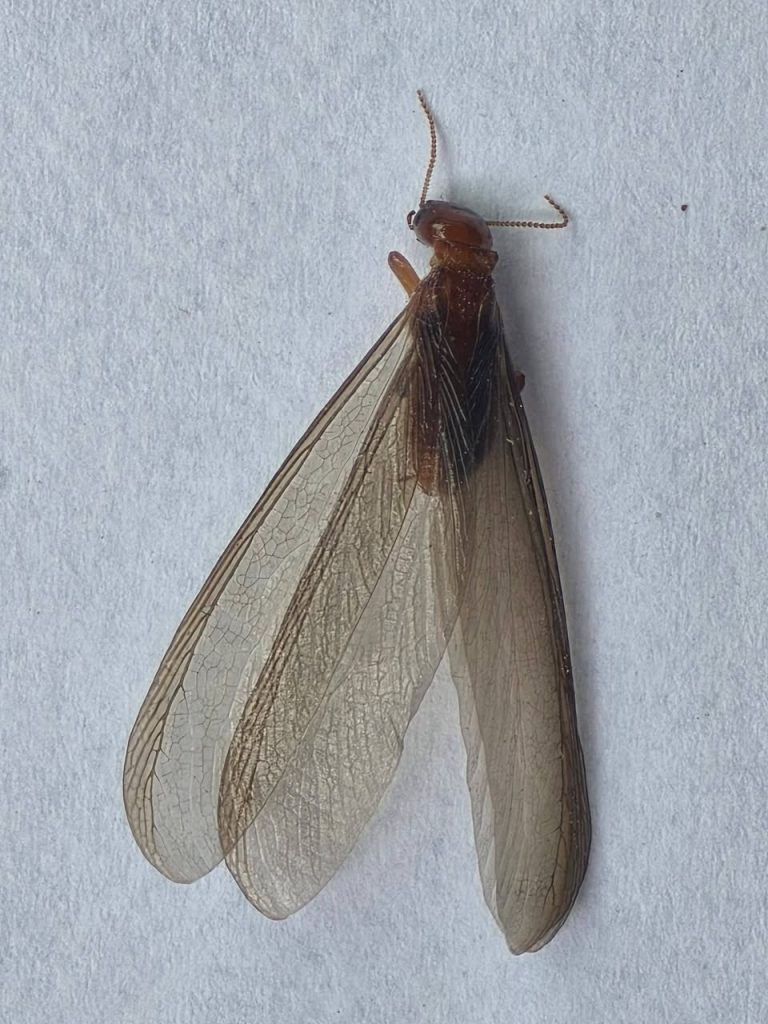
Dampwood Termites
Reviewed by TJ Jackson, Associate Certified Entomologist · Updated 2026-10-09
Zootermopsis angusticollis | Category: Termites | The big termite at your porch light in September
If a big brown termite flew to your porch light this summer or fall, it was almost certainly a Pacific dampwood termite, the largest termite in the Northwest and the one people here see most. Each late summer and fall, winged adults fly out of stumps, logs and wet wood. In a house, they only move into wood that is wet: a leaking sill, rotted trim, a crawl space with wood touching soil. If you find them inside, some wood on the house is staying wet, and the leak and rot keep doing damage until it is fixed.
Big termites at the porch light, or soft wood near a leak?
4.96 stars from 8,394 Google reviews · Family-owned since 1963
| Size | Workers about 1/2 in; soldiers about 3/4 in; winged adults 3/4 to 1 in |
|---|---|
| Color | Caramel to dark brown |
| Top ID Marker | Size: much bigger than any other Northwest termite |
| Habitat | Wet or decaying wood: stumps, logs, leaky sills, rotted trim, damp crawl spaces |
| Activity | Swarms late summer and fall; sightings peak August and September |
| Bite Risk | No risk to people; points to wet wood |
| Plan Coverage | Inspection first; termite work quoted separately from the All Seasons Plan |
Quick Answer: The Pacific dampwood termite (Zootermopsis angusticollis) is the largest termite in the Pacific Northwest and the most prevalent termite in western Oregon and Washington. Winged adults are caramel to dark brown and 3/4 to 1 inch long with wings, and they swarm in late summer and fall, often flying to lights after dark; public sightings peak in August and September. They live in wet or decaying wood and do not need soil contact or build mud tubes. In a home, they only infest wood that is or has been wet, such as wood touching soil, leaky plumbing or roofs, or a damp crawl space. Washington State University says pesticides are rarely needed for this termite, and the PNW Pest Management Handbook says fixing the moisture and replacing damaged wood usually solves it.
Key facts at a glance: 3/4 to 1 inch with wings · Caramel to dark brown · Swarms August and September · Lives in wet wood · No mud tubes · A moisture warning · Treatment: fix the moisture, replace the wood.
A September swarm is not an emergency. Oregon State University says flying termites are not cause for alarm. Dampwood termites live in stumps, logs and other wet wood outdoors, and most swarmers come from there. Check whether any wood on your house is staying wet.
Frequently Asked Questions
What are the big flying termites in Oregon and Washington in September?
Almost always Pacific dampwood termites. They are the largest termite in the Northwest, 3/4 to 1 inch long with wings, and they swarm in late summer and fall, often flying to porch lights in the evening. In public sighting records for Oregon and Washington, 82% of Pacific dampwood termite sightings are logged in August and September.
Are dampwood termites in my house a serious problem?
They mean some wood in the house is wet. Dampwood termites only infest wood that is or has been wet. If the moisture is fixed and the damaged wood is replaced, the infestation usually ends. Left alone, the leak and the rot keep doing damage whether the termites are there or not.
Do dampwood termites need soil contact or make mud tubes?
No. They nest inside wet wood and do not need soil contact. Mud tubes point to subterranean termites, a different termite that lives in the soil.
Where do dampwood termites get into houses?
Wherever wood stays wet: wood touching soil, leaking plumbing, roofs or gutters, porches and decks that hold water, and crawl spaces with condensation or poor ventilation. Wood decay fungus is often present in the same spot.
Do I need to spray for dampwood termites?
Usually not. Washington State University says pesticides are rarely needed for this termite, and Oregon State University says insecticide treatments will not work unless the moisture is removed and the damaged wood is repaired.
How can I tell dampwood termite damage from other wood pests?
Dampwood termites leave large, open galleries and small, football-shaped pellets in wood that is or has been wet. Carpenter ants leave clean, smooth galleries and push out piles of sawdust-like debris. Wood-boring beetles leave small round exit holes and fine powder or gritty pellets.
I saw one flying termite. Should I get an inspection?
One dampwood swarmer at a light in September is usually from outdoors. Get an inspection if you see termites coming from inside a wall or floor, find soft or damaged wood, or are buying or selling a home.
Is termite work part of the All Seasons Pest Plan?
No. Termite work starts with an inspection and is quoted separately. With dampwood termites, much of the fix is repair work, so we will tell you what needs a contractor and what needs us.
Signs You Have Dampwood Termites
1. Big swarmers at lights
Large, brown, long-winged termites at porch lights or windows on late summer and fall evenings. Swarms from outdoors are common and not proof of an infestation.
2. Wet or rotting wood
Soft, stained or crumbling sills, trim, posts or deck framing, especially where water collects or wood touches soil.
3. Small pellets in damaged wood
Fecal pellets about 1/16 inch, rounded at both ends, in or near the damaged wood. In very wet wood they can clump and lose their shape.
4. Large, open galleries
Opened wood shows big, open chambers rather than the thin layered damage subterranean termites leave.
5. A damp crawl space
Condensation, missing vapor barrier, poor ventilation, or form boards and scrap wood left on the soil. Dampwood termites move into wood in these conditions.
6. Leaks that have been there a while
Long-term drips from plumbing, roofs, gutters or windows. Wood decay fungus often shows up with dampwood termites.
Behavior, Biology & Lifecycle
The Northwest’s largest termite
Workers are about 1/2 inch, soldiers about 3/4 inch, and winged adults reach about 1 inch including wings.
Built for wet wood
Dampwood termites live in wet or decaying wood: stumps, fallen trees and logs in nature. They do not nest in dry, sound wood and do not need soil contact.
A late-summer swarm
Winged reproductives fly in late summer and fall, especially after rain. They are attracted to lights after dark, which is how most people first meet them.
Most common west of the Cascades
The PNW Pest Management Handbook says dampwood termites are more prevalent in western Washington and Oregon, while subterranean termites are more common east of the mountains.
A sign of an earlier problem
Washington State University calls their presence an indicator of a prior problem, like wood touching soil. The water came first; the termites followed.
Moisture decides the outcome
If the source of water is not fixed, the infestation continues. Fix the water and replace the wet wood, and the infestation usually ends.
Local Context: Oregon and Washington
Dampwood termites swarm in August and September. Our termite calls peak in the same weeks.
Dampwood termites are the Northwest’s most commonly seen termite. Of the 2,143 verifiable termite sightings logged on iNaturalist in Oregon and Washington from 2021 to 2025, 8 in 10 were dampwood termites. And they keep a tight calendar: 82% of Pacific dampwood termite sightings fall in August and September, when the big winged adults fly to lights.
Our records rise with them. Across five years in Portland, Vancouver, Salem, Olympia and Kelso, 52% of the visits where we recorded termites came August through October, with September the busiest month at 22%. Google searches for termites in the two states also peak in August and September. Most of our records say termites without naming the species, so our line covers all termites.
Most people call after seeing a swarm. Washington State University calls dampwood termites an indicator of a prior problem, like wood touching soil, and says pesticides are rarely needed for them. In our records, termites were the only pest on the first visit for 61% of new termite customers; carpenter ants, which often nest in damp wood, showed up for 19%.
Dampwood swarms and our termite visits peak together, August into October.
Each series is its share of the annual total, so the two are directly comparable. The orange line is our visits that recorded any termite.
Blue line: verifiable iNaturalist observations of Zootermopsis angusticollis in Oregon and Washington, grouped by the month observed. See the records on iNaturalist. Our records rarely name the termite species, so the orange line covers all termites.
Swarm first, calls after
Our visits hold up into October, after the swarms fade. Once a swarm gets their attention, people go looking and find the damage or the soft wood. Recorded dampwood sightings grew from 120 in 2021 to 319 in 2025, though some of that is more people using the app.
Worth knowing before you book
A swarm at the porch light in September usually comes from a stump, a log or wet wood somewhere nearby, not from inside your walls. An inspection tells you which it is. If the termites are in the house, they will be in wood that is wet, and repairing that wood is most of the job.
Fix the leak, replace the soft wood, get the soil off the siding and dry out the crawl space, and the colony has nothing to live on. If the moisture stays, any treatment is temporary. We also check for carpenter ants on the same visit, since they like the same damp wood.
Who sees termites when
Each row is that source’s share of its own annual total, by month. Darker means a bigger share. Our WDI inspections run 2022 to 2025; the rest run 2021 to 2025.
Blue rows are public data (iNaturalist sightings, Google searches). Orange rows are our records. Values are percent of the year. Weekly search volume is low, so single months are noisy.

“When a big termite lands on your porch light in September, it is easy to assume the worst. Here is what I tell people: dampwood termites can only live in wood that stays wet. If they are inside, they are showing you where the water is, and that water is rotting wood whether termites move in or not. We find the wet wood, show you the source and lay out the repair: fix the leak, replace the soft wood, pull the soil back from the siding. Do that and the infestation usually ends. Leave it and the rot keeps spreading.”TJ Jackson · ACE, Director of Operations, Interstate Pest Management
Termite work starts with an inspection and is quoted separately from the All Seasons Plan. QualityPro certified.
Call your local office
- Portland503-782-1899
- Vancouver360-996-1442
- Salem503-461-0259
- Olympia360-526-8004
- Kelso / Longview360-515-3882
Sources: Interstate Pest Management service records, 2021 to 2025, completed visits with termites recorded and new termite customers. Sightings: public iNaturalist records of Zootermopsis angusticollis and of all termites for Oregon and Washington, 2021 to 2025. Search interest: Google Trends for termites, Oregon and Washington, 2021 to 2025, combined in proportion to population. Biology: PNW Pest Management Handbooks, WSU PestSense, Oregon State University, WSU EB1814, UC Statewide IPM Program. Updated October 2026.
DIY Homeowner Steps
Find and fix the water
Track down the leak: plumbing, roof, gutters, window flashing or grading that sends water toward the house. Nothing else works until the wood dries out.
Replace the damaged wood
Remove and replace soft, rotted or termite-damaged wood with sound, dry wood. Pressure-treated lumber is a good choice where wood is near the ground.
Break wood-to-soil contact
Remove form boards and scrap wood from the crawl space, and keep siding, posts and trim from touching soil or mulch.
Dry out the crawl space
Make sure there is a vapor barrier over the soil and the vents are open and screened so the space can breathe.
Clear stumps and wood piles
Keep firewood and lumber away from the house and off the ground, and remove old stumps and logs near the foundation if practical.
Dampwood Termites vs. Common Look-Alikes
| Feature | Dampwood Termite | Subterranean Termite | Carpenter Ant | Flying Ant |
|---|---|---|---|---|
| Size (winged) | 3/4 to 1 in | About 3/8 in | About 1/4 to 1/2 in (queens larger) | Varies, usually small |
| Waist and antennae | Thick waist, straight antennae | Thick waist, straight antennae | Pinched waist, elbowed antennae | Pinched waist, elbowed antennae |
| Wings | Four wings, all the same length | Four wings, all the same length | Hind wings shorter | Hind wings shorter |
| Where it lives | Inside wet wood | In the soil, travels in mud tubes | Nests in damp or decayed wood | Soil or wood nest outdoors |
| Damage | Large open galleries, pellets | Thin-shelled wood, mud in galleries | Smooth, clean galleries, sawdust piles | None |
| What it means | Fix the moisture, replace the wood | Inspection, then treatment | Find and treat the nest | Identify the ant |
How Termite Inspections and Treatment Work
Step 1
Inspection
We find out whether you have termites, which kind, and what is drawing them in: wet wood, wood touching soil, crawl space moisture or debris. In Washington, a complete wood destroying organism (WDO) inspection for a home sale comes with a written report.
Schedule a Termite InspectionStep 2
A plan that fits what we find
Dampwood termites are usually solved by fixing the moisture and replacing the damaged wood. Subterranean termites call for professional treatment, such as a soil barrier or bait stations. You get a quote after the inspection. Termite work is separate from the All Seasons Plan.
Book NowWhat Our Customers Are Saying