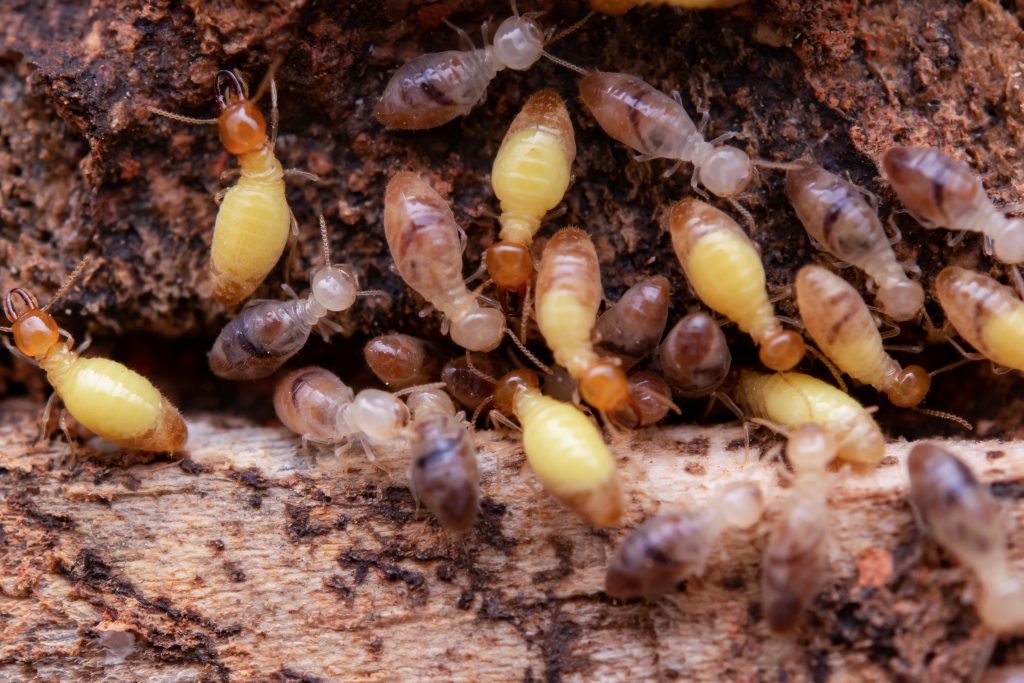
Subterranean Termites
Reviewed by TJ Jackson, Associate Certified Entomologist · Updated 2026-10-09
Reticulitermes hesperus | Category: Termites | The termite that lives in the soil and builds mud tubes
Subterranean termites live in colonies in the soil and travel up into wood through mud tubes, the clearest sign you have them. In the Pacific Northwest they are more common east of the Cascades, but they are found on the west side too, including mapped sites around Olympia, and unlike dampwood termites they do not need wet wood to do damage. Infestations rarely go away on their own, so mud tubes or damaged wood are worth an inspection.
Found mud tubes on the foundation or swarmers inside?
4.96 stars from 8,394 Google reviews · Family-owned since 1963
| Size | Workers about 3/16 to 1/4 in; swarmers about 3/8 in including wings |
|---|---|
| Color | Workers cream to grayish white; swarmers dark brown to black |
| Top ID Marker | Mud tubes on foundations; swarmers with four equal-length wings |
| Habitat | Soil colonies; feeds on wood touching or near soil, including sound, dry wood |
| Activity | Year-round in the soil; swarms can happen in any season |
| Bite Risk | No risk to people; real risk to wood |
| Plan Coverage | Inspection first; termite treatment quoted separately from the All Seasons Plan |
Quick Answer: Subterranean termites, mainly the western subterranean termite (Reticulitermes hesperus) in the Northwest, live in colonies in the soil and reach wood through mud tubes built over foundations and pipes. Workers are cream-colored and about 3/16 to 1/4 inch long; winged swarmers are dark brown to black and about 3/8 inch with wings. Unlike dampwood termites, they can attack sound, dry wood as long as they keep a connection to soil, and infestations rarely go away on their own. In Oregon and Washington they are more common east of the Cascades and less common than dampwood termites on the west side. Mud tubes are the clearest sign. Treatment is a professional job: a soil barrier or bait stations, plus removing wood-to-soil contact.
Key facts at a glance: Workers 3/16 to 1/4 inch · Swarmers dark, about 3/8 inch · Mud tubes · Live in soil · Can eat dry wood · Swarms in any season · Treatment: professional, quoted after inspection.
Saw a swarm? Oregon State University notes that flying termites alone are not proof the house is infested. Look for mud tubes and damaged wood, or have it inspected. Most of our termite work starts with exactly that: about 3 in 4 new termite customers begin with an inspection.
Frequently Asked Questions
How do I know if I have subterranean termites?
Look for mud tubes: tunnels of soil running up foundations, piers, pipes or walls. Other signs are wood that is thin on the surface and easy to puncture, wood that looks blistered or darkened, and swarms of small dark winged insects. Mud tubes are the most common evidence.
Are subterranean termites common in Portland and western Washington?
Less common than on the dry side of the state. The Pacific Northwest Pest Management Handbook says subterranean termites are more common east of the Cascades, while dampwood termites are more common in western Washington and Oregon. They are still found west of the mountains, and a statewide mapping project that included the Olympia area found them mostly in loamy soils.
Do subterranean termites need wet wood?
No. That is the big difference from dampwood termites. Subterranean termites get their moisture from the soil and carry it with them through mud tubes, so they can attack sound, dry framing as long as they keep a connection to the ground. Slab foundations do not stop them, since cracks, joints and plumbing gaps give them a way up.
When do subterranean termites swarm?
Washington State University and Oregon State University both say they may swarm at any time of year. In public sighting records for Oregon and Washington, September and April are the busiest months. A swarm means a colony is somewhere nearby, but it is not proof the house itself is infested.
How can I tell a termite swarmer from a flying ant?
Check three things. Termites have straight antennae, a thick waist and front and hind wings the same length. Ants have elbowed antennae, a pinched waist and hind wings shorter than the front wings.
Can I treat subterranean termites myself?
Extension services recommend leaving it to a professional. WSU says there are no reliable non-chemical prevention methods for subterranean termites, and UC IPM says do-it-yourself termite products are generally not effective. What you can do is cut down the conditions that help them: keep soil and mulch away from siding, and fix leaks.
What is a WDI or WDO inspection?
A wood destroying insect or organism inspection checks a home for termites, carpenter ants, moisture ants, wood-boring beetles, wood decay fungi and the conditions that invite them. In Washington, a complete WDO inspection tied to a sale, exchange or refinance must be done by a WSDA-licensed structural pest inspector and come with a written report. WSDA says nearly all complete WDO inspections are part of a sale, exchange or refinance.
Is termite treatment part of the All Seasons Pest Plan?
No. Termite work starts with an inspection and is quoted separately, because the right treatment depends on which termite you have and what is drawing it in.
Signs You Have Subterranean Termites
1. Mud tubes
Tunnels of soil and debris running up foundation walls, piers, pipes or the inside of a crawl space. Break one open: live termites inside mean the colony is active.
2. Swarmers or piles of wings
Small dark insects with four equal-length wings coming out of the ground or walls, or piles of shed wings on window sills and floors.
3. Wood that is thin and easy to puncture
A screwdriver sinks into the surface of a sill plate, joist or trim. Subterranean termites eat the softer wood and leave a thin shell.
4. Damage that follows the grain
Opened wood shows galleries running with the grain, where the softer springwood is eaten out and the harder rings remain.
5. Blistered or darkened wood
Paint that bubbles or wood that looks darker in a line can be termites working just under the surface.
6. Wood touching soil
Fence posts, deck footings, form boards left in a crawl space, or siding buried in soil or mulch. These are the bridges subterranean termites use.
Behavior, Biology & Lifecycle
A soil-dwelling colony
Subterranean termites nest in the ground, often in buried wood like stumps and logs, and return to the soil for water. The colony can be well below the surface.
Workers, soldiers and swarmers
Workers are cream to grayish white and about 1/4 inch. Soldiers have long, narrow, amber heads and no eyes. Winged reproductives are dark brown to black, about 3/8 inch including wings, and shed their wings after flying.
Mud tubes for travel
To cross concrete or open space, they build tubes of soil and debris that keep them in the dark and damp. That is how a colony in the yard reaches the framing of a house.
They can eat dry wood
Unlike dampwood termites, subterranean termites do not need the wood itself to be wet. Any wooden structure with a path to the soil can be attacked.
East of the Cascades, mostly
The PNW Pest Management Handbook says subterranean termites are more common east of the Cascades and dampwood termites more common in western Oregon and Washington. A WSDA and Washington State Pest Management Association mapping project, which included the Olympia area, found subterranean termites mostly in loamy soils. WSU now keeps those maps for historical reference.
Slow but persistent
Infestations rarely go away on their own. Colonies grow slowly, which is why the conditions that give them access, like wood touching soil, matter as much as the treatment.
Local Context: Oregon and Washington
Only 1 in 8 termite sightings in Oregon and Washington is a subterranean termite. Most of our termite work starts with an inspection.
Public records show how the Northwest’s termites split. Of the 2,143 verifiable termite sightings logged on iNaturalist in Oregon and Washington from 2021 to 2025, 261 were subterranean termites, about 12%. Nearly 8 in 10 were dampwood termites. That matches the PNW Pest Management Handbook, which calls subterranean termites more common east of the Cascades.
Subterranean sightings come in two bursts. September holds 43% of them and the March to May window holds 25%, when swarms of small dark termites make them easy to notice. Our own termite records follow the late-summer pattern: across five years in Portland, Vancouver, Salem, Olympia and Kelso, 52% of the visits where we recorded termites came August through October. Most of our records say termites without naming the species, so that line covers all termites.
The bigger pattern in our records is how much of the work is checking. 58% of our termite visits were inspections, either a full wood destroying insect (WDI) inspection or a limited inspection of one problem spot, and about 3 in 4 new termite customers started with one. With subterranean termites, confirm the finding before you pay for a soil barrier or bait stations.
Subterranean sightings come in spring and September. Our termite visits build from August.
Each series is its share of the annual total, so the two are directly comparable. The orange line is our visits that recorded any termite.
Blue line: verifiable iNaturalist observations of the genus Reticulitermes in Oregon and Washington, grouped by the month observed. See the records on iNaturalist. Our records rarely name the termite species, so the orange line covers all termites.
A swarm is a clue
Oregon State University notes that flying termites alone are not a sign the house is infested. Mud tubes and damaged wood are. Recorded subterranean sightings grew from 30 in 2021 to 86 in 2025, though some of that is more people using the app.
Worth knowing before you book
Home sales drive a lot of termite checking. Our WDI inspections peak in August, with 57% falling August through October, and WSDA says nearly all complete WDO inspections in Washington are part of a sale, exchange or refinance. In our records, fewer than 1 in 50 of those inspections led to a termite treatment visit in the next four months.
An inspection sorts that out. Most worried calls turn out to be dampwood termites in a wet spot, carpenter ants, old damage or a swarm from outside. When it is subterranean termites, you want that confirmed before you pay for treatment, and you want the conditions that let them in on the list too.
Who sees termites when
Each row is that source’s share of its own annual total, by month. Darker means a bigger share. Our WDI inspections run 2022 to 2025; the rest run 2021 to 2025.
Blue rows are public iNaturalist sightings. Orange rows are our records: visits that recorded termites, and WDI inspections. Values are percent of the year.

“If you found mud tubes on your foundation, I understand the worry. Subterranean termites are the one Northwest termite that will eat dry, sound framing, and they do not leave on their own. They are also less common on our side of the Cascades, about 1 in 8 termite sightings in Oregon and Washington. So we confirm it before anything else: we open the tubes, check the wood and find where they are getting in. If it is subterranean termites, we treat. If it is something else, you just saved yourself a treatment you did not need.”TJ Jackson · ACE, Director of Operations, Interstate Pest Management
Termite work starts with an inspection and is quoted separately from the All Seasons Plan. QualityPro certified.
Call your local office
- Portland503-782-1899
- Vancouver360-996-1442
- Salem503-461-0259
- Olympia360-526-8004
- Kelso / Longview360-515-3882
Sources: Interstate Pest Management service records, 2021 to 2025, completed visits with termites recorded and WDI inspections. Sightings: public iNaturalist records of Reticulitermes and of all termites for Oregon and Washington, 2021 to 2025. Biology and rules: PNW Pest Management Handbooks, WSU PestSense, Oregon State University, UC Statewide IPM Program, WSU Subterranean Termite Mapping Project, Washington State Department of Agriculture. Updated October 2026.
DIY Homeowner Steps
Break wood-to-soil contact
Keep a gap between soil and any wood on the house. UC IPM recommends at least 12 inches. Pull mulch and soil back from siding and remove form boards and scrap wood from the crawl space.
Fix leaks and drainage
Repair leaking pipes and gutters and direct downspouts away from the foundation. Moist soil next to the house helps a colony.
Move firewood and debris
Store firewood and lumber away from the house and off the ground, and clear stumps and buried wood near the foundation.
Check for mud tubes twice a year
With a flashlight, look along the foundation, piers and pipes in the crawl space and garage. Note any tubes and leave them in place for the inspector.
Skip store-bought termite treatments
UC IPM says do-it-yourself termite pesticides are generally not effective, and WSU says chemical control is usually the only option once they are established. Use your effort on the conditions above.
Subterranean Termites vs. Common Look-Alikes
| Feature | Subterranean Termite | Dampwood Termite | Carpenter Ant | Flying Ant |
|---|---|---|---|---|
| Size | Workers about 1/4 in; swarmers about 3/8 in | Much larger; winged adults 3/4 to 1 in | 1/4 to 1/2 in, black or black and red | Varies |
| Waist and antennae | Thick waist, straight antennae | Thick waist, straight antennae | Pinched waist, elbowed antennae | Pinched waist, elbowed antennae |
| Wings | Four wings, all the same length | Four wings, all the same length | Hind wings shorter (swarmers) | Hind wings shorter |
| Needs wet wood? | No, gets water from soil | Yes | Often damp or decayed wood, also sound wood | Not a wood pest |
| Signs | Mud tubes, wood thin at surface | Pellets in wet, decaying wood | Piles of sawdust-like debris, smooth galleries | Swarm near a nest |
| What it means | Inspection, then professional treatment | Fix the moisture, replace the wood | Find and treat the nest | Identify the ant |
How Termite Inspections and Treatment Work
Step 1
Inspection
We find out whether you have termites, which kind, and what is drawing them in: wet wood, wood touching soil, crawl space moisture or debris. In Washington, a complete wood destroying organism (WDO) inspection for a home sale comes with a written report.
Schedule a Termite InspectionStep 2
A plan that fits what we find
Dampwood termites are usually solved by fixing the moisture and replacing the damaged wood. Subterranean termites call for professional treatment, such as a soil barrier or bait stations. You get a quote after the inspection. Termite work is separate from the All Seasons Plan.
Book NowWhat Our Customers Are Saying