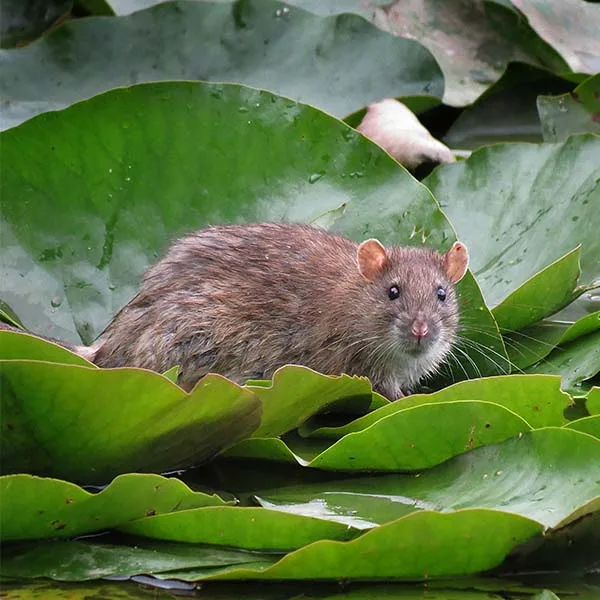
Norway Rat
Reviewed by TJ Jackson, Certified ACE · Updated 2026-08-11
Rattus norvegicus | Category: Rodents | ✓ Covered: All Seasons Rodent Plan
Norway rats are the big, ground-dwelling rat behind most rat problems in the Pacific Northwest. Heavy-bodied and brown, with a blunt nose and a tail shorter than its body, it burrows along foundations, under slabs, and beside woodpiles, and it works its way into basements, crawlspaces, and lower floors. Where the roof rat climbs, the Norway rat digs.
What You Need To Know About Norway Rats
Frequently Asked Questions
How do I know it’s a Norway rat and not a roof rat?
Size and shape tell them apart. Norway rats are larger and heavier with a blunt nose, small ears that do not reach the eyes, and a thick tail that is shorter than the head and body. Roof rats are sleeker with a pointed nose, large ears, and a tail longer than the body. Behavior helps too: Norway rats stay low and burrow, while roof rats climb and nest up high.
Are Norway rats dangerous?
Yes, in a few ways. They gnaw constantly and will chew through wiring, pipes, and building materials, which can cause fires and water damage. They contaminate food and surfaces with droppings and urine, and they can spread diseases such as leptospirosis and salmonella. Their burrowing can also undermine slabs and foundations.
Where do Norway rats nest?
They are ground rats. Outdoors they dig burrows along foundations, under decks and sheds, beside woodpiles, and around garbage. Indoors they favor the lowest levels: basements, crawlspaces, and the spaces under and behind appliances. They are strong swimmers and sometimes travel through sewer lines.
How do I get rid of Norway rats?
Control combines sealing entry points (rats can use gaps as small as a half inch), removing food and harborage like woodpiles and clutter, and trapping or baiting to reduce the population. Because they burrow and can reinvade, a consistent, whole-property approach works much better than spot treatment.
Does the All Seasons Rodent Plan cover Norway rats?
Yes. Norway rats are covered under the All Seasons Rodent Plan, which includes interior and exterior monitoring, scheduled service, and as-needed re-services between visits. Sealing and exclusion work to close entry points is quoted separately based on your home.
Quick Answer: Norway rats (Rattus norvegicus) are large, heavy brown rats with a blunt nose, small ears, and a thick tail shorter than the body. They are ground-dwellers that burrow along foundations and woodpiles and move into basements, crawlspaces, and lower floors. They gnaw through wiring and pipes, contaminate food, and can spread disease, so signs like fresh burrows or large droppings call for prompt action.
Most important distinction: The Norway rat is the low, burrowing rat: blunt nose, small ears, tail shorter than the body. That is what separates it from the sleek, big-eared, long-tailed roof rat that climbs and nests up high.
Behavior & Biology
The Norway rat (Rattus norvegicus), also called the brown rat or sewer rat, is the larger and heavier of the two rats found in the Pacific Northwest. A big adult can weigh a pound or more, with a stocky body, coarse brown-gray fur, a blunt muzzle, small ears that do not reach the eyes, and a thick tail noticeably shorter than its head and body.
Norway rats are ground animals. Outdoors they excavate burrow systems along foundations, under sheds and decks, and near reliable food and water such as garbage areas and pet feeding stations. Indoors they occupy the lowest levels of a building, and they are capable swimmers that sometimes enter through sewer and drain lines. They travel along established runways and leave greasy rub marks where they brush against walls.
Like all rats, they gnaw continuously to keep their incisors in check, and that gnawing is where much of the damage comes from: chewed wiring that can start fires, damaged pipes, and compromised building materials. Combined with their contamination of food and their role in spreading disease, that makes an established Norway rat population a problem worth resolving quickly and thoroughly.
Local context: Oregon and Washington
Rats do not have a season here. Everything else does.
Across five years of rodent service records in Portland, Vancouver, Salem, Olympia and Kelso/Longview, our new rodent customers arrive at close to the same rate every month of the year. The quietest month holds 7.0% of the year and the busiest holds 10.4%. An evenly split year would be 8.3% a month. Our records tag rodents as a group rather than by species, so the orange line is every rat and mouse we treat, not Norway rats alone.
For comparison, the same records swing more than seven to one between our busiest and quietest spider month. Rodents run at about one and a half to one. There is a real lift in September and October, and it is worth planning around, but it is a lift and not a season.
Here is the part that surprises people. Rodent work is 38% of every new customer we took on over those five years, and because the rest of the book goes quiet in winter, rodents are more than 6 in 10 of the new customers who call us in December. In March they are under 3 in 10. The rats did not get worse. Everything else stopped.
Two flat lines, twelve months
Each series is its share of its own annual total, so the two are directly comparable. The dotted line is what a perfectly even year looks like.
Blue line: Google search interest for the term rats in Oregon and Washington, over the last five years, the two states combined in proportion to their population. See it in Google Trends. Orange line: our own first-appointment records. Rodents are the largest single pest group in our files. We show shares rather than customer counts.
“On a Norway rat call I walk the outside of the house before I go in. These are ground animals. They burrow against the foundation, under the shed, in the blackberries along the back fence, and they come in low. A crawl space vent, a gap under a door, the hole where the utility line goes through. People want to start by putting bait in the attic. If it is really in your attic, the first thing we should be talking about is whether it is even a Norway rat. Find the burrow, find the hole they are using, and the trapping part gets a lot shorter.”
TJ Jackson · ACE, Director of Operations, Interstate Pest Management

Re-services included as needed if they come back between scheduled visits. Rodents are covered by the All Seasons Rodent Plan at $39/mo, or $47/mo for the pest and rodent bundle. Sealing and exclusion work is quoted separately after an inspection.
Book a rodent inspection
- Portland503-782-1899
- Vancouver360-996-1442
- Salem503-461-0259
- Olympia360-526-8004
- Kelso / Longview360-515-3882
What To Do If You Have Norway Rats
Norway rats are persistent and can reinvade, so control works best as a whole-property effort: seal the ways in, remove what feeds and shelters them, and reduce the population with the right stations and traps.
Seal the low entry points
Rats can push through gaps around a half inch. Seal openings around foundations, utility lines, vents, and door sweeps with rodent-proof materials, focusing on ground level where Norway rats travel.
Remove harborage
Clear woodpiles, dense ground cover, and clutter away from the house, and keep the area around foundations open. Fewer places to burrow and hide means fewer rats.
Cut off food and water
Secure garbage, pick up fallen fruit and pet food, and fix leaks and standing water. Rats settle where food and water are reliable.
Call a pro for burrows
Active burrows and an established population are best handled by a technician who can place and monitor stations safely and target the nest sites.
Plans That Keep Rodents Out
All Seasons Rodent Plan
$39/month
Setup fee $280 for initial service
Ongoing monitoring and control that keeps mice and rats out of your home year-round, with interior and exterior stations serviced on a regular schedule.
- Interior & exterior monitoring
- Scheduled seasonal service
- Re-services included as needed between visits
Pest & Rodent Bundle
$47/month
Setup fee $280 for initial service
The most complete protection for your home: full rodent coverage plus year-round control of the insects and spiders PNW homeowners deal with most. One plan, one team.
- Everything in the Rodent plan
- Full pest coverage too
- Best value for whole-home protection
Sealing and exclusion work (closing the gaps rodents use to get in) is quoted separately based on your home, and is not included in the monthly plan price. Your technician will walk the home and give you a clear estimate.
Get help with Norway rats in your area
Interstate Pest Management helps with Norway rats across Oregon and Washington. Choose your area to see local plans, pricing and the number for your nearest team.