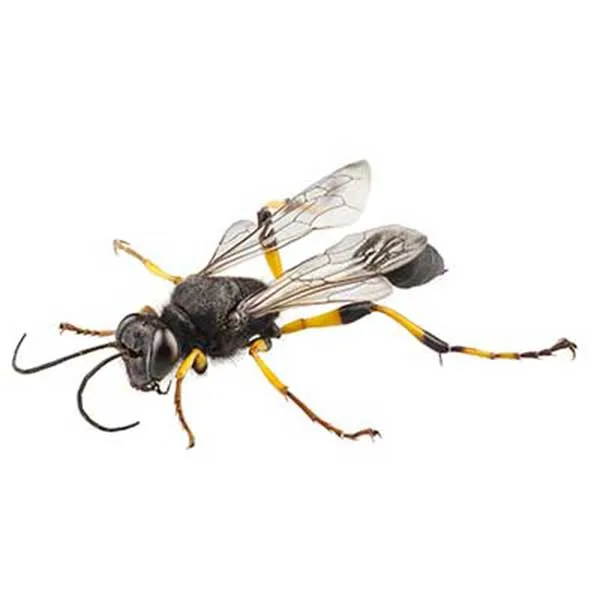
Mud Daubers
Reviewed by TJ, ACE Certified Technician · Updated 2026-05-21
Sceliphron, Trypoxylon, Chalybion spp. | Category: Stinging Insects | ✓ Covered: All Seasons Pest Plan
Mud daubers are the wasp most homeowners overestimate the threat of. They’re solitary, non-aggressive, and among the least likely stinging insects in the Pacific Northwest to actually sting you. They’re also genuinely useful, their entire reproductive strategy is built around hunting spiders. If you’ve found rows of mud tubes on your eaves and aren’t sure what to do, this page lays out the honest case for treating, leaving alone, or somewhere in between.
| Size | About 1″ long (with very thin “thread waist”) |
|---|---|
| Color | Black, black-and-yellow, or metallic blue depending on species |
| Top ID Marker | Dried mud tubes or clusters under eaves and in sheltered spots |
| Active Season | Late spring through early fall; peak July–August |
| Nest Sites | Eaves, porch ceilings, sheds, barns, garage corners, attics |
| Aggression | Very low, solitary, no nest to defend, rarely sting |
| Plan Coverage | ✓ Covered under All Seasons Pest Plan |
Need help with this pest?
Get A QuoteQuick Answer: Mud daubers are about 1-inch-long solitary wasps with a distinctive thread-thin waist, identified most easily by their dried-mud tube nests under eaves and in sheltered spots. They are among the least aggressive stinging insects in the Pacific Northwest, males have no stinger, females rarely use theirs. Their entire life cycle revolves around hunting spiders to provision egg chambers. In remote spots, leaving them alone is usually the right call. Removal makes sense when nests are in high-traffic areas, creating cosmetic issues on visible siding, or being reused by more aggressive wasps after the daubers leave.
Key facts at a glance: Size: ~1″ · Color: black, black-and-yellow, or metallic blue · Solitary: yes · Aggression: very low · Hunts spiders: yes · Sting risk: minimal · Annual nests: yes · Plan coverage: Yes, All Seasons Pest Plan (when warranted).
An honest note: Mud daubers are one of the few stinging insects we’ll regularly recommend leaving alone. Their spider-hunting behavior is a free pest control service, and they’re extremely unlikely to sting you. If your nest is in a low-traffic spot like a shed or barn corner, treating it isn’t usually necessary. Our technicians will tell you that honestly when we’re on-site, we’d rather give straight advice than push unneeded service.
What You Need To Know About Mud Daubers
Frequently Asked Questions
What do mud daubers look like?
About 1″ long with a really obvious thread-thin waist between the abdomen and thorax. PNW species can be black-and-yellow, all black, or metallic blue. Honestly, the easiest ID is the mud nest, nothing else in our region builds with mud.
Are they aggressive?
Not really. They’re solitary, there’s no colony to defend, and almost never sting unless you grab one. Males have no stinger at all. You can stand a few feet from a female working her nest and she’ll usually ignore you.
Do I have to remove them?
Often, no, and that’s us being straight with you. They’re beneficial spider hunters and basically harmless. Remove them if they’re above an entry, on visible siding, on playground equipment, or causing cosmetic problems. Leave them alone in barns, sheds, and quiet corners.
How do they hunt spiders?
A female mud dauber paralyzes a spider with her sting, carries it back to her mud chamber, and seals it inside with one egg. The larva hatches, eats the paralyzed-but-still-fresh spider, and develops over winter. It’s gruesome from the spider’s perspective but very effective natural pest control.
Are the empty nests a problem?
The nests themselves aren’t dangerous, but they can be reused. Other wasps, sometimes yellow jackets, will move into vacated mud tubes. Spiders also recolonize them. If you find old nests in high-traffic spots, removing them in fall or winter prevents both reuse and bird damage to siding underneath.
Does my All Seasons Plan cover them?
Yes, when removal makes sense. Our techs assess the location and recommend treatment only if it’s warranted. In remote spots doing useful spider control, we’ll typically suggest leaving them. In problem locations, removal is included in the plan.
If I knock down a nest, will they come back?
Not the same individual, but the location might. Mud daubers pick spots based on shelter, surface, and mud access. Removing the nest doesn’t change those factors, so new females may choose the same spot the next year. Long-term reduction means addressing the site itself.
When are they most active?
Late spring through early fall, peaking in July and August during the warm dry stretch. Females build through summer; larvae overwinter inside sealed mud chambers and emerge as adults the following spring.
Signs You Have Mud Daubers
Mud daubers are easy to identify because their nests give them away long before you spot the wasp:
1. Mud tubes or pipes on sheltered surfaces
The defining sign. Rows of 1-inch dried mud tubes arranged side by side (organ pipe pattern) or clusters of smaller mud blobs. Almost always on a sheltered vertical surface, under eaves, in porch ceilings, in sheds or barns.
2. Wasps with very thin waists
The thread-thin petiole between abdomen and thorax is unmistakable up close. About an inch long, often black, black-and-yellow, or metallic blue depending on species.
3. Wasps visiting mud puddles
If you see a thin-waisted wasp picking up mud from a damp spot on a driveway, garden bed, or puddle edge, that’s a female collecting nest material. Watch where she flies to find the nest site.
4. Brown staining under nests
On painted siding, eaves, or porch ceilings, mud nests can leave brown vertical streaks below as the mud weathers. Often the cosmetic issue, not the wasp, drives the call.
5. Fewer spider webs in the area
An indirect sign, but real. Active mud dauber populations measurably reduce spider numbers in their hunting range. If your shed used to be cobwebby and isn’t this summer, mud daubers may be the reason.
6. Holes in old nests
A small round exit hole in a sealed mud tube means an adult has emerged. If you see holes in nests left from previous years, the cycle has already completed for those chambers.
Behavior, Biology & Why They’re Different
Mud daubers behave nothing like the social wasps people usually picture. Understanding the differences explains why our approach to them is also different:
Solitary, not social
Unlike yellow jackets, hornets, and paper wasps, mud daubers live alone. Each female builds her own nest, hunts her own spiders, and provisions her own egg chambers. There’s no colony to defend, which is why aggression is so low.
Multiple PNW species
The Pacific Northwest hosts several mud dauber species: the black-and-yellow mud dauber (Sceliphron caementarium), the organ-pipe mud dauber (Trypoxylon politum), and the metallic-blue mud dauber (Chalybion californicum), which actually specializes in raiding other mud daubers’ nests for the spiders inside.
Spider hunters by design
A mud dauber’s entire reproductive strategy revolves around spiders. The female paralyzes a spider with her sting, hauls it back to her mud chamber, and seals it inside with an egg. The larva develops by eating the paralyzed-but-still-fresh spider over weeks.
Mud as building material
Females collect wet mud one mouthful at a time from puddles, garden beds, or damp soil. A single nest tube takes dozens of trips to build. The mud dries into hard, weather-resistant chambers that can persist on a building for years if undisturbed.
Annual cycle, overwintering larvae
Adults are active summer through early fall. Larvae develop inside sealed chambers and overwinter as pupae. New adults chew their way out of the mud the following spring and immediately start the cycle over. Nests are not reused by the same female.
Why aggression stays low
Social wasps defend nests collectively because losing the colony means everyone’s offspring die. A mud dauber loses only one chamber if her nest is disturbed, and she’ll often just build a new one. The evolutionary pressure that produces stinging defense behavior in yellow jackets and hornets isn’t there for mud daubers.
DIY Homeowner Steps
Mud daubers are one of the few stinging insects we’ll regularly say is fine to handle yourself, if the location justifies removal at all.
First decide: do you actually need to remove it?
If the nest is in a low-traffic spot, leaving it alone is genuinely the best option. Mud daubers do useful work, won’t sting you, and the nest will be abandoned by fall.
If removal is needed, wait for fall or winter
Late fall through early spring is the easy window, adults are gone and only sealed chambers remain. Working in cool weather, mid-morning, gives you the best margin of safety.
Use a putty knife or scraper
Wear gloves and eye protection. Knock the nest into a bag for disposal. Old mud comes off most surfaces with light scraping. For stains on siding, follow up with a brief wash.
Make the site less attractive
If new females keep choosing the same spot, address the conditions: paint or screen sheltered surfaces, reduce nearby mud sources, brush down nest starts before they’re finished.
Check old nests for reuse
If you’re finding old nests, watch for traffic that doesn’t look like a mud dauber, yellow jackets or other wasps sometimes occupy vacated tubes. That changes the calculation.
Mud Daubers vs. Other Stinging Insects
Mud daubers are sometimes confused with paper wasps or other thin-waisted wasps. Here’s how they actually compare:
| Feature | Mud Dauber | Paper Wasp | Yellow Jacket | Bald-Faced Hornet |
|---|---|---|---|---|
| Size | ~1″ | 15–20 mm | 1/2″ | 12–15 mm |
| Waist | Very thin (thread-like) | Narrow but visible | Sleek but not threadlike | Sleek but not threadlike |
| Social or solitary? | Solitary | Social (small colonies) | Social (large colonies) | Social (medium colonies) |
| Nest material | Dried mud | Paper (umbrella shape) | Hidden underground or in walls | Paper football, aerial |
| Aggression | Very low | Moderate | Very high | Very high |
| Beneficial? | Yes (hunts spiders) | Yes (hunts caterpillars) | Mixed (hunts pests, scavenges) | Yes (hunts flies, wasps) |
| Removal usually needed? | Often no | Sometimes | Yes | Yes |
| Plan coverage | ✓ All Seasons | ✓ All Seasons | ✓ All Seasons | ✓ All Seasons |
Plans That Cover Mud Daubers
All Seasons Pest Plan
$39/month
Setup fee $260 for initial treatment
Year-round protection from the pests Pacific Northwest homeowners deal with most, with honest assessment for beneficial insects like mud daubers.
- Honest assessment, not auto-treatment
- Stinging insect nest removal when needed
- Re-services included as needed between visits
Pest & Rodent Bundle
$47/month
Setup fee $280 for initial treatment
The most complete protection for your home. Full pest coverage plus active rodent monitoring, one plan, one team, one less thing to worry about.
- Everything in Pest & Rodent plans
- Best value for whole-home protection
- Re-service guarantee
What Our Customers Are Saying
Real Results From Real Customers
Get help with mud daubers in your area
Interstate Pest Management helps with mud daubers across Oregon and Washington. Choose your area to see local plans, pricing and the number for your nearest team.