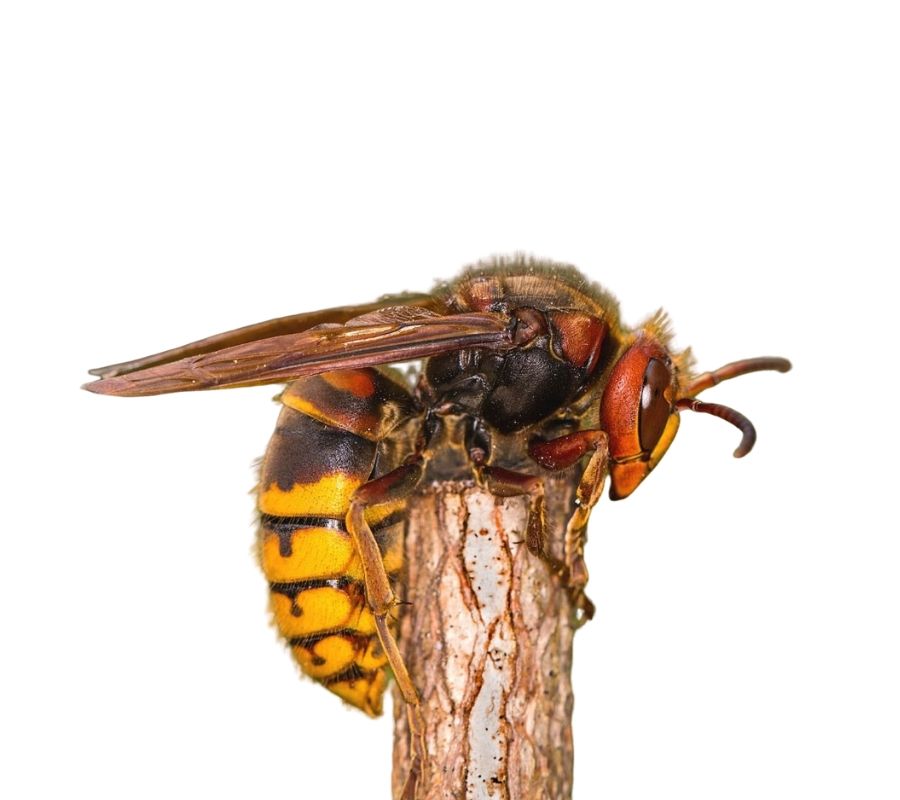
European Hornets
Reviewed by TJ, ACE Certified Technician · Updated 2026-05-21
Vespa crabro | Category: Stinging Insects | ✓ Covered: All Seasons Pest Plan
If you’ve spotted a large brown-and-yellow hornet thumping against your porch light at night, you’re looking at one of the more unusual stinging insects in North America. European hornets are the only true hornet species established in the United States, bigger than bald-faced hornets, smaller than the Asian Giant Hornets that made headlines a few years back, and notably less aggressive than yellowjackets despite their intimidating size. They’re also uncommon in our region. Here’s how to know if that’s what you’re actually seeing.
| Size | 1/2″ to 1.4″ long (largest established wasp in the US) |
|---|---|
| Color | Reddish-brown head & thorax; brown-and-dull-yellow striped abdomen; pale face |
| Top ID Marker | Nocturnal, attracted to porch lights at night |
| Active Season | Spring through fall; peak late summer |
| Nest Sites | Tree hollows, attics, wall voids, barns, usually 6+ ft up |
| PNW Prevalence | Uncommon, mostly established east of the Mississippi |
| Plan Coverage | ✓ Covered under All Seasons Pest Plan |
Need help with this pest?
Get A QuoteQuick Answer: European hornets (Vespa crabro) are large (1/2″–1.4″) reddish-brown and dull-yellow wasps and the only true hornet species established in the United States. Introduced from Europe in the 1840s, they are primarily found in the eastern and midwestern US and are uncommon in the Pacific Northwest. They are unusual among wasps for being nocturnal, foraging at night and often gathering at porch lights. Despite an intimidating size, they are notably less aggressive than yellowjackets or bald-faced hornets. They can sting multiple times and pose a serious risk to people with insect-sting allergies.
Key facts at a glance: Size: 1/2″–1.4″ · Color: brown & yellow · Nocturnal: yes · True hornet: yes · PNW prevalence: uncommon · Multiple stings: yes · Anaphylaxis risk: yes (for allergic individuals) · Plan coverage: Yes, All Seasons Pest Plan.
Not the same as “murder hornets”: European hornets are completely different from Northern Giant Hornets, also known as Asian Giant Hornets or “murder hornets” (Vespa mandarinia). The Northern Giant Hornet was detected in Washington state starting in 2019, and the Washington State Department of Agriculture confirmed eradication of the small established population by 2024. If you spot a large hornet in the PNW today, it’s far more likely to be a misidentified bald-faced hornet or queen yellowjacket than either species.
Safety note: If you or someone in your household has a known insect-sting allergy, treat any suspected European hornet nest near the home as an urgent issue. Symptoms of anaphylaxis after a sting, difficulty breathing, throat swelling, hives away from the sting site, rapid pulse, or dizziness, are a medical emergency. Call 911. Use a prescribed epinephrine auto-injector if available.
What You Need To Know About European Hornets
Our ACE Certified Technician TJ breaks down European hornets, what they actually look like, why their nocturnal behavior is unique, and how they differ from Asian Giant Hornets.
Frequently Asked Questions
What do European hornets look like?
Big, 1/2″ to 1.4″ long. Reddish-brown head and thorax, with a brown-and-dull-yellow striped abdomen and a pale face. Larger than bald-faced hornets, smaller than Asian Giant Hornets. The only true hornet established in the US.
Are these the “murder hornets”?
No. European hornets are a different species from Northern Giant Hornets (the “murder hornets” that were detected in WA from 2019–2024). WSDA confirmed eradication of the WA population in 2024. If you see a large hornet in the PNW today, it’s most likely a bald-faced hornet or queen yellowjacket.
Are they common in OR & WA?
No, uncommon. Their established range is mostly the eastern half of the US. They’ve been documented in the PNW occasionally but aren’t a widespread household pest here. Most large hornet sightings in the PNW are actually other species.
Are they dangerous?
They can sting multiple times and the venom causes intense pain. For people with insect-sting allergies, stings can trigger anaphylaxis. That said, they’re notably less aggressive than yellowjackets or bald-faced hornets, they usually only sting when the nest is directly threatened.
Why are they at my porch light?
Almost unique among wasps, European hornets forage at night and are strongly attracted to outdoor lights. If you see large brown-and-yellow hornets at your porch light after dark in summer, that’s the strongest behavioral indicator for the species, and a sign of a nest somewhere within a few hundred yards.
Where do they nest?
Enclosed sites at least 6 feet up: tree hollows, attics, wall voids, barns, sheds. Unlike bald-faced hornets that build visible aerial nests, European hornet nests are usually hidden inside cavities, which means you’ll often hear them before you see them.
Does my All Seasons Plan cover nest removal?
Yes, included. European hornet nests inside attics or wall voids often need specialized equipment to reach and treat safely without spreading the colony.
Do they damage trees?
Yes, they strip bark from young trees (lilac, birch, dogwood, ash are common targets) to feed on the sap. Severe girdling can kill the tree. This is one of the few ways they cause property damage beyond sting risk.
Signs You Might Have European Hornets
European hornets behave differently than the wasps most PNW homeowners encounter. Here’s what tips off our technicians:
1. Large hornets at porch lights at night
The single most diagnostic sign. Most wasps and hornets are strictly diurnal, if you’re seeing big brown-and-yellow hornets at lights after dark, this is probably European hornets.
2. Buzzing from inside walls or attics
Because European hornets nest inside cavities, the colony is often audible before it’s visible. Persistent buzzing from a specific spot in a wall, ceiling, or attic in late summer is a strong indicator.
3. Stripped bark on small trees or shrubs
European hornets sometimes girdle young branches of lilac, birch, dogwood, and ash. Look for fresh light-colored stripes where bark has been chewed away.
4. Hornets at a hole in a tree or eave
A steady stream of large hornets coming and going from a tree cavity, attic vent, or gap in siding indicates an enclosed nest. Watch from a safe distance.
5. Distinct brown & dull yellow coloration
If you can get a photo (safely) and it shows a reddish-brown head and thorax with brown-and-yellow stripes, not pure yellow-and-black like yellowjackets, that supports European hornet ID.
6. Continued activity late in the season
European hornet colonies tend to remain active into October in mild PNW falls, longer than many other wasps. Late-season activity around a cavity nest is consistent with the species.
Behavior, Biology & Lifecycle
European hornets are unusual among stinging insects in several ways, and the differences explain why removal looks different from other species:
The only true hornet in the US
Vespa crabro is the only species of true hornet (genus Vespa) established in North America. Bald-faced hornets are technically aerial yellowjackets, named “hornet” for their size, but biologically different. European hornets are the real thing.
Introduced from Europe in the 1840s
First documented in the New York City area in the 1840s, the species spread west and is now established across roughly 30 eastern and midwestern states. PNW establishment has been limited, the species exists here but isn’t a widespread household pest the way it is in places like Pennsylvania or Ohio.
Nocturnal foragers, rare among wasps
Most wasps and hornets return to the nest at dusk and stay put until dawn. European hornets break that rule, they continue foraging at night and are strongly attracted to outdoor lights. Banging against your porch light or window at night is classic behavior.
Less aggressive than reputation suggests
Despite their intimidating size, European hornets are notably less aggressive than yellowjackets or bald-faced hornets. They usually only sting when their nest is directly disturbed or they’re physically threatened. Foraging hornets at a porch light typically ignore people who don’t engage them.
Cavity nesters, not aerial builders
European hornets nest inside enclosed cavities, tree hollows, attics, wall voids, barns, sheds, abandoned beehives. They don’t build the visible football-shaped aerial nests bald-faced hornets are known for. The colony is usually hidden, which makes professional treatment more involved.
Annual colonies, predator diet
Like other wasps, European hornet colonies are annual, the colony dies in late fall and only mated queens overwinter. Workers prey on other insects (including pest species like flies and yellowjackets) to feed larvae, and adults consume tree sap and ripe fruit.
Homeowner Safety Steps
These steps are about identification and safety, not DIY nest removal from cavity locations.
Get a positive ID first
Most large hornet sightings in the PNW aren’t European hornets. A safely-taken photo and side-by-side comparison with the ID card on this page is the fastest way to confirm what you actually have.
Reduce outdoor lighting at night
European hornets are strongly drawn to outdoor lights. Switching to yellow “bug” bulbs, motion-activated lights, or warmer-temperature LEDs reduces nighttime attraction near the home.
Don’t attempt to open a cavity nest
European hornet nests inside walls, attics, or trees should not be opened by a homeowner. Disturbing a hidden colony can release hundreds of defensive workers into a confined space.
Keep distance from active entrances
If you’ve identified a nest entrance, stay 15–20 feet away and brief the household on the location. Move outdoor furniture out of the flight path. Keep pets and kids clear.
Call a licensed pro for removal
Cavity-nest treatment requires equipment most homeowners don’t have, injection products, proper PPE, and access methods to treat hidden colonies without spreading them.
European Hornets vs. Other Large Hornets & Wasps
Because misidentification is so common with large stinging insects, especially after the “murder hornet” coverage in 2019–2024, here’s a side-by-side comparison of the species PNW homeowners actually see and ask about:
| Feature | European Hornet | Bald-Faced Hornet | Yellowjacket | Northern Giant Hornet (“Murder Hornet”) |
|---|---|---|---|---|
| Size | 1/2″–1.4″ | 12–15 mm | 10–15 mm | Up to 2″ (largest) |
| Color | Brown & dull yellow | Black with white face | Yellow & black banded | Orange head, dark thorax |
| Active at night? | Yes (unique) | No | No | No |
| Nest type | Cavity (tree hollow, attic) | Aerial grey paper football | Underground or wall void | Underground cavity |
| Aggression at nest | Moderate | Very high | Very high | High |
| PNW presence | Uncommon | Common | Very common | Eradicated from WA in 2024 |
| True hornet? | Yes | No (aerial yellowjacket) | No (yellowjacket) | Yes |
| Plan coverage | ✓ All Seasons | ✓ All Seasons | ✓ All Seasons | Report to WSDA |
Plans That Cover European Hornets
All Seasons Pest Plan
$39/month
Setup fee $260 for initial treatment
Year-round protection from the pests Pacific Northwest homeowners deal with most, including stinging insect nest removal for hornets, yellowjackets, and wasps.
- Recurring exterior treatments
- Cavity-nest removal capability
- Re-services included as needed between visits
Pest & Rodent Bundle
$47/month
Setup fee $280 for initial treatment
The most complete protection for your home. Full pest coverage plus active rodent monitoring, one plan, one team, one less thing to worry about.
- Everything in Pest & Rodent plans
- Best value for whole-home protection
- Re-service guarantee
What Our Customers Are Saying
Real Results From Real Customers
Get help with European hornets in your area
Interstate Pest Management helps with European hornets across Oregon and Washington. Choose your area to see local plans, pricing and the number for your nearest team.