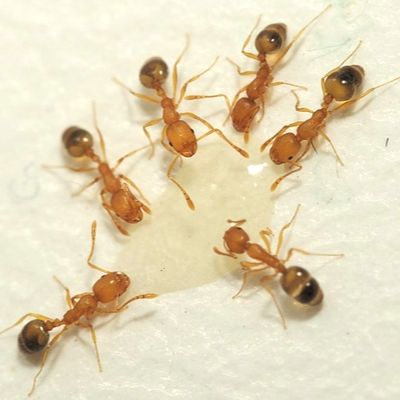
Pharaoh Ants
Reviewed by TJ, ACE Certified Technician · Updated 2026-05-19
Monomorium pharaonis | Category: Ants | ✓ Covered: All Seasons Pest Plan
Tiny yellowish ants that won’t leave your kitchen, no matter the season? You’re probably dealing with pharaoh ants. They’re an invasive species from Africa, they live almost exclusively inside heated buildings in our climate, and they’re one of the few ants that genuinely gets worse when you spray. We’ve been working with pharaoh ants in Pacific Northwest homes for over sixty years, here’s what you need to know before you call anyone.
| Size | 1/16″ – 1/12″ (smaller than most kitchen ants) |
|---|---|
| Color | Light yellow to reddish-brown with a darker abdomen tip |
| Top ID Marker | Tiny, pale, indoors year-round, even in winter |
| Active Season | Year-round indoors; cannot survive PNW winters outside |
| Nest Sites | Wall voids, under floors, behind appliances, inside outlets & switches |
| Colony Size | Hundreds of thousands of workers, thousands of queens per colony |
| Plan Coverage | ✓ Covered under All Seasons Pest Plan |
Need help with this pest?
Get A QuoteQuick Answer: Pharaoh ants (Monomorium pharaonis) are tiny (1/16″–1/12″), light yellow to reddish-brown ants that live exclusively inside heated buildings in the Pacific Northwest year-round. They don’t bite or sting, but university extension entomology research documents them as mechanical vectors of pathogens like Salmonella and Staphylococcus, a concern in kitchens and especially in healthcare settings. The species is famously resistant to DIY treatment because over-the-counter sprays cause colonies to “bud” and split, creating multiple new infestations. Bait-based professional treatment is the only reliable elimination method.
Key facts at a glance: Size: 1/16″–1/12″ · Color: light yellow/reddish-brown · Bites or stings: no · Pathogen carrier: yes (mechanical) · Indoors year-round: yes · Sprays make it worse: yes · Treatment time: 6–8 weeks · Plan coverage: Yes, All Seasons Pest Plan.
What You Need To Know About Pharaoh Ants
Frequently Asked Questions
What do pharaoh ants look like?
Very small, 1/16″ to 1/12″, light yellow to reddish-brown, with a darker abdomen tip. Workers are all the same size. The easiest tell: they’re indoors in the middle of winter when nothing else is.
Are they dangerous?
They don’t bite or sting. Entomology research has documented them as mechanical carriers of bacteria including Salmonella and Staphylococcus, a real concern in hospitals and food prep areas. In a typical home, the main practical issue is food contamination.
Why do they come back after I spray?
Sprays make pharaoh ants worse. When stressed, the colony “buds”, splits into multiple new colonies that scatter deeper into the structure. One spray often turns one infestation into three. Bait is the only reliable approach.
Are pharaoh ants the same as sugar ants?
“Sugar ant” is a catch-all homeowners use. In the PNW, it usually means pharaoh ants, odorous house ants, or thief ants. Pharaoh ants specifically are the small pale yellow ones that show up indoors all year, not just summer.
Does my All Seasons Plan cover them?
Yes, fully covered. Because pharaoh ants need a specific bait protocol and follow-up, the plan includes return visits and as-needed re-services if activity comes back between scheduled appointments.
Where do they nest in my house?
Warm and hidden: wall voids near plumbing, under floors, behind dishwashers and refrigerators, behind baseboards, and very commonly inside electrical outlets and switch boxes. They follow plumbing and wiring across long distances.
How long until they’re gone?
Activity usually drops noticeably within 2–4 weeks. Full colony elimination is typically 6–8 weeks, sometimes longer. With thousands of queens, every one has to be reached by bait, this takes patience and follow-up visits.
How do I tell them apart from other ants?
Tiny, pale, and indoors in winter is the pharaoh ant fingerprint. Odorous house ants are darker and smell like rotten coconut. Carpenter ants are huge by comparison. If you’re unsure, snap a photo and send it to us, one of our techs will give you a quick ID.
Signs You Have Pharaoh Ants
Pharaoh ants behave differently than the ants most PNW homeowners know. Here’s what tips off our technicians, in the order it usually shows up:
1. Tiny pale ants, in winter
The single most diagnostic sign. Small yellow-brown ants foraging in January in Portland or Olympia almost certainly means pharaoh ants, nothing else native to the PNW behaves this way.
2. Trails that don’t lead outside
Most ant trails terminate at an exterior wall. Pharaoh ant trails disappear into electrical outlets, switch plates, wall voids, or behind appliances, the nest is inside the structure.
3. Activity in bathrooms & kitchens
Heated, humid rooms with steady food and water. Pharaoh ants concentrate around sinks, toilets, dishwashers, refrigerators, and shower drains.
4. Recurrence after spraying
If you sprayed a trail and within a week or two new trails appeared in different rooms, the colony budded. This is one of the clearest pharaoh ant signatures.
5. Activity across multiple rooms
Pharaoh colonies travel along plumbing and electrical lines. Trails showing up in the upstairs bathroom and the downstairs kitchen usually means one large connected colony.
6. Foraging on both sweet & protein
Pharaoh workers will go after honey one day and pet food the next. If you saw a trail switch from one food type to another, that’s consistent with pharaoh behavior.
Behavior, Biology & Why They’re Different
Pharaoh ants behave unlike any other ant most PNW homeowners encounter. Understanding why is the single best argument for skipping DIY and calling a professional:
Invasive, not native, and indoor-only
Monomorium pharaonis is thought to have originated in Africa and is now distributed worldwide through human commerce. Crucially for the Pacific Northwest: they cannot survive our winters outdoors. Established pharaoh ant infestations live their entire lifecycle inside heated buildings.
Thousands of queens, not one
A single pharaoh colony can contain thousands of queens and hundreds of thousands of workers, spread across many interconnected sub-nests. Eliminating one queen does almost nothing. Treatment has to reach all of them, which is why bait is the only viable approach.
Budding under stress
When the colony is threatened, by repellent sprays, sudden weather changes, or even heavy disturbance, workers carry eggs, larvae, and several queens to a new location. This is why sprays are so counterproductive: each one risks splitting the colony into multiple new infestations.
Lifecycle: ~38 days egg to adult
Under typical indoor temperatures, eggs hatch in 7–8 days, larvae develop for about 18–19 days, and pupae take 9–12 days. Queens can live up to 12 months and lay hundreds of eggs in their lifetime. Rapid development plus year-round heated conditions means populations build quickly.
Mechanical pathogen vectors
University extension entomology literature documents pharaoh ants carrying Salmonella, Staphylococcus, Streptococcus, Pseudomonas, and Clostridium on their bodies. This is a particular issue in healthcare and food-handling environments. In a typical home, the practical risk is contamination of exposed food and prep surfaces.
No swarming flights indoors
Unlike most ant species, pharaoh ants don’t produce traditional winged swarms inside buildings. Reproductives mate inside the colony and new queens leave on foot with workers to start daughter colonies nearby, another reason infestations spread room to room rather than house to house.
DIY Homeowner Steps
Do not spray visible trails
The single most important rule. Repellent sprays cause pharaoh colonies to bud and multiply. If you’ve sprayed already, stop, and note where activity moves next.
Clean up food sources
Pharaoh ants forage on sweets, proteins, and greases. Seal pantry items, clean pet bowls, wipe counters daily. This slows recruitment but won’t resolve the colony.
Address moisture sources
Check under sinks, behind appliances, and around bathrooms for leaks or standing water. Pharaoh ants need consistent moisture to survive.
Note where you see activity
Outlets, switch plates, baseboards, behind appliances. Mapping the trails helps our technician identify nest locations on the first visit.
Call a pro for bait-based treatment
Pharaoh ants need a species-specific bait protocol, usually rotating between sweet and protein. This is not replicated effectively by store-bought ant traps.
Pharaoh Ants vs. Other PNW Ants
Pharaoh ants are routinely confused with the other small light-colored ants of the Pacific Northwest. Here’s how to tell them apart:
| Feature | Pharaoh Ant | Odorous House Ant | Thief Ant | Carpenter Ant |
|---|---|---|---|---|
| Size | 1/16″–1/12″ (smallest) | 1/16″–1/8″ | 1/32″–1/16″ | 1/4″–1/2″ |
| Color | Light yellow to reddish-brown | Dark brown to black | Pale yellow to light brown | Black, sometimes red & black |
| Indoors year-round? | Yes, can’t survive PNW winters outside | Often | Sometimes | Sometimes (in damp wood) |
| Smell when crushed | None distinctive | Rotten coconut | None distinctive | Slight formic acid (vinegar) |
| Damages structure? | No | No | No | Yes, excavates wood |
| Disease-vector risk | Yes (mechanical) | Low | Low | Low |
| DIY spray response | Buds & spreads (worst) | Buds & spreads | Workers die, queens unaffected | Workers die, queens unaffected |
| Plan coverage | ✓ All Seasons | ✓ All Seasons | ✓ All Seasons | ✓ All Seasons |
Plans That Cover Pharaoh Ants
All Seasons Pest Plan
$39/month
Setup fee $260 for initial treatment
Year-round protection from the pests Pacific Northwest homeowners deal with most, ants, spiders, wasps, box elder bugs, and more. Includes the bait-based protocol pharaoh ants require.
- Recurring exterior & interior treatments
- Species-specific bait protocols
- Re-services included as needed between visits
Pest & Rodent Bundle
$47/month
Setup fee $280 for initial treatment
The most complete protection for your home. Full pest coverage plus active rodent monitoring, one plan, one team, one less thing to worry about.
- Everything in Pest & Rodent plans
- Best value for whole-home protection
- Re-service guarantee
What Our Customers Are Saying
Real Results From Real Customers
Get help with pharaoh ants in your area
Interstate Pest Management helps with pharaoh ants across Oregon and Washington. Choose your area to see local plans, pricing and the number for your nearest team.