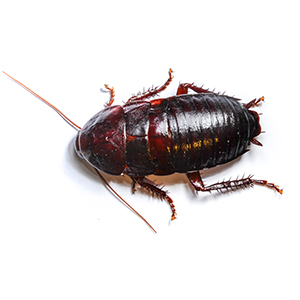
Wood Cockroach
Parcoblatta species · Category: Cockroaches · Outdoor insect, flies to lights in June, does not infest
This is the page where we tell you that you probably do not need us. The wood cockroach does not infest houses. It does not breed indoors, it does not feed indoors, and Penn State Extension reports it dies within a few days inside from dehydration. On control, the same source is direct: pesticides are not necessary or recommended.
It gets blamed for the other four constantly, because it is a cockroach, it turns up indoors, and in June the males fly at porch lights. Almost every call we take about this one ends with us explaining what it is and nobody buying anything. That seems like the right outcome, so we wrote the page that way.
Not sure which cockroach you have?
Ask Us To Identify It| Size | Males up to 1 inch, females up to 3/4 inch |
|---|---|
| Color | Light brown to nearly black, often with cream stripes along the edges of the wings and the shield behind the head |
| Top ID marker | Found in June, flying, near a light, in a rural or wooded area |
| Habitat | Outdoors only. Leaf litter, fallen logs, loose bark, woodpiles, under stones |
| Flight | Males fly. Females have short non-functional wings and cannot |
| Indoors | Dies within a few days. Does not feed or reproduce inside |
| Treatment | Not recommended. Exclusion and lighting changes instead |
Quick Answer: Wood cockroaches (Parcoblatta species) are outdoor insects that live in leaf litter, fallen logs, loose bark and woodpiles. They do not infest buildings: Penn State Extension states they die within a few days indoors from dehydration and do not feed or reproduce there, and that pesticides are not necessary or recommended. Males grow up to an inch and can fly, and are sometimes drawn to lights at night in rural areas, mostly in June. Females reach about three quarters of an inch and cannot fly. They get inside on firewood, through foundation cracks, and around doors and windows, or by flying to a porch light. The fix is exclusion, moving woodpiles away from the house, and changing outdoor lighting. Not a spray.
Key facts at a glance: Males up to 1 inch, females up to 3/4 inch · Cream stripes along the wing edges · Only males fly · Peak flight June · Dies indoors in days · Does not breed indoors · Treatment: not recommended
The short version: if you are in a wooded or rural part of Oregon or Washington, it is June, and something brown flew at your porch light, this is almost certainly what you have, and it will be dead in a few days whether you do anything or not. The only reason to keep reading is to be sure it is not one of the four cockroaches that genuinely do move in.
What You Need To Know About Wood Cockroaches
Frequently Asked Questions
Do I need to treat for these?
No. Penn State Extension says plainly that pesticides are not necessary or recommended for wood cockroaches, because they die quickly indoors and do not reproduce there. The things that actually work are exclusion and changing what is attracting them, and both are jobs you can do yourself in an afternoon. We would rather tell you that than sell you a quarterly service you do not need.
How do I know it is not a German or American cockroach?
Three questions usually settle it. Where were you? Wood cockroaches turn up in wooded and rural properties, not in apartment kitchens. What month is it? Their flight activity is concentrated in June. And was it flying? Male wood cockroaches fly readily, German cockroaches do not fly at all, and American cockroaches rarely fly this far north. If you are finding small striped cockroaches near the sink in February, that is a different insect and a different page.
Why are there suddenly several of them?
Because the males are out at once. Their flight period is concentrated, which is why national search interest for this species puts 20.3% of the whole year into June and swings 11.3 to one between its busiest and quietest month, more than double any other cockroach on our charts. It feels like an infestation starting. It is a few weeks of mating flights that end on their own.
How are they getting in?
Penn State lists the routes: cracks in the foundation, gaps around windows and doors, carried in on firewood, or flying to porch lights and then finding a way through. The firewood route is the one people underestimate. A stack against the siding is both habitat and a bridge.
Are they dangerous or dirty?
They are an outdoor insect that eats decaying plant matter in damp places, rather than one that travels through sewers and drains. They do not establish indoors, so they do not build up the populations that make other cockroach species a concern. Cockroach protein is a recognized asthma trigger in general, but that research concerns established indoor infestations, which this species does not create.
Can I tell males from females?
Easily, and it is worth knowing because only one of them flies. Males are longer and slimmer, up to an inch, with full wings covering the abdomen. Females reach about three quarters of an inch, are wider bodied, and have short non-functional wings that often leave the tip of the abdomen exposed. A wood cockroach that flew at you was a male.
Will they come back next year?
If you live next to woods, yes, every June, and that is normal. The point of the exclusion and lighting work below is not to eliminate them from your property, which is neither possible nor desirable. It is to stop them ending up inside where they die on your floor.
When should I actually call someone?
When you are not sure what you have, which is a good reason and costs you nothing. Also if you are finding cockroaches indoors outside the June flight window, if they are turning up in a kitchen or bathroom rather than near doors and windows, if they seem to be surviving and increasing rather than dying off, or if you are finding egg cases or nymphs indoors. Any of those point to one of the four species that do infest.
How To Recognize a Wood Cockroach
Context does most of the work here. The same insect in a different setting would mean something else entirely.
1. It flew at a light
Male wood cockroaches fly and are sometimes drawn to lights at night in rural areas. Of the five species here, this is by far the likeliest flyer in the Northwest.
2. It is June
Their flight activity concentrates hard into early summer. A flying cockroach at a porch light in June in a wooded area is close to a positive identification on its own.
3. Cream stripes along the wing edges
Many wood cockroaches carry pale cream stripes along the outer edges of the wings and the shield behind the head. Not dark lengthways stripes, and not crossways bands.
4. You live near trees
Leaf litter, fallen logs, loose bark, woodpiles and stones are the habitat. Wooded lots, rural properties and yards backing onto greenspace are where this comes up.
5. You find them dead, not thriving
Indoors they dehydrate and die within a few days. Finding dead ones near doors, windows and light fixtures is the normal pattern and is itself diagnostic.
6. No egg cases, no nymphs, no droppings
They do not feed or reproduce indoors, so the evidence of an established population never appears. If you are finding that evidence, you have a different species.
Behavior, Biology & Lifecycle
It is an outdoor animal
Leaf litter, under fallen logs and loose bark, in wood piles and under stones, feeding on decaying plant matter in damp areas. Everything about it is built for that and not for a heated house.
Indoors is fatal to it
Penn State reports wood cockroaches die within a few days indoors from dehydration, and that they do not feed or reproduce there. This is the single fact that separates it from every other cockroach on this site.
Only males fly
Males are longer and slimmer with full wings. Females are wider with short non-functional wings and cannot fly. That difference is why the June sightings are so lopsided.
The June spike is real
It is not an artifact of people paying more attention in summer. It is a concentrated male flight period, and it shows up in the data as the sharpest seasonal signal of any cockroach we track.
Firewood is the main ride
They live in woodpiles, so a stack carried inside brings them with it. Bringing in only what you will burn, and storing the rest off the ground and away from the house, removes most of the problem.
It is a genus, not one species
Parcoblatta covers several similar species, which is why size and shade vary from one to the next. For practical purposes they behave the same and the advice is identical.
Local context: Oregon and Washington
The biggest spike on the whole chart belongs to the one that does not infest
Across five years of cockroach service records in Portland, Vancouver, Salem, Olympia and Kelso/Longview, our new cockroach customers arrive at almost exactly the same rate every month of the year. The quietest month holds 7.1% of the year and the busiest holds 10.0%. An evenly split year would be 8.3% a month. Our records tag cockroaches as a group rather than by species, so the orange line is every cockroach we treat.
The wood cockroach is the exception to everything else on this page. Its search year swings 11.3 to one between the busiest month and the quietest, more than double the next species. June alone holds 20.3% of its year. Nothing else on the chart comes close.
That spike is not people noticing more in summer. It is a real event with a date: June is when the males fly, and Penn State notes they are sometimes drawn to lights at night in rural areas. So a species that cannot live in your house generates the sharpest seasonal signal of the five, in the one month its males are airborne. Everything worth knowing about this cockroach is contained in that sentence.
Two flat lines, twelve months
Each series is its share of its own annual total, so the two are directly comparable. The dotted line is what a perfectly even year looks like.
Blue line: Google search interest in Oregon and Washington, 2021 to 2025, the two states combined in proportion to their population. See it in Google Trends. Orange line: our own first-appointment records. We show shares rather than customer counts, and because this is a smaller sample than our spider or rodent records we describe the curve as flat rather than naming a busiest month.
Which cockroach actually has a season
One row per species, twelve months, darkest in that species’ busiest month. The right hand column is the gap between its busiest month and its quietest. The top row is ours and covers Oregon and Washington. The five species rows below it are national search interest, because Oregon and Washington on their own do not generate enough searches for individual cockroach species to measure.
Species rows: Google search interest across the United States, 2021 to 2025. See these five terms in Google Trends. Top row: Interstate Pest first appointments in Oregon and Washington.
Read the bottom row
One dark block in June and very little else. That is the only row on this chart driven by a single, datable biological event rather than by a gradual seasonal drift, and it belongs to the only species here that will never infest anything.
Now look at the top two rows. Ours and the German cockroach are nearly flat, and the German cockroach is the one that genuinely takes over a kitchen. The chart is a decent summary of the whole subject: the loudest signal and the real problem are not the same thing.
“June and July we get the calls. Somebody is out on the deck, something the size of your thumbnail flies at the porch light, and it looks like a roach because it is one. I tell them the same thing every time: it came out of the woodpile, it is going to die in your house in a couple of days, and you do not need us. Move the firewood off the siding, put a bulb out front that does not pull bugs in, fix the door sweep. That is the whole job.”
TJ Jackson · ACE, Director of Operations, Interstate Pest Management

You probably do not need a treatment for this one. If you are not certain what you are looking at, send us a photo or call and we will tell you, at no charge. If it turns out to be one of the four that do infest, both All-Seasons plans cover cockroaches.
Not sure what you have?
- Portland503-782-1899
- Vancouver360-996-1442
- Salem503-461-0259
- Olympia360-526-8004
- Kelso / Longview360-515-3882
What Actually Works
All of this is free or close to it, and none of it is a treatment.
1. Move the woodpile
Off the ground and away from the house rather than stacked against the siding. Bring in only what you are about to burn. This one change does more than everything else combined.
2. Change the porch light
Males come to lights. Warmer color temperature bulbs, fixtures aimed down rather than out, and switching off unused exterior lights during June all reduce how many arrive at the door in the first place.
3. Seal the obvious gaps
Foundation cracks, gaps around window and door frames, and worn weatherstripping. Penn State lists these as the entry routes, and closing them is ordinary maintenance that pays off against plenty of other things too.
4. Fit door sweeps
The gap under an exterior door is the most common way a porch-light visitor gets from outside to inside. A sweep is inexpensive and takes minutes.
5. Pull debris back from the foundation
Leaf litter, bark mulch and stacked material against the wall are habitat. A clear strip around the foundation reduces how many are living right at the threshold.
6. Vacuum and move on
For the ones that do get in, that is the entire treatment. They are dying anyway. There is nothing to break a lifecycle on, because there is no lifecycle happening indoors.
When it is worth a call anyway: if you are not confident in the identification. Getting this wrong in the other direction is the expensive mistake, because a German cockroach left alone for a season is a very different problem. Send a photo or call and we will tell you what it is at no charge. Also worth calling if you are seeing cockroaches indoors outside the June window, in kitchens or bathrooms rather than near doors and lights, or if you are finding egg cases, nymphs or droppings indoors.
Why we would rather you did not book this one: a quarterly treatment aimed at wood cockroaches would be billed against an insect that was going to die in your house in three days regardless, during a flight period that lasts a few weeks and then stops on its own. It would look like it worked. It would have worked without us. We would rather be the company that told you.
Wood Cockroach vs. The Cockroaches That Do Infest
This is the table worth reading, because the whole point of the page is making sure you have the one that does not infest rather than one of the four that do.
| Feature | Wood | German | Brown-banded | Oriental | American |
|---|---|---|---|---|---|
| Size | Males to 1 in, females to 3/4 in | 1/2 in | 1/2 in | About 1 to 1 1/4 in | 1 to 2 in |
| Marking | Light brown to near black, cream stripes along the wing edges | Two dark stripes front to back behind the head | Pale bands crossways over wings and abdomen | Uniform dark brown to nearly black, glossy | Reddish brown, pale edging around the shield behind the head |
| Lives | Outdoors only. Leaf litter, logs, bark, woodpiles | Indoors only | Indoors only | Crawl spaces, damp basements, drains | Sewers, drains, crawl spaces |
| Survives indoors? | No. Dies in a few days | Yes, and breeds rapidly | Yes, and breeds | Yes | Yes |
| Flies? | Males do, mostly in June | Winged, does not fly | Males sometimes, above 85°F | No. Neither sex | Able to, but rarely does here |
| Infests? | No. A nuisance, not an infestation | Yes, rapidly | Yes, more slowly | Sometimes | Sometimes |
| Our recommendation | Leave it alone. Exclusion and lighting only | Professional program | Professional program, placed high | Moisture and exclusion first | Exclusion and moisture first |
If It Turns Out To Be One Of The Others
You do not need a plan for wood cockroaches. If the identification goes the other way, though, cockroaches are covered by both plans, and the four species that do infest are all worth dealing with properly rather than late.
All-Seasons Pest Service
From $39/mo
- Insect elimination and ongoing prevention
- Covers 10+ common insects, cockroaches included
- Quarterly interior and exterior treatments
- Free emergency call-backs between scheduled visits
All-Seasons Pest and Rodent Service
From $47/mo
- Everything in the Pest Service, plus green rodent control
- Covers mice and rat removal
- Quarterly exterior treatments, interior as needed
- Free emergency call-backs, though rodent call-backs may be chargeable
Full details and the rest of the range are on the plans page.
Where This Information Comes From
Size by sex, coloring and cream stripes, wing development and flight, outdoor habitat, attraction to lights in rural areas, survival indoors, entry routes, and the recommendation against pesticides: Penn State Extension. Regional context and the species present in the Northwest: the PNW 186 cockroach bulletin from Washington State University, Oregon State University and the University of Idaho, and the Pacific Northwest Insect Management Handbook. Comparative identification and the figures for the four species that do infest: University of California IPM Pest Note 7467. Consumer guidance for the Northwest is maintained by NPIC at Oregon State University.