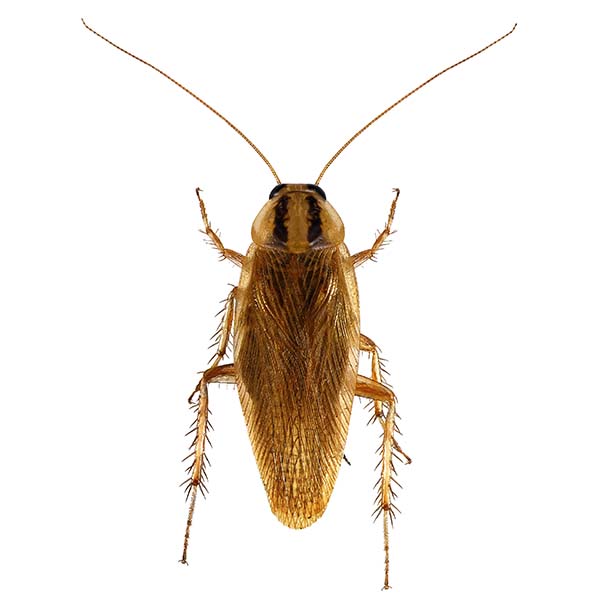
German Cockroach
Blattella germanica · Category: Cockroaches · Small, striped, lives indoors year round
The German cockroach is the one that moves in and stays. It is the most common cockroach in the Pacific Northwest, and unlike almost every other pest we treat, it has nothing to do with the weather outside. It lives, eats and breeds indoors, at the temperature you keep your house, 12 months a year.
That single fact explains most of what follows: why you see them in February, why a store-bought spray makes the problem look better for a week and worse for a month, and why this is the cockroach we tell people not to fight alone.
Need help with this pest?
Get A Free Quote| Size | About 1/2 inch as an adult |
|---|---|
| Color | Light brown to tan |
| Top ID marker | Two dark stripes running front to back on the shield behind the head |
| Habitat | Kitchens and bathrooms, within a few feet of food and water |
| Flight | Has wings, does not fly |
| Season | None. Active indoors all year |
| Plan coverage | ✓ Covered under both All-Seasons plans |
Quick Answer: German cockroaches (Blattella germanica) are small light brown cockroaches, about half an inch long, with two dark stripes behind the head. They are the most common cockroach in the Pacific Northwest. They live and breed entirely indoors rather than coming in from outside, they arrive carried in on groceries, cardboard, used appliances and furniture, and a female and her offspring can produce over 30,000 cockroaches in a year. Gel baits and sanitation work. Foggers and bug bombs do not, and can push the population deeper into the building.
Key facts at a glance: 1/2 inch · Two dark stripes on the pronotum · Indoors year round · 30 to 48 eggs per case · 3 to 4 generations a year · Carried in, not wandering in · Plan coverage: Yes
A note on timing: our own service records show cockroach work spread almost evenly across all 12 months. There is no season to wait out and no quiet period when the problem eases off on its own. Most pages on this site tell you when to act. This one spends its time on what to do.
What You Need To Know About German Cockroaches
Frequently Asked Questions
How did German cockroaches get into my house?
They were carried in. German cockroaches do not live outdoors in our climate and do not wander in from the yard the way Oriental cockroaches and other outdoor species do. Extension sources list the usual rides: grocery bags, especially bagged potatoes and onions, beverage cartons and cases, cardboard boxes, used furniture and used appliances, dry cleaning and luggage. In apartments and condos they also move between units through shared walls and plumbing. Finding them is not a verdict on how clean your home is.
Why do I see them in the middle of winter?
Because winter is irrelevant to them. They prefer 70 to 75 degrees, which is ordinary room temperature, and all life stages are present at any time of year. A cold snap outside does nothing to a population living behind your dishwasher.
Will a store-bought fogger or bug bomb clear them out?
No, and it usually makes things harder. The Pacific Northwest Insect Management Handbook, published jointly by Oregon State, Washington State and the University of Idaho, says over-the-counter sprays, foggers and bombs are not recommended because they scatter the cockroaches through the structure and into neighboring units. A 2019 study in 20 infested homes found foggers produced no reduction in cockroach numbers at all, while similarly priced gel baits produced significant declines. The same study measured pesticide residue on kitchen surfaces rising sharply after the foggers were used.
Why do sprays fail when baits work?
Resistance, and it is lopsided. Researchers testing cockroaches collected from apartments found roughly 202-fold resistance to cypermethrin, the pyrethroid class typical of foggers and consumer sprays, and only about 14-fold resistance to fipronil, a common bait ingredient. Over 96 percent carried a sodium channel mutation associated with pyrethroid resistance. The spray is fighting an insect that has been selected against it for decades. The bait is not.
Are they a health risk?
Cockroach proteins are a recognized asthma trigger. The clearest evidence concerns children who already have asthma: in a study of 476 inner-city children, those who were both allergic to cockroach allergen and living with high levels of it had more hospitalizations and more unscheduled medical visits than other children with asthma. Both halves mattered, allergy and exposure together. A later randomized trial found that reducing cockroach allergen in the home went along with fewer asthma complications. That is a good reason to deal with an infestation properly rather than live alongside it.
How fast does a small problem become a big one?
Faster than any other cockroach we deal with. A female produces 30 to 48 eggs per case and four to eight cases in her life, and there are three to four generations a year indoors, up to six in good conditions. University of California entomologists put the ceiling at over 30,000 individuals from one female and her descendants in a year. For comparison they put the brown-banded cockroach near 600 and the Oriental cockroach near 200.
Can I tell a German cockroach from a brown-banded one?
Yes, and it matters because the treatment differs. Both are about half an inch. The German cockroach has two dark stripes running front to back on the shield behind its head. The brown-banded cockroach has pale bands running crossways over the wings and abdomen, and pale markings on the sides of that shield rather than dark stripes. German cockroaches stay near food and water in kitchens and bathrooms. Brown-banded cockroaches spread out into warm high spots such as electronics and picture frames.
Signs You Have German Cockroaches
You will almost always see the evidence before you see a cockroach in daylight. Daytime sightings mean the harborage is already crowded.
1. Small striped cockroaches near the sink
Half an inch, light brown, two dark stripes behind the head, found within a few feet of food or water. That is the identification, and it is worth making carefully.
2. Droppings that look like ground pepper
Dark specks along the inside top edge of cabinet doors, in drawer corners, behind the refrigerator and under the sink. Smears in humid spots.
3. Egg cases
Light tan capsules around a quarter to a third of an inch, sometimes still attached to a female. Finding them means the population is breeding where you found them.
4. A musty odor
A sweetish, oily smell that gets stronger as numbers climb. Often noticed in a cupboard or under a sink before anything is seen.
5. Cockroaches in daylight
They prefer to move at night. Seeing them during the day usually means the hiding places are full, which points to a larger population than it looks like.
6. Shed skins
Nymphs molt six or seven times on the way to adulthood, leaving pale cast skins in cracks and corners. Steady numbers of skins mean steady breeding.
Behavior, Biology & Lifecycle
She carries the eggs
The female carries her egg case at the tip of her abdomen until one to two days before it hatches. Other pest cockroaches drop theirs early. Hers stays protected, which is a large part of why this species outbreeds the rest.
Built for cracks
An adult fits into a gap one sixteenth of an inch wide. Nymphs use smaller ones. Most of the population is inside a wall, a cabinet void or an appliance, not out where you can reach it.
Room temperature is their climate
They prefer 70 to 75 degrees and humid air, which is your kitchen. All life stages are present at any time of year, so there is no generation that dies off in winter.
Wings, but no flying
Adults are fully winged and stay on foot. If something cockroach-shaped flew at you outdoors on a summer evening here, a male wood cockroach is the likeliest candidate. They come to lights, they do not infest, and they die indoors within a few days.
Nymphs outnumber adults
In an established population most individuals are immature. That is why a treatment that only kills visible adults reads as a success for a week and a failure by the end of the month.
Egg to adult takes months
Roughly a month in the egg, then six weeks to four months as a nymph depending on warmth and food. Extension sources decline to give one number because it varies that much. Treatment has to keep working across that whole window.
Local context: Oregon and Washington
The German cockroach has no season here, and that is the whole problem
Across five years of cockroach service records in Portland, Vancouver, Salem, Olympia and Kelso/Longview, our new cockroach customers arrive at almost exactly the same rate every month of the year. The quietest month holds 7.1% of the year and the busiest holds 10.0%. An evenly split year would be 8.3% a month. Nothing in that spread is bigger than ordinary month-to-month noise.
For comparison, the same records put 44.8% of our spider year into three months, with a gap of more than seven to one between the busiest month and the quietest. Cockroaches run at 1.4 to one. Our records tag cockroaches as a group rather than by species, so the orange line is every cockroach we treat, not German cockroaches alone.
Search behavior in Oregon and Washington agrees. Interest in cockroaches runs from 5.7% of the year in February to 11.1% in August. That is a gentle summer rise across a year that is otherwise level. It is also growing: Oregon’s cockroach search interest ran about half again as high in 2025 as it did in 2021.
Two flat lines, twelve months
Each series is its share of its own annual total, so the two are directly comparable. The dotted line is what a perfectly even year looks like.
Blue line: Google search interest in Oregon and Washington, 2021 to 2025, the two states combined in proportion to their population. See it in Google Trends. Orange line: our own first-appointment records. We show shares rather than customer counts, and because this is a smaller sample than our spider or rodent records we describe the curve as flat rather than naming a busiest month.
Which cockroach actually has a season
One row per species, twelve months, darkest in that species’ busiest month. The right hand column is the gap between its busiest month and its quietest. The top row is ours and covers Oregon and Washington. The five species rows below it are national search interest, because Oregon and Washington on their own do not generate enough searches for individual cockroach species to measure.
Species rows: Google search interest across the United States, 2021 to 2025. See these five terms in Google Trends. Top row: Interstate Pest first appointments in Oregon and Washington.
Read the bottom row first
Wood cockroaches swing more than eleven to one across the year. June is when people go looking for them, which is when the males are flying and coming to lights. They do not infest, they die indoors within a few days, and the honest answer is usually to leave them alone.
Now read the top two rows. Ours and the German cockroach are the two flattest lines on the chart. Nothing about them eases off in November, which is why waiting is the one approach that reliably fails.
“People call us in January apologizing, like they have done something wrong by having cockroaches in winter. Nothing went wrong. German cockroaches never left, because they were never outside. Almost every job we walk into started with something carried through the door, a box, a used appliance, a bag of groceries. What I tell people is stop buying sprays. Every can you set off pushes them further into the walls and into the next apartment. Let us find where they actually live and bait it.”
TJ Jackson · ACE, Director of Operations, Interstate Pest Management

Free re-service if they come back between scheduled visits. Cockroaches are covered by both All-Seasons plans, from $39/mo for pests or $47/mo with rodents added.
Book an inspection
- Portland503-782-1899
- Vancouver360-996-1442
- Salem503-461-0259
- Olympia360-526-8004
- Kelso / Longview360-515-3882
What Actually Works
The extension consensus here is unusually consistent, and it points away from most of what the hardware store shelf offers.
1. Identify the species first
Both Oregon State and University of California guidance open on this point. Management options differ by species, and the German cockroach is the one that needs the full program. Getting this wrong wastes the next two months.
2. Sanitation, which the handbook calls the most important factor
Food residue, grease behind and under appliances, pet food left down overnight, and standing water. Cutting the food supply is what makes bait the most attractive thing in the room.
3. Gel bait, placed where they live
Under sinks, on the undersides of drawers, along baseboards, near the water heater and under or behind appliances. Expect seven days or more before numbers visibly drop.
4. Take away the harborage
Seal cracks of an eighth of an inch or more, seal around plumbing and outlets, fix the leaking trap under the sink, and get rid of stacked cardboard and paper. Cardboard is both a hiding place and the most common way they arrived.
5. Monitor with sticky traps
Extension guidance calls glue boards the best way to detect and track a population. Place them flat against walls, inside cabinets and under appliances. They tell you where the population actually is and whether treatment is working.
6. Skip the fogger
Covered above, and worth repeating because it is the most common wasted step. It scatters the population, raises pesticide residue on the surfaces you cook on, and leaves the cockroaches in the voids untouched.
Where do-it-yourself runs out: baits and sanitation genuinely work on a small, early, single-unit problem, and we would rather tell you that than sell you something you do not need. Call somebody when the population has been established for months, when you are in an apartment or condo where neighboring units are involved, or when baits worked and then stopped. If someone in the house has asthma, that is worth raising with us and with their doctor, because cockroach allergen is one of the things a thorough job reduces. Those situations need a monitoring-driven program rather than another product.
What a program looks like: in a study of 442 low-income apartments, a structured program of gel bait, targeted dust, sticky-trap monitoring and resident education cut the share of infested apartments by 74 percent in twelve months. Trap counts fell by more than 99 percent. The amount of bait needed dropped by roughly 90 percent between the first quarter and the fourth, because the population being fed kept shrinking. Cockroach allergen in house dust fell from 27.8 to 2.2 units per gram over the same year.
What Happens When You Call Us
Three steps, and the first one costs you nothing.
1. We find out where they live
An inspection with monitors, not a walk-through. We identify the species, place sticky traps, and find the harborage. In an apartment that includes working out whether the source is your unit or next door.
2. We bait the harborage and leave the monitors in
Gel bait where the population actually is, plus whatever exclusion and sanitation work the inspection turned up. The traps stay down so the next visit is measured rather than guessed.
3. We come back and read the traps
Counts either fell or they did not, and that decides the next move. If they come back between scheduled visits, the re-service is free.
German Cockroach vs. The Other PNW Cockroaches
Four cockroach species turn up in Pacific Northwest homes, and one wanderer gets blamed for all of them. Telling them apart decides what happens next.
| Feature | German | Brown-banded | Oriental | American | Wood |
|---|---|---|---|---|---|
| Size | 1/2 in | 1/2 in | About 1 1/4 in | Up to 2 in | 3/4 to 1 in |
| Marking | Two dark stripes front to back behind the head | Pale bands crossways over wings and abdomen | Uniform dark brown to nearly black, glossy | Reddish brown, pale edging around the shield behind the head | Brown, pale stripe along the wing edge |
| Lives | Indoors only | Indoors only | Outdoors, comes in | Outdoors and in warm damp voids | Outdoors, in woodpiles and leaf litter. Often carried in on firewood |
| Where in the home | Kitchens and bathrooms, near food and water | Warm high spots, electronics, furniture | Basements, crawl spaces, drains, ground level | Sewers, storm drains, water meter boxes, warm damp voids | Cannot survive indoors. Dies within a few days |
| Seasonal? | No, year round | No, year round | Yes, moves in as weather cools | Somewhat | Yes. Males fly through the warm months and come to lights at night |
| Infests? | Yes, rapidly | Yes, more slowly | Sometimes | Sometimes | No. A nuisance, not an infestation |
| Our recommendation | Professional program | Professional program | Exclusion plus treatment | Exclusion plus treatment | Usually leave it alone |
Plans That Cover German Cockroach Control
Cockroaches are covered by both plans. The difference is rodents, which matters more often than you would think: the same gaps and the same clutter that suit a cockroach suit a mouse.
All-Seasons Pest Service
From $39/mo
- Insect elimination and ongoing prevention
- Covers 10+ common insects, cockroaches included
- Quarterly interior and exterior treatments
- Free emergency call-backs between scheduled visits
All-Seasons Pest and Rodent Service
From $47/mo
- Everything in the Pest Service, plus green rodent control
- Covers mice and rat removal
- Quarterly exterior treatments, interior as needed
- Free emergency call-backs, though rodent call-backs may be chargeable
Full details and the rest of the range are on the plans page.
Where This Information Comes From
Identification, biology and regional prevalence: the PNW 186 cockroach bulletin from Washington State University, Oregon State University and the University of Idaho, and the Pacific Northwest Insect Management Handbook. Lifecycle and comparative reproduction figures: University of California IPM Pest Note 7467 and Penn State Extension. Fogger and resistance findings: DeVries et al. 2019, BMC Public Health and DeVries et al. 2019, Journal of Economic Entomology. Asthma evidence: Rosenstreich et al. 1997 and Morgan et al. 2004, both New England Journal of Medicine. Program results: Wang and Bennett 2009. Consumer guidance for the Northwest is maintained by NPIC at Oregon State University.