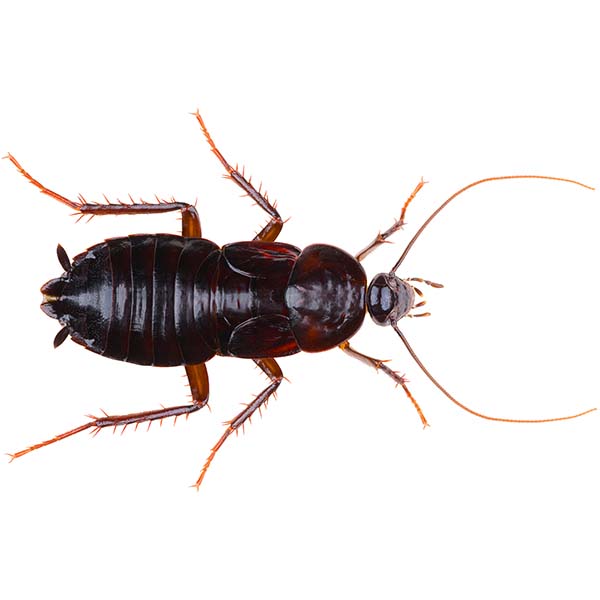
Brown-banded Cockroach
Supella longipalpa · Category: Cockroaches · Half an inch, banded crossways, lives high and dry
This is the cockroach that gets mistaken for a German cockroach, and the mistake is expensive. They are the same half inch long. They are both indoor breeders that never go outside. From across a kitchen they look like the same insect.
They live in opposite halves of the building. A German cockroach stays low, near food and water, in the kitchen and the bathroom. A brown-banded cockroach goes up and away from water: inside appliance housings, behind pictures on the wall, in the hollow legs of furniture, in closets and near the ceiling. Bait the kitchen for this one and you have baited an empty room.
Need help with this pest?
Get A Free Quote| Size | About 1/2 inch as an adult |
|---|---|
| Color | Males golden tan, females darker brown |
| Top ID marker | Pale bands running crossways over the wings and abdomen, and pale markings on the sides of the shield behind the head |
| Habitat | High and dry. Appliance housings, behind wall decor, hollow furniture legs, closets, near the ceiling |
| Flight | Males fly when disturbed, especially above 85°F. Females cannot |
| Season | None. Indoors year round, most visible in summer heat |
| Plan coverage | ✓ Covered under both All-Seasons plans |
Quick Answer: Brown-banded cockroaches (Supella longipalpa) are half-inch indoor cockroaches with pale bands running crossways over the wings and abdomen. Males are golden tan and fly when disturbed, especially above 85 degrees. Females are darker and cannot fly. They are routinely confused with German cockroaches, which are the same size but carry two dark stripes running front to back behind the head. The difference that matters is location: German cockroaches stay low near food and water, while brown-banded cockroaches spread high and dry through the building, into appliance housings, behind wall decor, inside hollow furniture legs and near ceilings. They prefer about 80 degrees, roughly 5 to 10 degrees warmer than a German cockroach. Treatment placed in the kitchen misses them.
Key facts at a glance: 1/2 inch · Pale crossways bands · Indoors year round · High and dry, away from water · About 13 eggs per case, around 14 cases · Over 600 per female per year · Egg cases glued to ceilings and undersides · Plan coverage: Yes
A note on how common this is: of the four cockroaches that infest Pacific Northwest buildings, this is the one we see least. If you have a small striped cockroach in a kitchen, a German cockroach is far more likely. It is worth taking two minutes over the identification anyway, because if it is this one, the entire treatment plan moves to a different part of the building.
What You Need To Know About Brown-banded Cockroaches
Frequently Asked Questions
How do I tell this from a German cockroach?
Look at the direction of the markings. The German cockroach has two dark stripes running front to back on the shield behind its head. The brown-banded cockroach has pale bands running crossways over the wings and abdomen, and pale markings on the sides of that shield rather than dark stripes down it. Males are golden tan, females are darker brown with wings that do not cover the whole abdomen. If you can, also note where you found it. Near the sink points to German. Up high, in a closet, or inside an appliance points here.
Why does the difference matter so much?
Because it moves the treatment to a different part of the building. University of California guidance notes brown-banded cockroaches are not usually associated with food preparation areas, and instead favor crevices in or near electrical appliances, behind artwork and decorations, inside hollow furniture legs and in accumulated clutter. Penn State puts it more bluntly: they hide nearer the ceiling than the floor and away from water sources. A gel bait program run along the kitchen baseboards is a good German cockroach program and close to useless here.
Do they fly?
Males do, sometimes, when disturbed, and University of California guidance notes this happens especially above 85 degrees. Females cannot fly at all. That is a real difference from the German cockroach, which is fully winged and stays on foot.
Where do the egg cases end up?
Glued down, in places you would never think to look. University of California entomologists describe females gluing light brown egg cases about a quarter inch long to ceilings, beneath furniture, and in closets and other dark places. Penn State puts a female’s output at around 14 capsules averaging 13 eggs each, with the egg stage lasting 37 to 103 days. Finding cases glued high in a closet is close to a confirmed identification on its own.
What are they even eating up there?
Not what you would guess. Penn State lists glue and paste, especially animal-based, starch, and certain color dyes, along with non-food items such as nylon stockings for the residual body oils and skin cells. That diet is why they end up in bookcases, behind wallpaper and picture frames, in dressers and inside electronics rather than in the pantry. It also means kitchen sanitation, which does real work against a German cockroach, does much less here.
How did they get in?
Carried, almost always, and usually inside something. Furniture, electronics, appliances, boxes and paper goods are the classic rides. In apartments and offices they also move between units. Because they do not live outdoors in our climate, an infestation means something came through the door with them in it.
How fast do they build up?
Faster than an Oriental or American cockroach, much slower than a German. University of California entomologists put one female and her offspring at over 600 in a year, next to more than 30,000 for a German cockroach. Penn State puts nymphal development at 8 to 31 weeks and adult females living 13 to 45 weeks. It is a problem that grows over months rather than weeks, which means an early identification genuinely changes the outcome.
Are they a health concern?
Cockroach proteins are a recognized asthma trigger, and most of the research concerns cockroach allergen in the home generally rather than this species specifically. If someone in the house has asthma, it is worth raising with us and with their doctor, because reducing cockroach allergen is one of the things a thorough job accomplishes.
Signs You Have Brown-banded Cockroaches
Nearly all of these are above waist height. If everything you are finding is under the sink, reconsider the identification.
1. Small banded cockroaches away from the kitchen
Half an inch, pale bands running crossways, found in a bedroom, living room, closet or office rather than within a few feet of food and water.
2. Egg cases glued up high
Light brown capsules about a quarter inch, glued to ceilings, the undersides of furniture, or inside closets. This is the most distinctive sign there is.
3. Activity in and around electronics
Inside television and appliance housings, behind a refrigerator motor, in a stereo or a cable box. Warm, dry, dark and undisturbed is the whole brief.
4. Droppings in odd, elevated places
Dark specks along the top edges of doors and picture frames, on upper shelves, and on the ceiling. German cockroach droppings show up low, in cabinets and drawers.
5. Shed skins in furniture
Pale cast skins in hollow chair and table legs, in dresser joints and behind wall decor. Nymphs molt repeatedly on the way to adulthood.
6. One flying at you on a hot day
Males fly when disturbed, especially above 85 degrees. A small banded cockroach that flew indoors in August is a strong pointer to this species.
Behavior, Biology & Lifecycle
It wants warm and dry
University of California guidance puts its preference at about 80 degrees, roughly 5 to 10 degrees warmer than a German cockroach prefers. Penn State notes it stays away from water sources. That combination is why it climbs.
It spreads out
A German cockroach concentrates near food and water, which makes it findable. This species distributes itself through the whole building in small pockets, which is why inspection takes longer and why partial treatment fails.
She glues the egg case down
Light brown, about a quarter inch, cemented to ceilings, furniture undersides and closet interiors. Around 14 capsules in a lifetime at roughly 13 eggs each, incubating 37 to 103 days.
Only the males fly
And only sometimes, when disturbed, mostly above 85 degrees. Females have wings that do not cover the whole abdomen and cannot fly at all.
An unusual diet
Glue and paste, starch, some dyes, and non-food items including nylon for the body oils left on them. It explains the bookcases and the furniture, and it is why cleaning the kitchen does not solve this one.
Slower than a German cockroach
Nymphs take 8 to 31 weeks, adult females live 13 to 45 weeks, and one female and her offspring reach over 600 in a year against the German cockroach’s 30,000. Early identification buys you real time.
Local context: Oregon and Washington
The rarest of the five here, and the one most often treated as something else
Across five years of cockroach service records in Portland, Vancouver, Salem, Olympia and Kelso/Longview, our new cockroach customers arrive at almost exactly the same rate every month of the year. The quietest month holds 7.1% of the year and the busiest holds 10.0%. An evenly split year would be 8.3% a month. Our records tag cockroaches as a group rather than by species, so the orange line is every cockroach we treat, not brown-banded alone.
Of the five species on this page, the brown-banded cockroach is by some distance the least searched for. Set the German cockroach at 100 and it comes in at 7. Part of that is genuine rarity. Part of it is that people who have one usually think they have a German cockroach and search for that instead, which is the mistake this whole page is about.
Its search year swings 4.6 to one and peaks in August, the same month as the German cockroach. That is a little surprising for a species that lives indoors year round, until you look at what it wants: about 80 degrees, roughly 5 to 10 degrees warmer than a German cockroach prefers, and the males start flying above 85. An August heat stretch in a house without air conditioning is exactly when this one becomes visible.
Two flat lines, twelve months
Each series is its share of its own annual total, so the two are directly comparable. The dotted line is what a perfectly even year looks like.
Blue line: Google search interest in Oregon and Washington, 2021 to 2025, the two states combined in proportion to their population. See it in Google Trends. Orange line: our own first-appointment records. We show shares rather than customer counts, and because this is a smaller sample than our spider or rodent records we describe the curve as flat rather than naming a busiest month.
Which cockroach actually has a season
One row per species, twelve months, darkest in that species’ busiest month. The right hand column is the gap between its busiest month and its quietest. The top row is ours and covers Oregon and Washington. The five species rows below it are national search interest, because Oregon and Washington on their own do not generate enough searches for individual cockroach species to measure.
Species rows: Google search interest across the United States, 2021 to 2025. See these five terms in Google Trends. Top row: Interstate Pest first appointments in Oregon and Washington.
Read the fourth row against the second
Brown-banded and German are the two species on this chart that live indoors and never go outside, and they are the two that peak in August. Everything else on the chart peaks in June, because everything else spends its year outdoors.
So the two indoor species look alike on this chart, they look alike in the kitchen, and they are the same half inch long. They still need different treatment, because they live in different parts of the building. That is the single most useful thing on this page.
“If somebody has been baiting under the sink for a month and nothing is happening, I start looking up. These do not want your kitchen. I find them behind a picture frame, up in the top corner of a closet, inside the case of a television, in the legs of a dining chair. Same size as a German roach, completely different address. Bait in the wrong room is just an expensive way to feed nothing.”
TJ Jackson · ACE, Director of Operations, Interstate Pest Management

Free re-service if they come back between scheduled visits. Cockroaches are covered by both All-Seasons plans, from $39/mo for pests or $47/mo with rodents added.
Book an inspection
- Portland503-782-1899
- Vancouver360-996-1442
- Salem503-461-0259
- Olympia360-526-8004
- Kelso / Longview360-515-3882
What Actually Works
Most of this is a German cockroach program pointed at a different part of the building.
1. Confirm the species before anything else
Crossways pale bands, not lengthways dark stripes. Found high and dry, not low and damp. Getting this wrong is what makes people spend two months baiting the wrong room.
2. Search high, and search wide
Closet shelves and corners, the tops of door frames, behind wall decor, inside hollow furniture legs, in dressers and bookcases, and inside and behind appliances and electronics. This is an inspection job more than a product job.
3. Put the bait where they actually are
Gel bait works on this species, but only if it is placed in the harborage. That means upper cabinet corners, closet shelving, behind wall-mounted items and near appliance housings, not along the kitchen baseboard.
4. Monitor high as well as low
Sticky traps on upper shelves, on top of cabinets and inside closets, not just under the sink. Trap placement is what tells you whether you have this species and whether treatment is working.
5. Deal with the clutter
Accumulated clutter is listed harborage for this species. Stacked paper, boxes, and undisturbed storage in warm rooms give it exactly what it wants, and clearing it removes hiding places bait cannot reach.
6. Check what comes through the door
Used furniture, secondhand electronics and appliances, and delivered boxes are how this species arrives. Worth a look before something goes into a bedroom or an office.
Where do-it-yourself runs out: a small, early, single-room problem can be handled with careful inspection and well-placed bait, and if that is your situation we would rather you just did it. Call somebody when you are finding them in more than one room, when you are in an apartment or office building where other units may be involved, when baits worked and then stopped, or when you have treated for a month with nothing to show for it, which usually means the identification or the placement was wrong. If someone in the house has asthma, that is worth raising with us and with their doctor.
Why the wrong identification costs a month: the two indoor cockroaches are the same size and look similar at a glance, so a brown-banded problem routinely gets a German cockroach program. That program concentrates bait and monitoring in the kitchen and bathroom, which is precisely where this species is not. Counts do not move, the conclusion drawn is that the bait failed, and the next step taken is usually a stronger product rather than a different room.
What Happens When You Call Us
Three steps, and the first one costs you nothing.
1. We identify it properly
Species confirmed first, because with these two it decides everything that follows. Then a whole-room inspection that includes the high and dry places, not just the kitchen.
2. We bait the harborage we found
Gel bait placed in the pockets the inspection turned up, plus monitors high and low so the next visit is measured rather than guessed.
3. We come back and read the traps
Counts either fell or they did not, and that decides the next move. If they come back between scheduled visits, the re-service is free.
Brown-banded vs. The Other PNW Cockroaches
Four cockroach species turn up in Pacific Northwest homes, and one wanderer gets blamed for all of them. Telling them apart decides what happens next.
| Feature | Brown-banded | German | Oriental | American | Wood |
|---|---|---|---|---|---|
| Size | 1/2 in | 1/2 in | About 1 to 1 1/4 in | 1 to 2 in | 3/4 to 1 in |
| Marking | Pale bands crossways over wings and abdomen, pale markings on the sides of the shield | Two dark stripes front to back behind the head | Uniform dark brown to nearly black, glossy | Reddish brown, pale edging around the shield behind the head | Brown, pale stripe along the wing edge |
| Where in the home | High and dry. Appliances, wall decor, furniture legs, closets, ceilings | Low and damp. Kitchens and bathrooms, near food and water | Crawl spaces, damp basements, floor drains | Basements, crawl spaces, floor drains | Cannot survive indoors. Dies within a few days |
| Temperature | About 80°F, warmer than a German cockroach | Room temperature, about 70 to 75°F | Prefers under 84°F, tolerates cold | Prefers above 82°F, warm and humid | Outdoor temperatures |
| Flies? | Males sometimes, above 85°F. Females never | Winged, does not fly | No. Neither sex | Able to, but rarely does here | Yes. Males fly to lights |
| Roughly per female per year | Over 600 | Over 30,000 | About 200 | Over 800 | Does not infest |
| Our recommendation | Professional program, placed high | Professional program | Moisture and exclusion first | Exclusion and moisture first | Usually leave it alone |
Plans That Cover Brown-banded Cockroach Control
Cockroaches are covered by both plans. The difference is rodents, and it is worth a thought even here: the stored clutter that suits a brown-banded cockroach suits a mouse too.
All-Seasons Pest Service
From $39/mo
- Insect elimination and ongoing prevention
- Covers 10+ common insects, cockroaches included
- Quarterly interior and exterior treatments
- Free emergency call-backs between scheduled visits
All-Seasons Pest and Rodent Service
From $47/mo
- Everything in the Pest Service, plus green rodent control
- Covers mice and rat removal
- Quarterly exterior treatments, interior as needed
- Free emergency call-backs, though rodent call-backs may be chargeable
Full details and the rest of the range are on the plans page.
Where This Information Comes From
Identification, biology and regional prevalence: the PNW 186 cockroach bulletin from Washington State University, Oregon State University and the University of Idaho, and the Pacific Northwest Insect Management Handbook, which lists the brownbanded cockroach among the four species present in the region. Size, coloring, band placement, flight above 85 degrees, the 80 degree preference, harborage away from food preparation areas, egg case placement and the comparative reproduction figures: University of California IPM Pest Note 7467. Egg counts and capsule numbers, egg and nymphal development times, adult lifespan, hiding nearer the ceiling than the floor, and diet: Penn State Extension. Asthma evidence: Rosenstreich et al. 1997 and Morgan et al. 2004, both New England Journal of Medicine. Consumer guidance for the Northwest is maintained by NPIC at Oregon State University.