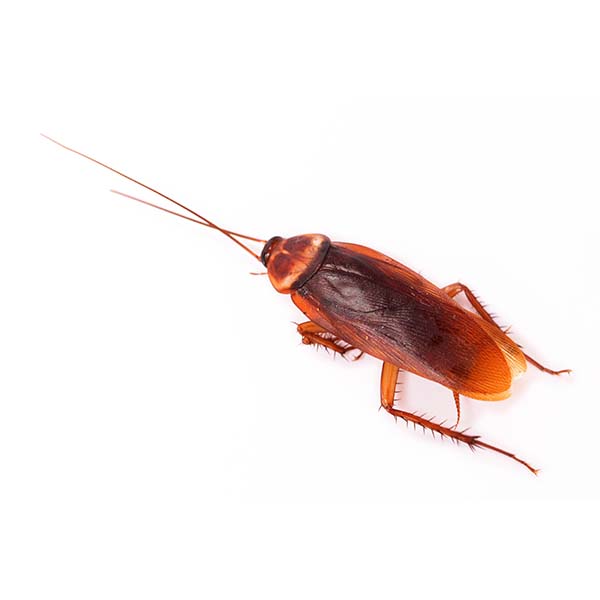
American Cockroach
Periplaneta americana · Category: Cockroaches · Large, reddish brown, comes up from drains and crawl spaces
The American cockroach is the big one. At one to two inches it is the largest cockroach that turns up in Pacific Northwest buildings, and at that size it is hard to ignore. It is also, in most Oregon and Washington homes, not the infestation people assume it is.
This species does not set up house in your kitchen the way a German cockroach does. It lives in sewers, storm drains, floor drains, crawl spaces and warm damp voids, and it comes up into the building from there. That changes the whole job. The question worth answering is not what to spray. It is what it walked up through, and how to close that.
Need help with this pest?
Get A Free Quote| Size | 1 to 2 inches as an adult, the largest cockroach in PNW buildings |
|---|---|
| Color | Reddish brown, glossy |
| Top ID marker | Pale yellow edging around the shield behind the head |
| Habitat | Sewers, storm and floor drains, crawl spaces, boiler rooms, damp basements |
| Flight | Fully winged and able to fly, but rarely does in our climate |
| Season | Present year round in heated buildings. Sightings and searches climb through spring and summer |
| Plan coverage | ✓ Covered under both All-Seasons plans |
Quick Answer: American cockroaches (Periplaneta americana) are large reddish brown cockroaches, one to two inches long, with pale yellow edging around the shield behind the head. In Oregon and Washington they live in sewers, storm drains, floor drains, crawl spaces and other warm damp places, and enter buildings from there rather than breeding in living space. One or two indoors usually means a plumbing or exclusion problem, not an infestation. They reproduce far more slowly than German cockroaches: University of California entomologists put one female and her offspring at over 800 in a year, against more than 30,000 for a German cockroach. Fixing dry drain traps, uncapped cleanouts and crawl space moisture solves more of these than any spray.
Key facts at a glance: 1 to 2 inches · Pale edging on the pronotum · Comes in from drains and crawl spaces · 14 to 16 eggs per case · Egg case cemented to a surface, not carried to hatching · Can fly, rarely does here · Plan coverage: Yes
A note on what this usually is: seeing one large reddish cockroach is not the same as having a cockroach problem, and we would rather say that than sell you a program you do not need. A single American cockroach in a basement or bathroom is most often a traveler from a drain or a crawl space. What matters is whether you keep seeing them, and where. The sections below are organized around finding that out.
What You Need To Know About American Cockroaches
Frequently Asked Questions
Where did a cockroach this big come from?
Almost always from below or outside, through a connection you cannot see. The usual routes are a floor drain whose trap has dried out, a sewer cleanout with a missing or loose cap, a broken or unsealed drain line, a gap where plumbing passes through a wall or floor, and a damp crawl space or basement. Extension sources list sewers, storm drains, water meter boxes and steam tunnels as the places this species actually lives. The Pacific Northwest handbook describes it as most often found in basements and areas with high moisture. It is not a species that arrives in a grocery bag the way a German cockroach does.
Does one mean there are hundreds more?
Not the way it would with a German cockroach. American cockroaches reproduce slowly by comparison. A female produces an egg case of roughly 14 to 16 eggs, carries it only about six days, then cements it somewhere protected where it incubates for two months or more. University of California entomologists put the total output of one female and her offspring at over 800 in a year. The same source puts a German cockroach at more than 30,000. Repeated sightings still mean a source worth finding, but a single insect is a single insect.
Why am I seeing them in summer?
Because unlike the German cockroach, this one’s year is set by the weather rather than by your thermostat. It is an outdoor and below-ground animal for most of its life, so warmth moves it. Dry weather matters too: when a floor drain trap evaporates, the barrier between your basement and the sewer line is gone. The search data further down the page fits that picture, with American cockroach searches peaking in June, though searches measure when people go looking rather than how many insects are out there.
Do they fly?
They can, and they rarely do here. Adults are fully winged, and Penn State Extension notes they are capable of flight but seldom fly in northern parts of the country. If something cockroach-shaped flew at a porch light on a warm evening in Oregon or Washington, a male wood cockroach is the far more likely answer. Those do not infest and die indoors within a few days.
How do I tell it from an Oriental cockroach?
Size and color settle it. The American cockroach is one to two inches, reddish brown and glossy, with pale yellow edging around the shield behind its head. The Oriental cockroach is smaller, around an inch to an inch and a quarter, and a uniform very dark brown to nearly black with no pale markings. Oriental females have short stubby wing pads and cannot fly at all. Both turn up in the same damp basements and crawl spaces, and the exclusion and moisture work that handles one handles the other.
Are they a health concern?
They travel through sewers and drains and then walk across surfaces, which is reason enough to keep them out of a kitchen. Cockroach proteins are also a recognized asthma trigger, and most of the research on that concerns cockroach allergen in the home generally rather than this species in particular. If someone in the house has asthma, it is worth raising with us and with their doctor, because reducing cockroach allergen is one of the things a thorough job accomplishes.
Will bait work on them?
Bait has a place, but it is second. With a German cockroach the population lives in the room and bait reaches it. With an American cockroach the population is usually in a drain, a sewer line or a crawl space, and the insects you see are visitors. Baiting visitors while the route stays open is why people treat the same bathroom four times. Close the route first, then treat what is left.
Does a dry floor drain really matter that much?
It is one of the first things our technicians check. A drain trap holds a plug of water that seals your building off from the sewer line. In a basement drain that nothing runs into, that water evaporates over a few weeks and the seal disappears. Pouring a quart of water down every unused drain once a month restores it, and costs nothing.
Signs You Have American Cockroaches
With this species the useful signs are about location and repetition. One in a bathtub on a Tuesday is a traveler. The same thing every week is a route.
1. Large reddish cockroaches at ground level
One to two inches, reddish brown and glossy, with pale edging behind the head. Found in basements, bathrooms, laundry rooms and crawl spaces rather than upstairs.
2. Sightings near a drain
In or beside a floor drain, a shower, a laundry standpipe or a sump. Repeated sightings in the same few feet point at the connection rather than the room.
3. Droppings with blunt ends
Larger than a German cockroach’s, roughly an eighth of an inch, blunt at both ends with ridges along the sides. Often mistaken for mouse droppings, which are pointed at one end.
4. Egg cases cemented to surfaces
Dark capsules about five sixteenths of an inch, glued into protected spots near food or moisture. Unlike a German cockroach, this female does not carry hers to hatching.
5. A musty smell in a basement or crawl space
Strongest where the population actually lives. In this species that is usually below the living space, not in it.
6. Standing water or a wet crawl space
Not a sign of cockroaches exactly, but the condition that keeps them. Where we find these repeatedly, we usually find a moisture problem first.
Behavior, Biology & Lifecycle
She cements the eggs and leaves
The female carries her egg case about six days, then glues it to a protected surface where it incubates for two months or more. A German cockroach carries hers until they hatch, which is part of why that species multiplies so much faster.
Slow to mature
Penn State Extension puts the nymphal stage anywhere from 160 to 971 days depending on conditions. An adult female can live up to about 15 months. Generations overlap, and nothing about this species happens quickly.
It wants heat and damp
University of California guidance describes a preference for warm humid conditions, generally above 82 degrees. In our climate that means boiler rooms, steam lines, sewers and heated commercial basements rather than an average living room.
Winged, and mostly walking
Adults have full wings covering the abdomen and can fly, but seldom do this far north. They are fast runners, which is usually what people actually see.
It eats nearly anything
Extension lists bakery products, beer, cheese, glue, bookbinding starch, hair, dead animals, plant material and flakes of dried skin. Sanitation helps, but you cannot starve this one out of a sewer.
Outdoors is normal for it
Unlike the German cockroach, this species lives outside and below ground for most of its life and enters buildings opportunistically. That is why exclusion does more here than any product does.
Local context: Oregon and Washington
Our cockroach year is flat. The American cockroach’s is not, and the gap is the clue
Across five years of cockroach service records in Portland, Vancouver, Salem, Olympia and Kelso/Longview, our new cockroach customers arrive at almost exactly the same rate every month of the year. The quietest month holds 7.1% of the year and the busiest holds 10.0%. An evenly split year would be 8.3% a month. Our records tag cockroaches as a group rather than by species, so the orange line is every cockroach we treat, not American cockroaches alone.
Search behavior tells a different story for this species specifically. Nationally, American cockroach searches run 3.9 to one between the busiest month and the quietest, and the peak is June. That is nearly half again the swing of the German cockroach, which barely moves across the year because it lives indoors and never leaves.
The difference is where the two species live. A German cockroach’s year is your thermostat. An American cockroach’s year is the weather, because it spends most of it in sewers, storm drains, crawl spaces and floor drains, and comes up into buildings when conditions push it there. If you are seeing one in a Portland or Vancouver home, the useful question is not what season it is. It is what it walked up through.
Two flat lines, twelve months
Each series is its share of its own annual total, so the two are directly comparable. The dotted line is what a perfectly even year looks like.
Blue line: Google search interest in Oregon and Washington, 2021 to 2025, the two states combined in proportion to their population. See it in Google Trends. Orange line: our own first-appointment records. We show shares rather than customer counts, and because this is a smaller sample than our spider or rodent records we describe the curve as flat rather than naming a busiest month.
Which cockroach actually has a season
One row per species, twelve months, darkest in that species’ busiest month. The right hand column is the gap between its busiest month and its quietest. The top row is ours and covers Oregon and Washington. The five species rows below it are national search interest, because Oregon and Washington on their own do not generate enough searches for individual cockroach species to measure.
Species rows: Google search interest across the United States, 2021 to 2025. See these five terms in Google Trends. Top row: Interstate Pest first appointments in Oregon and Washington.
Read the third row
The American cockroach peaks in June and falls away through the fall. So do the Oriental and the wood cockroach, and all three are species that spend most of the year outdoors or below ground. The two that peak later, in August, are the two that live indoors.
Now compare it to the row above. The German cockroach is almost flat, because it never goes outside. Two cockroaches, two completely different problems, and the same can of spray will not solve either one.
“When somebody calls about a big reddish cockroach, the first thing I ask about is drains. Floor drain in the basement, a trap that dried out, a cleanout with a missing cap, a crawl space that stays wet. Nine times out of ten that is the road they came up. People want us to spray the kitchen. The kitchen is not the problem. Pour water down the dry traps, cap the cleanout, fix the crawl space, and most of these go away on their own.”
TJ Jackson · ACE, Director of Operations, Interstate Pest Management

Free re-service if they come back between scheduled visits. Cockroaches are covered by both All-Seasons plans, from $39/mo for pests or $47/mo with rodents added.
Book an inspection
- Portland503-782-1899
- Vancouver360-996-1442
- Salem503-461-0259
- Olympia360-526-8004
- Kelso / Longview360-515-3882
What Actually Works
The order matters more than the products. With this species almost everything worth doing is structural, and most of it you can do yourself.
1. Identify the species first
Both Oregon State and University of California guidance open on this point, and here it decides everything. A large reddish cockroach and a small striped one are two different jobs with two different solutions.
2. Refill every dry drain trap
A quart of water down each unused floor drain, laundry standpipe, basement shower and spare bathroom, monthly. It restores a barrier you already have, and it costs nothing.
3. Cap the cleanouts and seal the penetrations
Sewer cleanouts need their caps. Gaps where pipes pass through walls, floors and the crawl space need sealing. These are the routes, and closing them does more than any treatment applied on the other side of them.
4. Dry out the crawl space
Standing water, a failed vapor barrier, a leaking line or blocked drainage against the foundation. This is a species that needs damp, so fixing the water is what makes the rest of the work last.
5. Close the outside up
Door sweeps, weatherstripping, screened crawl space and foundation vents, and no mulch, leaf litter or firewood stacked against the house. The same work keeps Oriental cockroaches out, and they arrive by the same routes.
6. Monitor before you treat
Sticky traps in the rooms where sightings happen tell you whether you have a route or a resident population, and which direction they are coming from. That answer changes the plan.
Where do-it-yourself runs out: refilling traps, capping cleanouts and sealing gaps genuinely solve a lot of these, and if that is your situation we would rather you just did it. Call somebody when sightings continue after the obvious routes are closed, when you are finding them on upper floors or in multiple rooms, when you are in an apartment or a shared building where the source may not be in your unit, or when the crawl space or basement has a moisture problem you cannot get to the bottom of. If someone in the house has asthma, that is worth raising with us and with their doctor.
Why exclusion beats treatment here: this is a species that lives in sewers, storm drains and crawl spaces and visits buildings. An insecticide applied inside the building treats the visitors. It does not reach the population, and it does not close the door they came through. That is the whole reason the sequence above starts with plumbing and moisture rather than with a product.
What Happens When You Call Us
Three steps, and the first one costs you nothing.
1. We find the route
An inspection that includes the crawl space, the basement, the drains and the exterior, not just the room where you saw one. We confirm the species and work out whether you have a population or a path.
2. We close it and treat what needs treating
Exclusion and moisture findings written down so you know what to fix, sealing where we can do it, and targeted treatment of the harborage rather than a blanket spray of your kitchen.
3. We come back and check
Monitors stay in place so the follow-up is measured rather than guessed. If they come back between scheduled visits, the re-service is free.
American Cockroach vs. The Other PNW Cockroaches
Four cockroach species turn up in Pacific Northwest homes, and one wanderer gets blamed for all of them. Telling them apart decides what happens next.
| Feature | American | Oriental | German | Brown-banded | Wood |
|---|---|---|---|---|---|
| Size | 1 to 2 in | About 1 1/4 in | 1/2 in | 1/2 in | 3/4 to 1 in |
| Marking | Reddish brown, pale edging around the shield behind the head | Uniform dark brown to nearly black, glossy | Two dark stripes front to back behind the head | Pale bands crossways over wings and abdomen | Brown, pale stripe along the wing edge |
| Lives | Sewers, drains and crawl spaces. Comes in | Outdoors, comes in | Indoors only | Indoors only | Outdoors, in woodpiles and leaf litter. Often carried in on firewood |
| Where in the home | Basements, crawl spaces, floor drains, ground level | Basements, crawl spaces, drains, ground level | Kitchens and bathrooms, near food and water | Warm high spots, electronics, furniture | Cannot survive indoors. Dies within a few days |
| Seasonal? | Somewhat. Activity climbs in warm weather | Yes, moves in as weather cools | No, year round | No, year round | Yes. Males fly through the warm months and come to lights at night |
| Infests? | Sometimes | Sometimes | Yes, rapidly | Yes, more slowly | No. A nuisance, not an infestation |
| Our recommendation | Exclusion and moisture first, then treatment | Exclusion plus treatment | Professional program | Professional program | Usually leave it alone |
Plans That Cover American Cockroach Control
Cockroaches are covered by both plans. The difference is rodents, which matters more here than it might sound: a crawl space gap that lets an American cockroach in is usually big enough for a mouse, and the moisture that suits one suits the other.
All-Seasons Pest Service
From $39/mo
- Insect elimination and ongoing prevention
- Covers 10+ common insects, cockroaches included
- Quarterly interior and exterior treatments
- Free emergency call-backs between scheduled visits
All-Seasons Pest and Rodent Service
From $47/mo
- Everything in the Pest Service, plus green rodent control
- Covers mice and rat removal
- Quarterly exterior treatments, interior as needed
- Free emergency call-backs, though rodent call-backs may be chargeable
Full details and the rest of the range are on the plans page.
Where This Information Comes From
Identification, biology and regional prevalence: the PNW 186 cockroach bulletin from Washington State University, Oregon State University and the University of Idaho, and the Pacific Northwest Insect Management Handbook, which describes the American cockroach as most often found in basements and areas of high moisture. Size, harborage, egg case behavior and the comparative reproduction figures: University of California IPM Pest Note 7467. Egg counts, nymphal development, adult lifespan, flight behavior in northern states and diet: Penn State Extension. Asthma evidence: Rosenstreich et al. 1997 and Morgan et al. 2004, both New England Journal of Medicine. Consumer guidance for the Northwest is maintained by NPIC at Oregon State University.