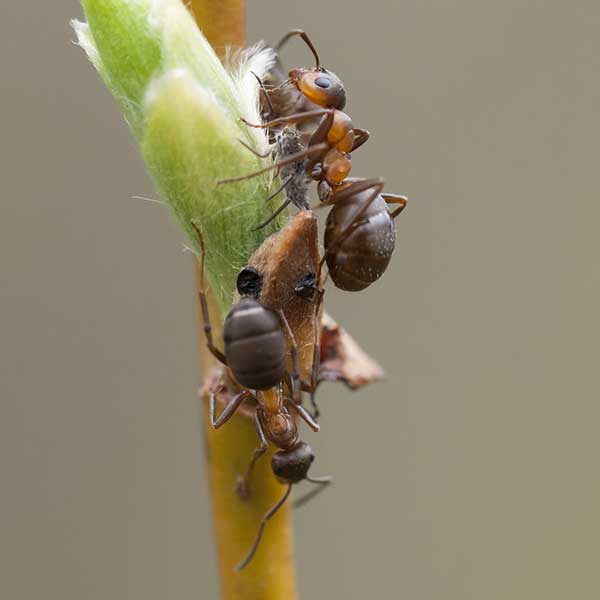
Velvety Tree Ants (VTAs)
Reviewed by TJ Jackson, Certified ACE · Updated 2026-05-06
Liometopum occidentale | Category: Ants | ✓ Covered: All Seasons Pest Plan
Velvety tree ants get their name from the fine, soft hairs on their black abdomen, and their preference for nesting in trees. In the PNW, they’re often confused with carpenter ants because they’re similar in size and behavior, and they too excavate damaged wood. They are aggressive when disturbed, will bite, and emit a strong rancid-butter smell when crushed. If you see them on your house, the colony is likely in a nearby tree, fence post, or in damp structural wood, and they’ll defend their trail vigorously.
| Size | 5/32″ – 1/4″ (workers polymorphic) |
|---|---|
| Color | Yellowish-red head & thorax with velvety black abdomen |
| Top ID Marker | Strong rancid-butter / blue cheese smell when crushed; aggressive bite |
| Active Season | Year-round PNW; peak May through September |
| Nest Sites | Hollow trees, fence posts, log walls, decaying outdoor wood, occasionally wall voids |
| Colony Size | Several thousand workers; multiple queens common |
| Plan Coverage | ✓ Covered under All Seasons Pest Plan |
Need help with this pest?
Get A QuoteQuick Answer: Velvety tree ants (Liometopum occidentale) are medium-sized (5/32″–1/4″) ants with a distinctive yellowish-red head and thorax paired with a velvety black abdomen. They primarily nest in hollow tree cavities, fence posts, and decaying outdoor wood throughout the Pacific Northwest, but readily invade homes via branches that touch the structure or through wall-void wood. Unlike most PNW ants, velvety tree ants are aggressive, they bite, and they emit a strong rancid-butter or blue cheese odor when crushed. They are wood-excavating, like carpenter ants, but cause less structural damage because they prefer outdoor wood.
Key facts at a glance: Size: 5/32″–1/4″ · Color: bicolored (red/black) · Tell-tale sign: rancid butter smell + bite · Damages wood: yes (outdoor mostly) · Plan coverage: Yes, All Seasons Pest Plan.
What You Need To Know About Velvety Tree Ants
Our Certified ACE technician TJ Jackson breaks down ant identification and why store-bought sprays usually make infestations worse. (Pest-specific video coming soon.)
Frequently Asked Questions
How do I identify a velvety tree ant?
Look for the distinctive two-tone color: yellowish-red head and thorax with a velvety-looking black abdomen. They are medium-sized (5/32″ to 1/4″) and have polymorphic workers (different sizes in the same colony). Crush one, a strong rancid butter or blue cheese smell confirms it.
Do velvety tree ants bite?
Yes. Unlike most Pacific Northwest ants, velvety tree ants will bite when their trails are disturbed or when handled. The bite is sharp but not medically dangerous to most people, it feels like a brief pinch. They also spray formic acid into the bite, which can sting and leave a small red welt.
Where do velvety tree ants nest?
Almost always in trees, hollow oaks, decaying maples, dead branches, and in outdoor wood like fence posts, log walls, and woodpiles. They rarely nest indoors but will forage inside through any branch or vine touching the house, or through cracks where outdoor wood meets the structure.
Are velvety tree ants destructive?
They excavate decaying wood like carpenter ants, but cause significantly less structural damage because they prefer outdoor wood that’s already failing. The bigger concern is colony size: velvety tree ants form large colonies that can be aggressive defenders, especially in summer.
What’s the difference between velvety tree ants and carpenter ants?
Carpenter ants are larger (1/4″–1/2″), uniform black or red-and-black, and primarily nest in damp structural wood. Velvety tree ants are smaller (5/32″–1/4″), distinctly bicolored with that velvety black abdomen, and prefer trees and outdoor wood. Velvety tree ants also bite readily; carpenter ants typically don’t.
Why do they smell like rancid butter?
When threatened, velvety tree ants release pyrazines and other volatile compounds from their pygidial glands. The smell is often compared to rancid butter, blue cheese, or sour milk and is one of the most reliable ID markers in the field.
Does the All Seasons Plan cover velvety tree ants?
Yes. Velvety tree ant control is included in the All Seasons Pest Plan, including treatment of foraging trails, perimeter applications, and inspection of nearby trees and outdoor wood that may host the parent colony.
How do velvety tree ants get into the house?
They follow scent trails along branches that touch the roof or siding, climb up vines and ivy, or enter through cracks where decking, fences, or porches connect to the structure. Trim vegetation back at least 12 inches from the house and seal exterior gaps to interrupt their path.
Signs You Have Velvety Tree Ants
Most homeowners don’t see a single ant, they see a hundred. Here’s what to look for, in the order it usually shows up:
1. Bicolored ants on the home exterior
Two-tone red-and-black ants moving along siding, fascia, fence rails, or deck posts, especially in May through September. They follow well-defined trails.
2. Strong rancid butter smell when crushed
Crush one ant. A pungent rancid butter, blue cheese, or sour-milk odor confirms velvety tree ants. The smell is far stronger than the OHA’s coconut scent.
3. Aggressive defense when disturbed
Tap or step on a trail and you’ll see workers swarm and bite. This is a key behavioral signal, most PNW ants flee or scatter; velvety tree ants attack.
4. Trails leading to a tree or fence
Follow the line. Velvety tree ant trails typically end at an outdoor structure: a hollow tree, dead limb, fence post, or log wall section. The colony lives in that structure.
5. Damaged outdoor wood with smooth galleries
Like carpenter ants, they excavate clean galleries, but in dead branches, decaying fence posts, or hollow tree limbs rather than indoor structural wood.
6. Late-summer swarmers
Mature colonies release winged reproductives in August and September, often around dusk. Finding small accumulations of wings near outdoor wood structures indicates an established colony.
Behavior, Biology & Lifecycle
Understanding how velvety tree ants live is the single biggest reason professional treatment succeeds where DIY fails. Here’s what makes this species different:
Aggressive colony defense
Velvety tree ants have one of the most defensive temperaments of any PNW ant. Workers attack disturbances en masse, biting and spraying formic acid. This is a survival adaptation for colonies in exposed tree cavities.
Tree cavity nesters first, structures second
Mature colonies establish in hollow tree cavities, decaying limbs, or rotting log walls. They invade homes only as foragers or as satellite colonies, making outdoor inspection essential to long-term control.
Polygynous and large
Like odorous house ants, velvety tree ants typically have multiple queens, allowing rapid colony growth and budding behavior under stress. A single tree can host tens of thousands of individuals across linked galleries.
Diet: honeydew and other insects
Workers tend aphid and scale insect colonies for honeydew, and prey on smaller insects. They are aggressive territorial competitors and often displace other ant species in their range.
Active May through September
Foraging activity peaks in warm months. In winter, colonies enter a quiet state inside their tree cavities but remain alive. Sightings drop dramatically October through April.
Native to western North America
Velvety tree ants are native to the western U.S. and Canada, well-adapted to PNW forests, oak woodlands, and fragmented suburban landscapes with mature trees. WSU Extension’s PNW ant guide identifies them as one of the region’s most common tree-nesting species.
DIY Homeowner Steps
Inspect trees and outdoor wood
Walk the perimeter looking for hollow limbs, dead branches, decaying fence posts, and rotting woodpiles. The parent colony is almost always in one of these.
Trim back branches and vegetation
Cut any branches that touch or overhang the house. Remove ivy and vines from siding. Maintain a 12-inch clearance between vegetation and the structure to break their access route.
Have dead/dying trees evaluated
Trees with hollow cavities or significant dead wood are ideal velvety tree ant habitat, and a hazard. An arborist can advise on whether to keep, treat, or remove problem trees.
Don’t disturb visible trails
Disturbed colonies bite and bud. If you see a defined trail on your home, mark its path mentally but resist the urge to spray it. Call a pro to address the parent colony, not just the foragers.
Velvety Tree Ants vs. Other PNW Ants
Not sure which species you have? Here’s a side-by-side of the four ants we get called about most often in Oregon and Washington homes:
| Feature | Odorous House Ant | Carpenter Ant | Pavement Ant | Moisture Ant |
|---|---|---|---|---|
| Size | 1/16″–1/8″ | 1/4″–1/2″ | 1/8″ | 1/8″–3/16″ |
| Color | Dark brown/black, uniform | Black, sometimes red & black | Brown to black with darker abdomen | Yellow to light brown |
| Smell when crushed | Rotten coconut | Slight formic acid (vinegar) | None distinctive | Lemony / citronella |
| Damages structure? | No | Yes, excavates wood | No | Often follows existing wood damage |
| Typical nest site | Wall voids, near pipes, baseboards | Damp/damaged wood, attics, decks | Cracks in driveways, sidewalks, foundations | Rotting wood, wet crawl spaces |
| Sawdust piles? | No | Yes (frass) | No | Sometimes |
| DIY spray response | Buds & spreads | Workers die, queens unaffected | Some kill, recurring | Buds & spreads |
| Plan coverage | ✓ All Seasons | ✓ All Seasons | ✓ All Seasons | ✓ All Seasons |
Plans That Cover Velvety Tree Ants
All Seasons Pest Plan
$39/month
Setup fee ~$260 for initial treatment
Year-round protection from the pests Pacific Northwest homeowners deal with most, ants, spiders, wasps, box elder bugs, and more.
- Recurring exterior treatments
- Seasonal pest coverage
- Free re-service between visits
- No contracts
Pest & Rodent Bundle
$47/month
Setup fee ~$280 for initial treatment
The most complete protection for your home. Full pest coverage plus active rodent monitoring, one plan, one team, one less thing to worry about.
- Everything in Pest & Rodent plans
- Best value for whole-home protection
- Free re-service guarantee
- No contracts
What Our Customers Are Saying