Watch: Shiny Green or Blue Flies in One Room? What’s Feeding Them
Blow Flies & Bottle Flies
Reviewed by TJ Jackson, Associate Certified Entomologist · Updated 2026-11-17
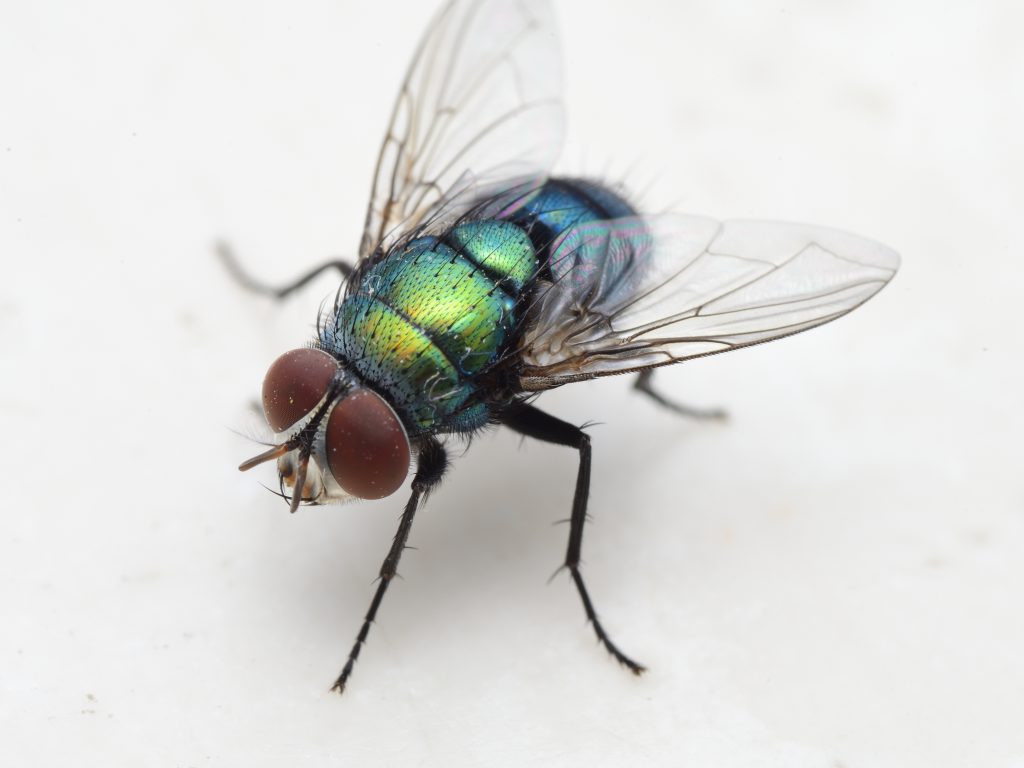
Family Calliphoridae | Category: Flies | Shiny flies are feeding on something nearby
Shiny green or blue flies buzzing at one window are blow flies, often called bottle flies. They do not wander in at random. Their larvae grow in food waste, pet waste or a dead animal, and adults come out about a week later. Several in one room usually means the source is close: a trash can that sat too long, food forgotten in a garage, or a dead mouse in a wall or crawl space.
Shiny flies in one room? Let us help find what is feeding them.
Family-owned since 1963. 4.96 average from 8,500+ Google Reviews.
| Size | About 1/4 to 1/2 in, larger and bulkier than a house fly |
|---|---|
| Color | Shiny metallic green, blue or blue-black |
| Top ID Marker | Loud, metallic flies gathering in one room or at one window |
| Habitat | Garbage cans, pet waste, compost, and anywhere a dead animal is |
| Activity | Spring through early fall outdoors; indoors any time a source is nearby |
| Bite Risk | Does not bite; can carry germs from garbage to food |
| Plan Coverage | Covered on the All Seasons Pest Plan |
Quick Answer: Blow flies, also called bottle flies, are robust flies with shiny metallic green or blue bodies. UC IPM says their most common development site around homes is human food waste, though pet waste and dead animals also produce them, and under ideal temperatures they can go from egg to adult in as little as 7 days. A sudden group of shiny flies in one room almost always means a source nearby: garbage left for more than a week, food in a garage freezer that lost power, or a dead mouse, rat or bird in a wall, attic or crawl space. The flies will stop once the source is found and removed and the larvae have finished. Sprays aimed at the adults do not fix it, and sticky fly ribbons do not work well because blow flies rarely rest on vertical surfaces.
Key facts at a glance: 1/4 to 1/2 inch · Metallic green or blue · Breed in food waste, pet waste and carcasses · Egg to adult in about a week · Several in one room means a source nearby · No bites · Plan coverage: All Seasons Pest Plan.
Flies after rodent work? A dead mouse or rat in a wall or crawl space can produce bottle flies within days. If you have had mice or rats, mention it when you call, and see our rodent guide.
Frequently Asked Questions
Why are there big shiny flies in my house?
Shiny green or blue flies are blow flies, also called bottle flies. They develop in food waste, pet waste or a dead animal. Several indoors at once usually means the source is close by, often in the same room, the attic above it or the crawl space below.
Does a bunch of flies in one room mean something died?
Sometimes. A dead mouse, rat or bird in a wall, attic or crawl space is a common cause. So is food waste: a trash can, a garage freezer that lost power, or groceries forgotten in a car. Check the easy sources first, then the hidden ones.
How long will the flies keep coming?
UC IPM says blow flies can develop from egg to adult in as little as 7 days in warm weather. Once the source is gone and the last larvae have finished, the flies stop. Flies that are already adults can be vacuumed or caught with a swatter.
Are blow flies dangerous?
They do not bite. UC IPM notes they may carry disease agents from garbage or animal waste and deposit them on human food, so keep food covered and garbage sealed.
How do I keep blow flies out of my trash?
Bag household garbage and pet waste and seal the bag before it goes in the can. UC IPM recommends setting cans out for pickup at least once a week even if they are not full, because garbage that sits more than a week is likely to produce blow flies, and washing the cans out regularly.
Do fly strips work on bottle flies?
Not well. UC IPM says hanging sticky fly ribbons will not control blow flies because, unlike house flies, they do not regularly rest on vertical surfaces. Fly baits made for house flies also do not attract them well.
Why are bottle flies in my house in winter?
The University of Kentucky notes bottle flies are often found in homes in winter and early spring, usually in small numbers, and that they are strong fliers drawn to lamps and lights. Larger numbers mean a source.
Are blow flies covered on the All Seasons Pest Plan?
Yes. Flies are covered on the All Seasons Pest Plan. We help find the source, treat where the flies rest and get in, and come back between visits as needed.
Signs of Blow Flies and Bottle Flies
1. Shiny flies at one window
Metallic green or blue flies gathering at a single window or light, often loud in flight.
2. A sudden start
No flies one week, a dozen the next. A new group of shiny flies means a new source.
3. An odor
A faint smell of something dead or spoiled near the flies, sometimes in a wall, closet or crawl space.
4. Maggots near garbage
Cream-colored larvae in or under a trash can, recycling bin or pet waste area.
5. Wandering larvae
UC IPM notes blow fly larvae leave their food to find a drier place to pupate, so you may see them crawling away from the source.
6. Recent rodent activity
Mice or rats in the walls or crawl space in the last few weeks can leave a dead rodent behind.
Behavior, Biology & Lifecycle
A family of shiny flies
Blow flies are a group of species with similar habits. In Oregon and Washington, the common green bottle fly and the blue blowfly are the ones reported most often.
Named for carrion
The name comes from their link to dead animals, where some species lay eggs. Around homes, UC IPM says the most common development site is human food waste, with pet waste a close second.
Fast development
Under ideal temperatures, blow flies can develop from egg to adult in as little as 7 days.
Larvae move to pupate
When larvae are fully grown they leave the food source to find a drier, more protected spot to pupate.
Strong fliers
Adults are robust, loud fliers attracted to lights and lamps, which is why they end up at windows and fixtures.
Not biting flies
Like house flies, blow flies have sponging mouthparts. They do not bite or feed on blood.
Local Context: Oregon and Washington
Blow flies are reported from April to September. Calls about flies keep coming into October.
Of the 4,325 verifiable blow fly sightings logged on iNaturalist in Oregon and Washington over the last five years, 84% came April through September, with May the busiest month. The common green bottle fly made up 23% of all sightings and the blue blowfly 17%.
Our technicians record these as flies rather than by species, so our line is all general fly visits. Across five years of service records in Portland, Vancouver, Salem, Olympia and Kelso, those visits peaked in September, and 37% came August through October, after outdoor blow fly sightings had already started to fall.
The difference makes sense once flies move indoors. The University of Kentucky notes bottle flies are often found in homes in winter and early spring, and a single dead mouse or a forgotten bag of garbage can produce them any month. Search interest for blow flies and bottle flies is too low in either state to chart.
Blow fly sightings peak in late spring. Our fly visits peak in fall.
Each series is its share of the annual total. Our records do not separate blow flies, so the orange line is all visits tagged as flies or house flies.
Blue line: verifiable iNaturalist observations of the family Calliphoridae in Oregon and Washington, grouped by the month observed. See the records on iNaturalist.
Inside flies run late
Outdoors, blow flies taper off by fall. Indoors, a source can produce them any month, so the calls do not follow the outdoor season.
Worth knowing before you book
Bottle flies are a sign, not the problem. When shiny flies show up in one room, the question is what they are growing in. Around homes, that is most often food waste, then pet waste, then an animal that died somewhere out of sight.
Most sources are quick to fix once found: take out and wash the can, clear the forgotten food, or remove the dead animal. If mice or rats are behind it, deal with them too, or the next one will start the cycle again.
Blow flies, other flies and our fly calls
Each row is that source’s share of its own annual total, by month, over the last five years. Darker means a bigger share.
Blue rows are public iNaturalist sightings for Oregon and Washington. Orange rows are our service records. Values are percent of the year.

“A room full of loud, shiny flies is unpleasant, and most people’s first guess is that something got in through a window. Usually something is feeding them close by. Blow flies are reported most from April to September, but we get these calls into October and beyond, because a source indoors does not care what month it is. Check the trash and anything forgotten first. If that is not it, we will look in the walls, attic and crawl space with you. Find the source and the flies are gone within a week or two.”TJ Jackson · ACE, Director of Operations, Interstate Pest Management
Flies are covered on the All Seasons Pest Plan. If pests come back between scheduled visits, re-services are included in your plan, as needed. QualityPro certified.
Call your local office
- Portland503-782-1899
- Vancouver360-996-1442
- Salem503-461-0259
- Olympia360-526-8004
- Kelso / Longview360-515-3882
Sources: Interstate Pest Management service records, over the last five years, completed visits tagged as flies or house flies, and all fly visits. Sightings: public iNaturalist records of blow flies (family Calliphoridae), house flies and cluster flies for Oregon and Washington, over the last five years. Google Trends had no usable search volume for blow fly or bottle fly in either state. Biology: UC Statewide IPM Program, University of Kentucky. Updated November 2026.
DIY Homeowner Steps
Check the easy sources first
Trash cans, recycling, pet waste, compost, a garage freezer, pet food bowls and groceries left in a car. Remove anything spoiled and clean the area.
Follow the flies
The room with the most flies is usually closest to the source. Check closets, under appliances, the attic above and the crawl space below, and notice any odor.
Bag and seal garbage
Bag food waste and pet waste and seal the bag before it goes in the can. Set cans out every week, even if they are not full.
Wash the cans
Rinse garbage and recycling cans with soap and water so residue does not feed the next round of flies.
Vacuum the adults
Vacuum or swat the flies already in the house. Hanging sticky ribbons will not catch many bottle flies.
Blow Flies vs. Common Look-Alikes
| Feature | Blow / Bottle Fly | House Fly | Cluster Fly | Flesh Fly |
|---|---|---|---|---|
| Size | 1/4 to 1/2 in | About 1/4 in | About 5/16 in | Up to about 1/2 in |
| Look | Shiny metallic green or blue | Gray, four dark stripes on thorax | Dull gray, golden hairs on thorax | Gray stripes, checkered abdomen, red eyes |
| Breeds in | Food waste, pet waste, carcasses | Garbage, manure, compost | Earthworms, outdoors | Carcasses and waste |
| Indoors when | Any time a source is nearby | Summer | Fall to spring | Near a source |
| What it means | Find the source nearby | Seal garbage, fix screens | Seal gaps before fall | Find the source nearby |
Fly Control on the All Seasons Plan
All Seasons Pest Plan
$39/month
Setup fee $260 for initial treatment
Flies are covered on the All Seasons Pest Plan. We treat the outside where flies rest and enter, and look for what is breeding them.
- Exterior treatment where flies rest and enter
- Breeding-source check on every visit
- Re-services included as needed
- Covers spiders, ants, wasps and more
Pest & Rodent Bundle
$47/month
Setup fee $280 for initial treatment
Flies plus mice and rats in one plan. A good fit when flies show up alongside rodents, or when a dead rodent is feeding them.
- Everything in the All Seasons Pest Plan
- Rodent monitoring and baiting
- Re-services included as needed
- Exclusion quoted separately
What Our Customers Are Saying