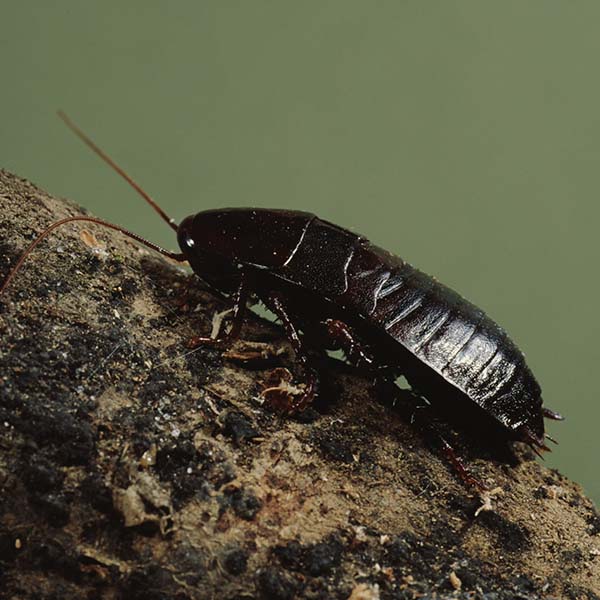
Oriental Cockroach
Blatta orientalis · Category: Cockroaches · Glossy near-black, lives in the damp, often called a water bug
Of the five cockroaches that turn up in Pacific Northwest homes, this is the one built for our climate. The others tolerate the Northwest. The Oriental cockroach prefers it. Minnesota Extension records a preference for conditions under 84 degrees and notes it has been found outdoors in freezing weather.
Cool, dark and damp is not a place it survives. It is the habitat. That is why the answer to an Oriental cockroach problem here is almost always about water rather than about insecticide, and why the most useful thing we do on these calls is look under the house.
Need help with this pest?
Get A Free Quote| Size | About 1 to 1 1/4 inches as an adult |
|---|---|
| Color | Very dark brown to nearly black, with a greasy sheen |
| Top ID marker | No usable wings. Females have short stubby pads, males have wings covering about three quarters of the abdomen |
| Habitat | Crawl spaces, damp basements, floor drains, under sinks and washing machines, ground level and below |
| Flight | Neither sex flies |
| Season | Outdoor numbers peak late spring and early summer. Comes indoors on a season change, heavy rain or disturbance |
| Plan coverage | ✓ Covered under both All-Seasons plans |
Quick Answer: Oriental cockroaches (Blatta orientalis) are glossy, very dark brown to nearly black cockroaches about an inch long, often called water bugs. Neither sex flies. They prefer cool, damp, dark conditions, generally under 84 degrees, and have been recorded outdoors in freezing weather, which makes them the cockroach best suited to the Pacific Northwest. They live in crawl spaces, damp basements, floor drains and outdoor leaf litter, and enter buildings on a change of season, after heavy rain, or when their harborage is disturbed. They are also the slowest breeder of the four house-infesting species: one female and her offspring produce roughly 200 in a year, against more than 30,000 for a German cockroach. Fixing the moisture is what makes treatment last.
Key facts at a glance: 1 to 1 1/4 inches · Glossy near-black · No useful wings, cannot fly · Prefers under 84 degrees · About 16 eggs per case · One to two years from nymph to adult · Roughly 200 per female per year · Plan coverage: Yes
A note on where this one lives: nearly every Oriental cockroach problem we see has a water problem underneath it. A wet crawl space, a downspout draining against the foundation, a dried out floor drain, a failed sump. Treatment without fixing that buys you a season. Fixing it is what actually ends the problem, and a fair amount of it is work you can do or hire out yourself.
What You Need To Know About Oriental Cockroaches
Frequently Asked Questions
Is this the thing people call a water bug?
Usually, yes. The name gets used loosely for any large dark roach found near drains, but it most often means this species. The association is earned: they live in drains, crawl spaces, damp basements and sewers, and they cannot go long without moisture. Penn State notes they can survive about a month without food if they have water. Water is the resource that matters to them, not crumbs.
Why do I have these in Oregon or Washington specifically?
Because our climate suits them better than it suits any of the others. Minnesota Extension records a preference for conditions under 84 degrees, and notes this species tolerates cool environments and has been found outdoors in freezing weather. University of California guidance says it prefers cooler temperatures than the other cockroach species and lives in cool, dark, damp places. Compare that to the American cockroach, which prefers warm humid conditions above 82 degrees. West of the Cascades, one of those two descriptions matches the ground under your house and the other does not.
What makes them come inside?
Minnesota Extension lists a change in the seasons, excess rainfall and lawn mowing. The first two do a lot of work here. A wet stretch floods the voids and leaf litter they were living in, and they move to the next dry dark place, which is often a crawl space or a basement. Disturbance does the same thing, which is why people sometimes see a wave of them after yard work.
Do they fly?
No. Neither sex can. Females have small stubby wing pads that do not work, and males have wings covering only about three quarters of the abdomen and still cannot fly. If something cockroach-shaped flew, it was not this. On a warm evening in the Northwest the likeliest flying candidate is a male wood cockroach coming to a light, and those do not infest.
How do I tell it from an American cockroach?
Color and size settle it quickly. The Oriental cockroach is about an inch to an inch and a quarter and a uniform very dark brown to nearly black, glossy, with no pale markings anywhere. The American cockroach is larger, one to two inches, reddish brown, with pale yellow edging around the shield behind its head, and it can fly even though it rarely does here. They overlap in damp basements and crawl spaces, and the moisture and exclusion work that fixes one fixes the other.
How fast do they multiply?
Slowly, by cockroach standards, and that is genuinely good news. A female produces around eight egg capsules of roughly 16 eggs each. Development from newly emerged nymph to adult takes one to two years according to University of California entomologists, with seven to ten molts along the way. They put the total at nearly 200 from one female and her offspring in a year. The German cockroach figure from the same source is over 30,000. An Oriental cockroach population is something that built up over seasons, not weeks.
Is the smell them?
It can be. Penn State notes this species produces odorous secretions that can affect the flavor of food where infestations are heavy. In a basement or crawl space it usually reads as a musty, slightly sour smell that gets stronger in warm weather.
Can I just seal them out?
Exclusion helps a great deal and it is the right first move, but on its own it tends to disappoint, because the population is already living in the crawl space or against the foundation rather than arriving from far away. Seal the gaps and fix the water, in that order of effort but ideally at the same time. Dry ground does more than a sealed vent.
Signs You Have Oriental Cockroaches
Almost all of these point downward. If the evidence is upstairs, reconsider the identification.
1. Glossy near-black roaches at ground level
An inch or so, very dark, no pale markings, moving slowly compared to other roaches. Found in basements, crawl spaces, laundry areas and garages.
2. Sightings after rain
A wet stretch floods the outdoor voids they live in. A cluster of sightings in the few days after heavy rain is one of the more reliable tells.
3. Activity around drains and standpipes
Floor drains, laundry standpipes, sump pits, under the washing machine and water heater. They travel plumbing routes and stay near water.
4. Dark egg capsules in sheltered spots
Dark red-brown, about three eighths of an inch, dropped in debris or sheltered places rather than carried. Finding them means they are breeding there.
5. A musty, sour smell
Strongest where they actually live, which is below the living space. Gets more noticeable in warm weather and as numbers climb.
6. A crawl space that is wet
Standing water, a torn vapor barrier, condensation on ducts, soil that stays damp. This is the condition that keeps them, and it is usually the real finding.
Behavior, Biology & Lifecycle
It prefers the cold
Minnesota Extension records a preference for conditions under 84 degrees and notes it has been found outdoors in freezing weather. University of California guidance says it prefers cooler temperatures than the other cockroach species. This is the only one of the five you could describe that way.
Water matters more than food
Penn State reports it can survive about a month without food if water is available. It eats decaying organic matter, rubbish and filth, so sanitation helps less here than it does with a German cockroach. Moisture control is the lever.
Neither sex flies
Females have short, functionless wing pads. Males have wings covering about three quarters of the abdomen and still cannot fly. Everything this species does, it does on foot, which is why exclusion at ground level works.
It is slow
One to two years from newly emerged nymph to adult, through seven to ten molts. Adult females live roughly five to twenty-six weeks. You are almost never looking at something that appeared this month.
She drops the egg case
Around eight capsules in a lifetime, roughly 16 eggs each, deposited in debris or a sheltered spot rather than carried to hatching. Incubation runs about 60 days at room temperature.
It has a real season outdoors
Penn State puts peak adult numbers in late spring and early summer, falling away by early fall as adults die off and the next generation is still immature. That is a genuine population cycle, not just a change in when people notice them.
Local context: Oregon and Washington
Of the five, this is the one whose weather is our weather
Across five years of cockroach service records in Portland, Vancouver, Salem, Olympia and Kelso/Longview, our new cockroach customers arrive at almost exactly the same rate every month of the year. The quietest month holds 7.1% of the year and the busiest holds 10.0%. An evenly split year would be 8.3% a month. Our records tag cockroaches as a group rather than by species, so the orange line is every cockroach we treat, not Oriental cockroaches alone.
The Oriental cockroach has the second largest swing of the five species, 5.2 to one between its busiest search month and its quietest, and it peaks in June. That peak is worth more than most on this page, because it lines up with the insect rather than just with curiosity: Penn State puts peak adult Oriental cockroach numbers in late spring and early summer, which is when the searching happens.
What makes this species the local one is temperature. University of Minnesota Extension records a preference for conditions under 84 degrees and notes it tolerates cool environments, having been found outdoors in freezing weather, and lists a change in the seasons, excess rainfall and lawn mowing as what pushes it indoors. University of California guidance separately says it prefers cooler temperatures than the other species and lives in cool, dark, damp places. Two of those three triggers describe an ordinary year west of the Cascades.
Two flat lines, twelve months
Each series is its share of its own annual total, so the two are directly comparable. The dotted line is what a perfectly even year looks like.
Blue line: Google search interest in Oregon and Washington, 2021 to 2025, the two states combined in proportion to their population. See it in Google Trends. Orange line: our own first-appointment records. We show shares rather than customer counts, and because this is a smaller sample than our spider or rodent records we describe the curve as flat rather than naming a busiest month.
Which cockroach actually has a season
One row per species, twelve months, darkest in that species’ busiest month. The right hand column is the gap between its busiest month and its quietest. The top row is ours and covers Oregon and Washington. The five species rows below it are national search interest, because Oregon and Washington on their own do not generate enough searches for individual cockroach species to measure.
Species rows: Google search interest across the United States, 2021 to 2025. See these five terms in Google Trends. Top row: Interstate Pest first appointments in Oregon and Washington.
Read the fifth row
The Oriental cockroach peaks in June, along with the American and the wood cockroach. All three spend most of the year outdoors or below ground, so their year is set by the weather rather than by a thermostat.
The two that peak in August, German and brown-banded, are the two that live indoors and never leave. That split is the whole point of the chart. It tells you whether the answer to your problem is outside the house or inside it.
“These are a wet crawl space problem more than anything else. Every bad one I have walked into had water somewhere it should not be. A failed vapor barrier, a downspout dumping against the foundation, a sump that quit. People want to talk about what we are going to spray. I want to see under the house. Get that dry and you have taken away the reason they were living there in the first place.”
TJ Jackson · ACE, Director of Operations, Interstate Pest Management

Free re-service if they come back between scheduled visits. Cockroaches are covered by both All-Seasons plans, from $39/mo for pests or $47/mo with rodents added.
Book an inspection
- Portland503-782-1899
- Vancouver360-996-1442
- Salem503-461-0259
- Olympia360-526-8004
- Kelso / Longview360-515-3882
What Actually Works
Water first, gaps second, product last. That order is not a preference, it is what makes the result hold.
1. Dry the crawl space
Intact vapor barrier, working drainage, no standing water, no leaking lines. In our climate this is the single highest-value thing on the list and it is often the whole job.
2. Move water away from the foundation
Downspouts extended and discharging away from the house, gutters clear, grade sloping away, no low spots holding water against the wall. Cheap, and it changes the habitat.
3. Refill dry drain traps
A quart of water down each unused floor drain, laundry standpipe and spare bathroom, monthly. A dry trap is an open pipe between your basement and the sewer.
4. Seal at ground level
They walk, so ground level is where it counts. Door sweeps, crawl space and foundation vent screens, sealing where pipes and wiring pass through the foundation, and gaps under siding.
5. Clear the harborage against the house
Leaf litter, bark mulch, ivy and ground cover, woodpiles and stacked material against the foundation. These are listed outdoor habitat, and moving them back is free.
6. Then treat, and monitor
Targeted treatment of the harborage and entry routes, with sticky traps down so the next visit is measured rather than guessed. Product applied before the water is fixed is product you will be reapplying.
Where do-it-yourself runs out: the drainage and exclusion work above genuinely solves a lot of these, and if that is your situation we would rather you just did it. Call somebody when the crawl space has a moisture problem you cannot get to the bottom of, when you are still seeing them after the water and the gaps are handled, when they are turning up above ground level, or when you are in a shared building where the source may not be under your unit. If someone in the house has asthma, that is worth raising with us and with their doctor.
Why the slow lifecycle changes the plan: one to two years from nymph to adult means an established population has overlapping generations sitting in the crawl space at every stage. A treatment that clears the adults you can see will read as a success and then be contradicted a few months later by the next cohort. That is the argument for changing the conditions rather than only reducing the count.
What Happens When You Call Us
Three steps, and the first one costs you nothing.
1. We go under the house
An inspection that covers the crawl space, the foundation line, the drains and the exterior grade, not just the room where you saw one. We confirm the species and find the water.
2. We tell you what to fix and treat what needs treating
Moisture and exclusion findings written down so you can act on them, sealing where we can do it, and targeted treatment of the harborage rather than a blanket spray indoors.
3. We come back and check
Monitors stay in place so the follow-up is measured rather than guessed. If they come back between scheduled visits, the re-service is free.
Oriental Cockroach vs. The Other PNW Cockroaches
Four cockroach species turn up in Pacific Northwest homes, and one wanderer gets blamed for all of them. Telling them apart decides what happens next.
| Feature | Oriental | American | German | Brown-banded | Wood |
|---|---|---|---|---|---|
| Size | About 1 to 1 1/4 in | 1 to 2 in | 1/2 in | 1/2 in | 3/4 to 1 in |
| Marking | Uniform very dark brown to nearly black, glossy, no pale markings | Reddish brown, pale edging around the shield behind the head | Two dark stripes front to back behind the head | Pale bands crossways over wings and abdomen | Brown, pale stripe along the wing edge |
| Temperature | Prefers under 84°F. Tolerates cold, recorded outdoors in freezing weather | Prefers warm and humid, generally above 82°F | Room temperature, indoors year round | Warm and dry, indoors year round | Outdoor temperatures. Cannot establish indoors |
| Where in the home | Crawl spaces, damp basements, floor drains, ground level and below | Basements, crawl spaces, floor drains, ground level | Kitchens and bathrooms, near food and water | Warm high spots, electronics, furniture | Cannot survive indoors. Dies within a few days |
| Flies? | No. Neither sex | Able to, but rarely does here | Winged, does not fly | Males fly when disturbed | Yes. Males fly to lights |
| Roughly per female per year | About 200 | Over 800 | Over 30,000 | Over 600 | Does not infest |
| Our recommendation | Moisture and exclusion first, then treatment | Exclusion and moisture first, then treatment | Professional program | Professional program | Usually leave it alone |
Plans That Cover Oriental Cockroach Control
Cockroaches are covered by both plans. The difference is rodents, which is worth thinking about here: a damp crawl space with gaps at ground level is attractive to both, and the inspection that finds one usually finds the other.
All-Seasons Pest Service
From $39/mo
- Insect elimination and ongoing prevention
- Covers 10+ common insects, cockroaches included
- Quarterly interior and exterior treatments
- Free emergency call-backs between scheduled visits
All-Seasons Pest and Rodent Service
From $47/mo
- Everything in the Pest Service, plus green rodent control
- Covers mice and rat removal
- Quarterly exterior treatments, interior as needed
- Free emergency call-backs, though rodent call-backs may be chargeable
Full details and the rest of the range are on the plans page.
Where This Information Comes From
Identification, biology and regional prevalence: the PNW 186 cockroach bulletin from Washington State University, Oregon State University and the University of Idaho, and the Pacific Northwest Insect Management Handbook, which describes the Oriental cockroach as very common in moist areas such as basements and notes it travels along pipes within structures. Size, harborage, cool-temperature preference, egg case behavior and the comparative reproduction figures: University of California IPM Pest Note 7467. Egg counts, molts, development time, adult lifespan, survival without food, odorous secretions and the late spring population peak: Penn State Extension. Temperature preference, cold tolerance and what drives them indoors: University of Minnesota Extension. Consumer guidance for the Northwest is maintained by NPIC at Oregon State University.