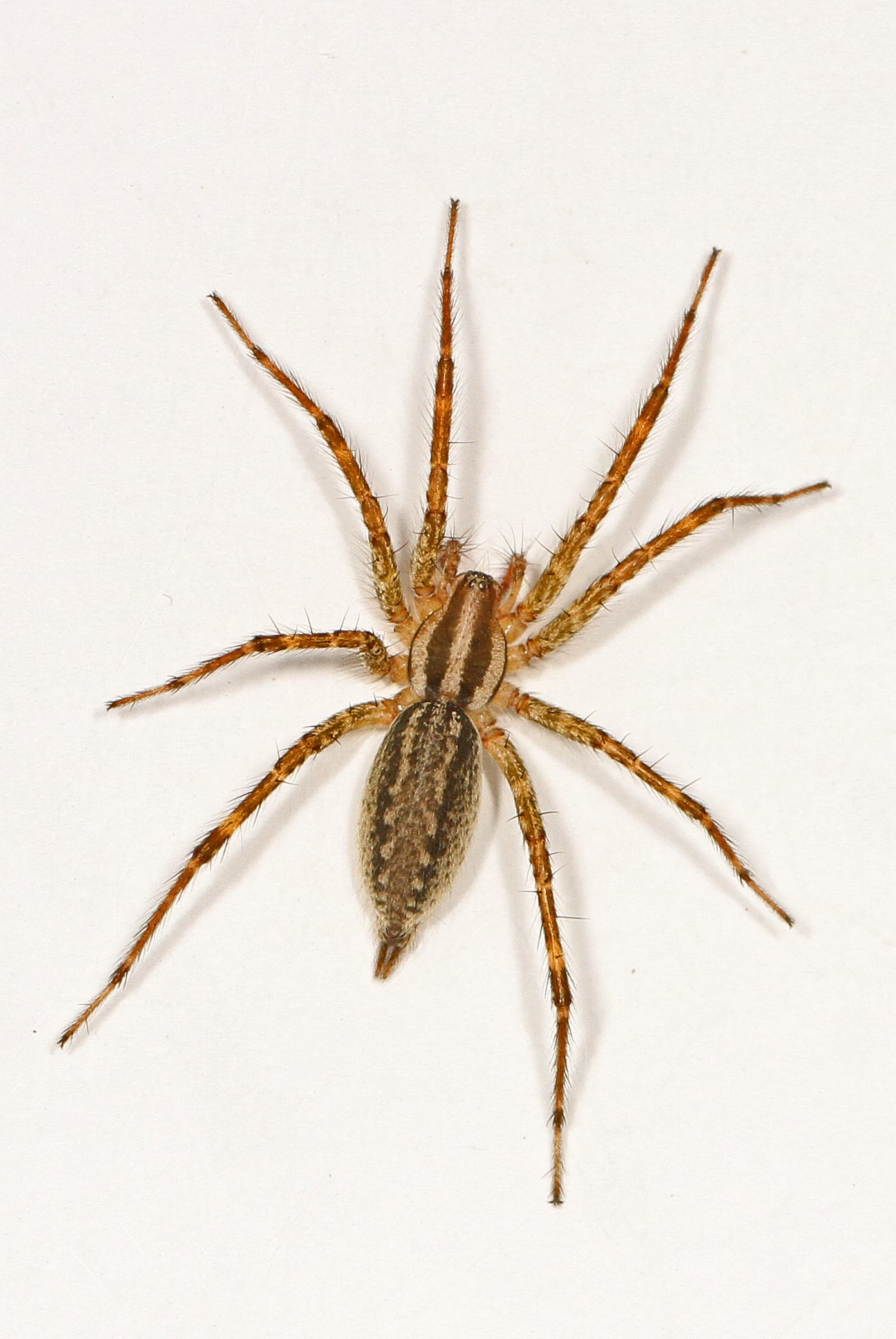
Grass Spider
Reviewed by TJ Jackson, Certified ACE · Updated 2026-07-24
Genus Agelenopsis | Category: Spiders | ✓ Covered: All Seasons Pest Plan
Walk outside on a dewy fall morning and you might find your lawn covered in dozens of flat, sheet-like webs, each with a funnel tucked into one corner. That’s the work of grass spiders. They’re one of the most common outdoor spiders in Oregon and Washington, and they’re constantly mistaken for the more notorious hobo spider. Here’s how to tell them apart, and why the grass spider in your yard is nothing to worry about.
What You Need To Know About Grass Spiders
Our ACE Certified Technician TJ breaks down grass spiders — how to ID them, how to tell them from hobo spiders, and why they’re nothing to worry about.
Frequently Asked Questions
How do I tell a grass spider from a hobo spider?
Look for two things: grass spiders have two dark stripes down the top of the front body section, and long rear spinnerets that stick out like two little tails. They also build the flat sheet-and-funnel webs you see in lawns. Hobo spiders are more uniformly brown and don’t make those visible lawn webs. The long spinnerets are the most reliable tell.
What is that funnel web in my grass?
A grass spider’s web is a flat, horizontal sheet with a funnel-shaped retreat off to one side. The spider waits in the funnel and rushes out to grab insects that land on the sheet. The web isn’t sticky — it works by speed, not glue.
Are grass spiders dangerous?
No. They’re fast and can look startling darting across a web, but they’re not aggressive and bites are rare and mild. The only PNW spider with real medical risk is the black widow.
Why did my whole lawn suddenly fill with webs?
Fall is peak season. The spiders mature over summer, so by late season there are more of them and bigger webs. Morning dew makes all those flat sheet webs visible at once, so it looks like they appeared overnight. They were there the whole time.
Does the All Seasons Pest Plan cover grass spiders?
Yes — all spider species are covered, including exterior web removal with every visit and free re-service between appointments.
Quick Answer: Grass spiders (genus Agelenopsis) are funnel-weaving spiders that build flat, sheet-like webs with a funnel retreat in lawns, ground cover, and along foundations across the Pacific Northwest. They’re brown with two dark stripes down the front body section and have distinctively long rear spinnerets. They’re fast, harmless, and most visible in fall when dew reveals their webs. They’re frequently mistaken for hobo spiders, but the long spinnerets and the sheet-and-funnel lawn web set them apart.
Most important distinction: Grass spiders are harmless outdoor spiders. Those alarming lawn webs are a sign of a healthy insect-hunting population, not an infestation.
Behavior & Biology
Grass spiders belong to the genus Agelenopsis in the family Agelenidae, the funnel weavers. Several species live throughout the Pacific Northwest, and they’re among the most abundant outdoor spiders in the region. If you have a lawn, you almost certainly have grass spiders, whether you’ve noticed them or not.
Their signature is the web: a flat, horizontal sheet of silk with a funnel-shaped tunnel leading off one edge. Unlike an orb weaver’s sticky spiral, the grass spider’s sheet isn’t adhesive. It works through speed. The spider hides in the mouth of the funnel, waits for the vibration of an insect landing on the sheet, then rushes out, seizes the prey, and retreats back into the tunnel to feed. They are remarkably fast, which is part of why they startle people.
The confusion with hobo spiders is understandable, because hobo spiders are also funnel weavers in the same family. The two reliable ways to tell them apart are the grass spider’s long, visible rear spinnerets and the two dark stripes running down the top of its cephalothorax. Grass spiders also build the conspicuous lawn webs, while hobo spiders tend to keep their funnels tucked into cracks, wood piles, and foundation gaps.
Grass spiders mature through the summer and are most conspicuous in late summer and fall, when adults are largest and webs are most numerous. Males wander in search of mates as the season winds down, which is the main reason one might occasionally turn up near a doorway or inside. They’re beneficial predators, quietly reducing the population of insects around your home.
What To Do If You Have Grass Spiders
Grass spiders are beneficial and belong outdoors, so in most cases there’s nothing you need to do. If the lawn webs bother you or you’re seeing them creep toward the house:
Leave the lawn webs alone
Those webs mean the spiders are eating insects you’d rather not have. The webs disappear on their own as the season ends and the spiders die off in cold weather.
Clear webs near doorways
If funnels are turning up in window wells or by entryways, knocking the webs down with a broom encourages the spider to relocate away from the house.
Reduce foundation harborage
Trimming vegetation back from the foundation and reducing exterior lighting that attracts prey insects makes the area around your home less appealing.
Recurring exterior treatment
If spider numbers around the home are high, a recurring exterior plan with web removal keeps the perimeter clear and manages the broader spider population.
Plans That Cover All PNW Spider Species
All Seasons Pest Plan
$39/month
Setup fee ~$260 for initial treatment
Year-round protection from the pests Pacific Northwest homeowners deal with most — spiders, ants, wasps, box elder bugs, and more. Includes exterior web removal with every visit.
- Recurring exterior treatments
- Exterior web removal
- Free re-service between visits
Pest & Rodent Bundle
$47/month
Setup fee ~$280 for initial treatment
The most complete protection for your home. Full pest coverage plus active rodent monitoring — one plan, one team, one less thing to worry about.
- Everything in Pest & Rodent plans
- Best value for whole-home protection
- Free re-service guarantee