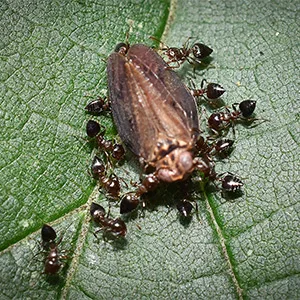
Acrobat Ants
Reviewed by TJ, ACE Certified Technician · Updated 2026-05-19
Crematogaster spp. | Category: Ants | ✓ Covered: All Seasons Pest Plan
If you’ve watched a tiny ant flip its abdomen up over its head like a circus performer, you’ve met an acrobat ant. They’re small, fast, and usually a sign that something else is going on in your home: damp or damaged wood. Acrobat ants don’t chew through sound timber the way carpenter ants do, but they happily move into wood that’s already compromised. Finding them is often the easy part. Finding what they’re telling you is where Interstate Pest comes in.
| Size | 1/16″ – 1/8″ (about the size of a sesame seed) |
|---|---|
| Color | Light brown to black, can be two-toned |
| Top ID Marker | Heart-shaped abdomen raised over the body when disturbed |
| Active Season | Spring through fall in the PNW; swarmers May–September |
| Nest Sites | Damp/damaged wood, wall voids, foam insulation, old termite or carpenter ant galleries |
| Defensive Behavior | Raises abdomen, may bite, emits foul odor when threatened |
| Plan Coverage | ✓ Covered under All Seasons Pest Plan |
Need help with this pest?
Get A QuoteQuick Answer: Acrobat ants (Crematogaster spp.) are small (1/16″–1/8″), light-brown-to-black ants identified by a heart-shaped abdomen they raise over their head when disturbed. In Oregon and Washington, they almost always nest in damp or damaged wood, wall voids, water-damaged framing, foam insulation, or abandoned termite and carpenter ant galleries. They don’t excavate sound wood themselves, but their presence is a reliable warning that a hidden moisture problem or past wood-destroying pest activity exists. Treatment means finding both the ants and the underlying damage.
Key facts at a glance: Size: 1/16″–1/8″ · Color: light brown to black · Tell-tale sign: heart-shaped abdomen raised in defense · Damages sound wood: no · Indicates moisture damage: yes · Bites: rarely · Plan coverage: Yes, All Seasons Pest Plan.
What You Need To Know About Acrobat Ants
Our ACE Certified Technician TJ breaks down acrobat ants, how to ID them in the field and why finding them often means finding a deeper moisture problem.
Frequently Asked Questions
What do acrobat ants look like?
Small, 1/16″ to 1/8″, light brown to black, with two spines on the thorax. The fast tell: disturb one and it flips its heart-shaped abdomen up over its head. That’s the move that gives the species its name.
Are they the same as carpenter ants?
No. Carpenters are much larger (1/4″–1/2″) and chew sound wood, leaving sawdust. Acrobat ants are tiny and don’t excavate, but they often move into wood that carpenters or termites already damaged. Finding them sometimes means a bigger problem already happened.
Why are they in my house?
Moisture and damaged wood. They love wall voids near plumbing, water-damaged window and door frames, foam insulation, and abandoned termite or carpenter ant galleries. Indoors they hunt sweets, honey, syrup, sugary residue.
Do they bite or sting?
They can bite when threatened, but it’s rare and mild. They also emit a foul defensive odor. Most encounters happen when you disturb infested wood or pick something up they were trailing on.
Does my All Seasons Plan cover them?
Yes, fully covered. Includes scheduled seasonal treatments, moisture-source assessment, and free re-service visits if they return between appointments. No extra charge.
What about swarmers?
Acrobat ants produce winged reproductives from May to September. Seeing winged ants indoors during summer almost always means an established colony inside the structure, usually in damaged wood. Time to inspect.
How do they get inside?
They follow utility lines, plumbing penetrations, and branches that touch the house. Tree limbs against siding are a major entry route in PNW homes, trim them back at least a few feet from the structure.
Why can’t I find the nest?
Because it’s usually inside wood or insulation you can’t see. Trails can travel surprising distances from the actual nest, and they often nest in the same cavities termites or carpenter ants vacated years ago. A professional inspection is the practical fix.
Signs You Have Acrobat Ants
Acrobat ants tend to give themselves away by behavior more than sheer numbers. Here’s what tips off our techs most often in Oregon and Washington homes:
1. The raised-abdomen behavior
A tiny ant that flips its rear end up over its body when you get close. Nothing else in the PNW does this. Once you see it, you know.
2. Trails along utility lines & pipes
Acrobat ants follow plumbing and electrical penetrations into walls. If you see steady trails on or behind pipes, that’s the highway to the nest.
3. Activity around water-damaged wood
Window sills, door frames, baseboards under a leak, or fascia boards on the exterior. Any soft, stained, or punky wood is fair game.
4. A faint, sharp odor when crushed
Workers emit a foul defensive scent when threatened or crushed. It’s less coconut-like than odorous house ants, more sharp and acrid.
5. Winged ants indoors in summer
From May through September, mature colonies release swarmers. Finding them indoors almost always means a colony inside the structure. Don’t wait on this one.
6. Trails into Styrofoam insulation
Acrobat ants will tunnel through foam insulation to nest. If you see them disappearing into the foam around a rim joist or basement wall, that’s the colony.
Behavior, Biology & Habitat
Acrobat ants are one of those species where understanding the biology saves you money, because the ant isn’t usually the real problem. Here’s what makes them different:
The famous “acrobat” behavior
When threatened, workers raise their heart-shaped abdomen up over the thorax and head, like a scorpion’s tail. It’s a defensive display, sometimes paired with a foul odor or a mild bite. The behavior gives the species its common name and is the easiest in-the-field ID test.
They don’t damage sound wood
Unlike carpenter ants and termites, acrobat ants don’t excavate healthy wood. They move into wood that’s already soft from water damage or hollowed by other wood-destroying insects. That’s why their presence is so diagnostic, the ant tells you something else got there first.
Diet: sweet indoors, predatory outdoors
Outdoors, acrobat ants tend honeydew-producing aphids and prey on other small insects. Indoors, they shift hard toward sugary foods, sweet residue, honey, syrups, fruit. Workers will follow a sweet trail across a counter for a long way.
Tree-and-utility highways
Acrobat ants are exceptional climbers and routinely use tree branches, utility lines, and trellises as bridges into homes. Vegetation touching the house is one of the most common entry routes. Cutting the bridge cuts the access.
Swarmer season: May to September
Mature colonies release winged reproductives anytime from late spring through early fall. Swarmers emerging indoors are one of the few unmistakable signs of an established interior colony, usually in damaged wood, sometimes inside foam insulation.
The PNW connection: moisture, moisture, moisture
Oregon and Washington homes are full of the conditions acrobat ants love: damp crawl spaces, water-damaged siding, leaky window flashing, roof overflows. Treating the ant without finding the moisture source is a guarantee they’ll be back.
DIY Homeowner Steps
Clean up sweet food sources
Wipe counters, seal sugary pantry items, rinse soda cans before recycling. Acrobat ants love sweets, eliminate the reward to slow recruitment.
Find moisture damage
Check window sills, door frames, baseboards, around plumbing, and in crawl spaces for water staining or soft wood. That’s where the nest is.
Trim trees and shrubs off the house
Branches touching siding, roof, or utility lines are direct entry routes. Cut everything back at least a couple feet from the structure.
Seal around plumbing & window frames
Caulk gaps where pipes and wires enter the home, and where window/door frames meet siding. These are the most common acrobat ant entry points.
Skip the spray, get an inspection
Sprays kill the ants you see and miss the nest. And the bigger concern is what’s damaging the wood they’re nesting in. A pro inspection finds both.
Acrobat Ants vs. Other PNW Ants
Acrobat ants are routinely confused with carpenter ants, odorous house ants, and moisture ants, all three of which we get called about constantly in Oregon and Washington. Here’s how to tell them apart:
| Feature | Acrobat Ant | Carpenter Ant | Odorous House Ant | Moisture Ant |
|---|---|---|---|---|
| Size | 1/16″–1/8″ | 1/4″–1/2″ | 1/16″–1/8″ | 1/8″–3/16″ |
| Color | Light brown to black, sometimes two-toned | Black, sometimes red & black | Dark brown to black, uniform | Yellow to light brown |
| Signature behavior | Raises heart-shaped abdomen over head | Excavates sound wood, leaves frass | Rotten coconut smell when crushed | Lemony / citronella smell when crushed |
| Damages sound wood? | No | Yes, excavates wood | No | Follows existing wood damage |
| Signals moisture damage? | Yes, strongly | Often | No | Yes, strongly |
| Typical nest site | Wall voids, foam insulation, old galleries | Damp/damaged wood, attics, decks | Wall voids, near pipes, baseboards | Rotting wood, wet crawl spaces |
| DIY spray response | Returns until nest & moisture fixed | Workers die, queens unaffected | Buds & spreads | Returns until moisture fixed |
| Plan coverage | ✓ All Seasons | ✓ All Seasons | ✓ All Seasons | ✓ All Seasons |
Plans That Cover Acrobat Ants
All Seasons Pest Plan
$39/month
Setup fee ~$260 for initial treatment
Year-round protection from the pests Pacific Northwest homeowners deal with most, ants, spiders, wasps, box elder bugs, and more.
- Recurring exterior treatments
- Moisture-source assessment
- Free re-service between visits
Pest & Rodent Bundle
$47/month
Setup fee ~$280 for initial treatment
The most complete protection for your home. Full pest coverage plus active rodent monitoring, one plan, one team, one less thing to worry about.
- Everything in Pest & Rodent plans
- Best value for whole-home protection
- Free re-service guarantee
What Our Customers Are Saying