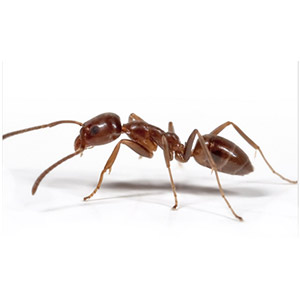
Argentine Ants
Reviewed by TJ Jackson, Certified ACE · Updated 2026-05-06
Linepithema humile | Category: Ants | ✓ Covered: All Seasons Pest Plan
Argentine ants are one of the most successful invasive species on the planet, they’ve taken over four continents from a single source population in Argentina. They’ve been moving into the Pacific Northwest from California for the past 30 years, especially around urban Portland and the southern Willamette Valley. They form massive supercolonies that span entire neighborhoods, which is why one house’s Argentine ant problem is usually 50 houses’ Argentine ant problem. They don’t bite, don’t damage structure, and don’t sting, but their sheer numbers and ability to displace native ants make them one of the toughest ants to manage long-term.
| Size | 1/16″ – 1/8″ |
|---|---|
| Color | Light to dark brown, uniform; matte (not shiny) |
| Top ID Marker | Musty / moldy smell when crushed; massive trails along same path day after day |
| Active Season | Year-round; activity peaks April–October |
| Nest Sites | Shallow soil, mulch, under stones, leaf litter; rarely deep indoor nests |
| Colony Size | Hundreds of thousands; supercolonies can include millions across acres |
| Plan Coverage | ✓ Covered under All Seasons Pest Plan |
Need help with this pest?
Get A QuoteQuick Answer: Argentine ants (Linepithema humile) are small (1/16″–1/8″), light to dark brown invasive ants that form supercolonies, interconnected nest networks containing hundreds of thousands of workers across many properties. Native to South America, they’ve established throughout California and are now well-established in the southern Pacific Northwest, particularly metro Portland and the Willamette Valley. They displace native ant species, do not bite or damage structure, but invade homes in massive numbers seeking sweets and water. Identifying features: uniform brown color with matte finish, single waist node, and a faint musty or moldy smell when crushed (much weaker than the OHA’s coconut scent).
Key facts at a glance: Size: 1/16″–1/8″ · Color: brown, matte · Tell-tale sign: massive trails + faint musty smell · Bites: no · Damage: none · Plan coverage: Yes, All Seasons Pest Plan.
What You Need To Know About Argentine Ants
Frequently Asked Questions
How do I identify Argentine ants?
Argentine ants are small (1/16″ to 1/8″), uniformly light to dark brown with a slightly matte (not shiny) finish, and have a single petiole node between thorax and abdomen. They emit a very faint musty or moldy smell when crushed, far less pungent than odorous house ants. Their most diagnostic behavior is forming enormous trails on the same path day after day, often along sidewalks, foundation lines, and irrigation systems.
Are Argentine ants dangerous?
No. They don’t bite humans, don’t sting, don’t damage wood, and don’t transmit disease. The threat is ecological and infrastructural: they out-compete native ants and other beneficial insects, and they invade homes in such overwhelming numbers that food contamination becomes a real problem.
How are Argentine ants different from odorous house ants?
Both are small dark ants, but odorous house ants smell strongly of rotten coconut when crushed, while Argentine ants smell faintly musty or moldy. Argentine ants are usually a slightly lighter brown, while OHAs are uniformly dark brown to black. Argentine ants form much larger colonies and longer trails.
What is a ‘supercolony’?
A network of interconnected nests with shared queens, workers, and resources, often spanning entire neighborhoods or larger areas. Argentine ants from one supercolony do not fight each other, even across vast distances. The California supercolony is over 600 miles long. This means treating one yard rarely solves an Argentine ant problem long-term.
Why do they keep coming back?
Because the colony you’re seeing is just one node in a much larger supercolony spanning multiple properties. Eliminating ants on your property reduces local population, but workers from neighboring nests continue to push in. Long-term management requires perimeter prevention rather than one-time elimination.
Are Argentine ants in Oregon and Washington?
Yes, increasingly. Argentine ants have been moving north from California since the 1990s. They are well-established in metro Portland, the Willamette Valley, and southern Washington. Climate change and urban heat islands favor their continued northward expansion.
Does the All Seasons Plan cover Argentine ants?
Yes. Argentine ant control is fully covered under the All Seasons Pest Plan, including perimeter applications and bait placements. Because of supercolony pressure, ongoing scheduled service is especially important for Argentine ants, single treatments rarely produce lasting results.
Why don’t store-bought sprays work on Argentine ants?
Store-bought sprays kill workers but the supercolony has effectively unlimited backup. Worse, repellent sprays cause Argentine ant trails to relocate to nearby properties, scattering the problem. Slow-acting bait is the only DIY method that has any chance, and even that requires sustained application.
Signs You Have Argentine Ants
Most homeowners don’t see a single ant, they see a hundred. Here’s what to look for, in the order it usually shows up:
1. Massive trails along the same path
Argentine ant trails are enormous, often 10+ ants per inch of trail, and follow the exact same route day after day, even week after week. Unlike most ants, they don’t really change paths.
2. Brown ants, not black
Argentine ants are uniformly light-to-medium brown, not black. If you see ants in massive numbers but they look paler than typical odorous house ants, this is a strong Argentine ant indicator.
3. Faint musty smell when crushed
Crush several ants. A weak musty or moldy odor confirms Argentine ants. The smell is much subtler than the OHA’s rotten coconut, if you can barely smell anything, that’s diagnostic.
4. Indoor activity in late summer drought
Argentine ants invade homes most aggressively in late summer when outdoor moisture sources dry up. Look for activity around sinks, dishwashers, and pet water bowls in August and September.
5. Total absence of native ants
If Argentine ants have taken over your property, you’ll notice you don’t see any other ant species anymore. They aggressively displace native ants, including odorous house ants and pavement ants.
6. Trails crossing property lines
Watch where ant trails go. If they continue across the sidewalk to the neighbor’s yard and beyond, you’re looking at supercolony behavior, not a single localized colony.
Behavior, Biology & Lifecycle
Understanding how argentine ants live is the single biggest reason professional treatment succeeds where DIY fails. Here’s what makes this species different:
Form supercolonies, not single colonies
Argentine ants are uniquely cooperative within their introduced range. Workers from any nest will accept workers from any other nest, allowing massive interconnected colonies to form. The largest known supercolony stretches more than 6,000 km along the Mediterranean coast.
Aggressive displacement of native ants
Where Argentine ants establish, native ant biodiversity crashes. They out-compete and aggressively kill local ant species, in California’s coastal scrub, Argentine ants have nearly eliminated native ants entirely. This ecological disruption is one of the main reasons they’re a research priority.
Lifecycle: 5–8 weeks egg to adult
Eggs hatch in 12–18 days, larvae develop for 11–60 days depending on caste, pupae form for 10–25 days. Workers live about 1 year; queens up to 10 years. Colonies grow rapidly because multiple queens lay simultaneously.
Diet: heavily sweet-focused
Workers strongly prefer sweet foods, honeydew, nectar, kitchen sweets, over protein and fats. They tend aphid colonies on garden plants for honeydew, often expanding aphid populations and causing secondary plant damage.
Highly invasive, widely established
Per UC IPM, Argentine ants are now established across most of California, parts of the southern Pacific Northwest, and increasingly into urban and suburban landscapes throughout the western U.S. Climate warming may accelerate their spread.
Cannot survive harsh cold
Argentine ants struggle in freezing temperatures, which is why they remain mostly limited to warmer parts of the PNW. Hard PNW winters can knock back populations, but supercolonies survive in heated structures and recolonize quickly the following season.
DIY Homeowner Steps
Map their trails before treating
Walk your property in early morning when Argentine ant trails are most visible. Note where they enter the structure and where they’re headed (kitchen, water sources). Treatment is much more effective when applied to known travel paths.
Eliminate water and sweet sources
Fix dripping outdoor faucets, redirect downspouts, and store sweets in airtight containers. Argentine ants invade most aggressively in late summer when outdoor water dries up, reducing indoor water access slows them substantially.
Trim vegetation away from the house
Branches touching siding, ivy on walls, and shrubs against the foundation all give Argentine ants direct entry. Maintain a 12-inch clearance between vegetation and your home, and keep mulch beds 6 inches back from the foundation.
Talk to your neighbors
Because Argentine ants form supercolonies, your treatment is much more effective if neighboring properties also treat. Coordinated neighborhood treatment dramatically improves long-term results.
Argentine Ants vs. Other PNW Ants
Not sure which species you have? Here’s a side-by-side of the four ants we get called about most often in Oregon and Washington homes:
| Feature | Odorous House Ant | Carpenter Ant | Pavement Ant | Moisture Ant |
|---|---|---|---|---|
| Size | 1/16″–1/8″ | 1/4″–1/2″ | 1/8″ | 1/8″–3/16″ |
| Color | Dark brown/black, uniform | Black, sometimes red & black | Brown to black with darker abdomen | Yellow to light brown |
| Smell when crushed | Rotten coconut | Slight formic acid (vinegar) | None distinctive | Lemony / citronella |
| Damages structure? | No | Yes, excavates wood | No | Often follows existing wood damage |
| Typical nest site | Wall voids, near pipes, baseboards | Damp/damaged wood, attics, decks | Cracks in driveways, sidewalks, foundations | Rotting wood, wet crawl spaces |
| Sawdust piles? | No | Yes (frass) | No | Sometimes |
| DIY spray response | Buds & spreads | Workers die, queens unaffected | Some kill, recurring | Buds & spreads |
| Plan coverage | ✓ All Seasons | ✓ All Seasons | ✓ All Seasons | ✓ All Seasons |
Plans That Cover Argentine Ants
All Seasons Pest Plan
$39/month
Setup fee $260 for initial treatment
Year-round protection from the pests Pacific Northwest homeowners deal with most, ants, spiders, wasps, box elder bugs, and more.
- Recurring exterior treatments
- Seasonal pest coverage
- Re-services included as needed between visits
- No contracts
Pest & Rodent Bundle
$47/month
Setup fee $280 for initial treatment
The most complete protection for your home. Full pest coverage plus active rodent monitoring, one plan, one team, one less thing to worry about.
- Everything in Pest & Rodent plans
- Best value for whole-home protection
- Re-service guarantee
- No contracts
What Our Customers Are Saying
Real Results From Real Customers
Get help with Argentine ants in your area
Interstate Pest Management helps with Argentine ants across Oregon and Washington. Choose your area to see local plans, pricing and the number for your nearest team.