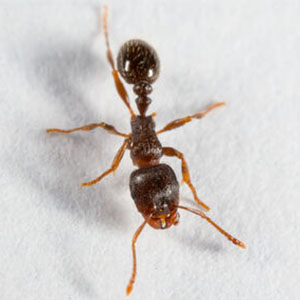
Pavement Ants
Reviewed by TJ Jackson, Certified ACE · Updated 2026-05-06
Tetramorium immigrans | Category: Ants | ✓ Covered: All Seasons Pest Plan
Pavement ants are exactly what they sound like, small, dark ants you find marching out of cracks in driveways, sidewalks, and patio joints. They’re not native to the PNW; they hitched rides from Europe in the 1800s and now thrive in nearly every paved residential area in Oregon and Washington. They won’t damage your home, but they’ll find their way inside in surprising numbers, especially in spring and after heavy rain. They’re also famous for the territorial ‘sidewalk wars’ between neighboring colonies that pile up dead workers along property lines.
| Size | 1/10″ – 1/8″ |
|---|---|
| Color | Dark brown to black; pale legs; lighter abdomen tip |
| Top ID Marker | Two nodes between thorax and abdomen; nests under pavement |
| Active Season | Year-round in heated structures; outdoor peak May–September |
| Nest Sites | Cracks in concrete, under stones, along foundation perimeters, occasionally wall voids |
| Colony Size | 3,000–10,000 workers; one queen typically |
| Plan Coverage | ✓ Covered under All Seasons Pest Plan |
Need help with this pest?
Get A QuoteQuick Answer: Pavement ants (Tetramorium immigrans) are small (1/10″–1/8″) dark brown ants commonly seen emerging from cracks in concrete driveways, sidewalks, and patio joints. They’re a non-native European species now established throughout Pacific Northwest residential areas. Pavement ants do not damage structures, do not bite or sting (though they can if handled), and pose no health threat, but they invade homes in large numbers seeking food, especially sweets and grease. Identifying features include a 12-segment antenna, two nodes (waist segments) between thorax and abdomen, and a small but noticeable stinger workers rarely use.
Key facts at a glance: Size: 1/10″–1/8″ · Color: dark brown/black · Tell-tale sign: nests under pavement · Bites: rarely · Damage: none · Plan coverage: Yes, All Seasons Pest Plan.
What You Need To Know About Pavement Ants
Frequently Asked Questions
How do I identify pavement ants?
Pavement ants are small (1/10″ to 1/8″), dark brown to black, with lighter pale legs and a slightly lighter abdomen tip. Under magnification, they show two distinct nodes between thorax and abdomen, a key ID feature. They are most commonly seen pouring out of pavement cracks during warm weather.
Are pavement ants dangerous?
No. Pavement ants don’t damage homes, don’t transmit disease, and rarely bite or sting humans. They are a nuisance pest, primarily an issue when they invade kitchens and pantries in large numbers. Their stinger is small and weak compared to fire ants or wasps.
Why are they coming inside?
Food and warmth. Pavement ants forage up to 30 feet from their nest. Spring rains push them into structures looking for drier ground; summer heat drives them in seeking water; cold weather pulls them to heated wall voids. Sweet residue, grease, and pet food all attract them.
Where do pavement ants nest?
Almost always in or under hard surfaces: cracks in driveways, expansion joints in sidewalks, under patio pavers, between concrete slabs, along foundation walls. Rarely they’ll establish in wall voids near a kitchen or bathroom, but most nests are outdoors.
What are ‘pavement ant wars’?
Adjacent pavement ant colonies fight territorial battles in spring and early summer, especially along sidewalks and driveways. You may see piles of dead ants along property edges, these are the casualties of two colonies meeting at a boundary. The behavior is harmless to humans but striking to witness.
Why don’t store-bought sprays work long-term?
Surface sprays kill foragers but the queen and the rest of the colony are protected deep under concrete or pavement, often inaccessible from above. Without reaching the queen, the colony rebuilds the foraging force within weeks. Professional treatment uses slow-acting bait carried back to the queen.
Does the All Seasons Plan cover pavement ants?
Yes. Pavement ant treatment is fully covered under the All Seasons Pest Plan, including perimeter applications around concrete surfaces, crack-and-crevice treatments, and bait placements where needed.
Will sealing the cracks help?
Some, but not enough on its own. Sealing pavement cracks with concrete patch or polyurethane sealant reduces entry points but doesn’t eliminate the colony, workers will find new exits or relocate. Sealing combined with bait treatment is highly effective.
Signs You Have Pavement Ants
Most homeowners don’t see a single ant, they see a hundred. Here’s what to look for, in the order it usually shows up:
1. Ants emerging from sidewalk cracks
Dark brown ant streams flowing out of expansion joints, driveway seams, or patio paver gaps, often most active in late afternoon during warm months.
2. Small soil piles next to cracks
As pavement ants excavate underground galleries, they push fine sandy soil up through the crack. Small dirt piles next to driveway joints are diagnostic.
3. Trails along foundation walls
Defined ant lines moving along the base of exterior walls, especially where the foundation meets siding or where weep holes exit.
4. Indoor activity near kitchens and pantries
Pavement ants invade homes through any small gap. Look for trails along baseboards, around dishwashers, under sinks, and toward sweet or greasy food sources.
5. Piles of dead ants along property lines
After territorial battles between colonies, dead workers accumulate along driveway edges or sidewalks. This is a sign of multiple active colonies on the property.
6. Spring swarmers around windows
Mature colonies release winged reproductives in late spring. Small accumulations of winged ants on windowsills indicate established colonies, possibly inside the structure.
Behavior, Biology & Lifecycle
Understanding how pavement ants live is the single biggest reason professional treatment succeeds where DIY fails. Here’s what makes this species different:
Master pavement excavators
Pavement ants prefer hard-surface nesting because the concrete or stone provides constant warmth, protection from predators, and excellent thermal regulation. They excavate galleries up to 18 inches deep beneath driveways and sidewalks.
Single queen, simple structure
Unlike polygynous odorous house ants, pavement ants typically have just one queen per colony. This makes treatment simpler, bait reaching the queen eliminates the colony, but also means colonies don’t bud as readily.
Lifecycle: 2–3 months egg to adult
Eggs hatch in 5–10 days, larvae develop for 3–6 weeks, pupae form for 2–4 weeks. Workers live 1–2 years; queens up to 6 years. Colony reaches mature size of about 10,000 workers in 3 to 4 years.
Diet: omnivorous opportunists
Pavement ants eat almost anything, meat, grease, dairy, sweets, dead insects, pet food, seeds. This dietary flexibility is why kitchen sanitation alone rarely solves an infestation; they always find something to eat.
European immigrants
Per UC IPM, Tetramorium immigrans arrived in North America in cargo ships in the 1800s. Today they are one of the most common urban pavement-nesting ants across temperate North America, including throughout the PNW.
Territorial colony combat
Adjacent pavement ant colonies engage in dramatic spring battles, with thousands of workers from each side meeting on sidewalks and porches to fight. Most workers killed are losers’ colonies, the boundary between active colonies usually settles within a few days.
DIY Homeowner Steps
Seal pavement and foundation cracks
Use concrete patch on driveway and sidewalk cracks. Apply polyurethane sealant around exterior weep holes, foundation gaps, and where utilities enter the home. Reduces entry points significantly.
Eliminate indoor food sources
Wipe counters daily, store sweets and grease in sealed containers, clean pet food bowls after meals. Pavement ants forage for any food residue and pass scent trails to recruit reinforcements.
Reduce moisture around the home
Fix dripping outdoor faucets, redirect downspouts away from the foundation, and address irrigation overspray. Pavement ants need water and prefer foundations with elevated soil moisture.
Don’t spray visible trails inside
Surface sprays scatter foragers and break the bait trail you actually want. Set sweet-and-protein baits where ants travel, then leave them undisturbed for 5–7 days while workers carry the bait home.
Pavement Ants vs. Other PNW Ants
Not sure which species you have? Here’s a side-by-side of the four ants we get called about most often in Oregon and Washington homes:
| Feature | Odorous House Ant | Carpenter Ant | Pavement Ant | Moisture Ant |
|---|---|---|---|---|
| Size | 1/16″–1/8″ | 1/4″–1/2″ | 1/8″ | 1/8″–3/16″ |
| Color | Dark brown/black, uniform | Black, sometimes red & black | Brown to black with darker abdomen | Yellow to light brown |
| Smell when crushed | Rotten coconut | Slight formic acid (vinegar) | None distinctive | Lemony / citronella |
| Damages structure? | No | Yes, excavates wood | No | Often follows existing wood damage |
| Typical nest site | Wall voids, near pipes, baseboards | Damp/damaged wood, attics, decks | Cracks in driveways, sidewalks, foundations | Rotting wood, wet crawl spaces |
| Sawdust piles? | No | Yes (frass) | No | Sometimes |
| DIY spray response | Buds & spreads | Workers die, queens unaffected | Some kill, recurring | Buds & spreads |
| Plan coverage | ✓ All Seasons | ✓ All Seasons | ✓ All Seasons | ✓ All Seasons |
Plans That Cover Pavement Ants
All Seasons Pest Plan
$39/month
Setup fee $260 for initial treatment
Year-round protection from the pests Pacific Northwest homeowners deal with most, ants, spiders, wasps, box elder bugs, and more.
- Recurring exterior treatments
- Seasonal pest coverage
- Re-services included as needed between visits
- No contracts
Pest & Rodent Bundle
$47/month
Setup fee $280 for initial treatment
The most complete protection for your home. Full pest coverage plus active rodent monitoring, one plan, one team, one less thing to worry about.
- Everything in Pest & Rodent plans
- Best value for whole-home protection
- Re-service guarantee
- No contracts
What Our Customers Are Saying
Real Results From Real Customers
Get help with pavement ants in your area
Interstate Pest Management helps with pavement ants across Oregon and Washington. Choose your area to see local plans, pricing and the number for your nearest team.